Fruit and vegetable processing: joint development projects
5 projects open for teams, with CIDSA lab support, software access and staged funding. Notes on each project follow the list.
All projects
M-223Product grade
Dehydrated onion and garlic flake line
Slicing, drying and milling line with energy recovery
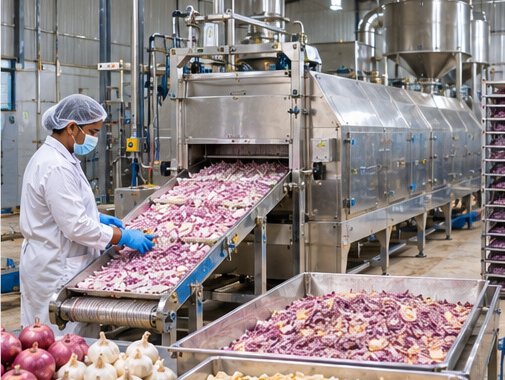
When onion and garlic prices crash, farmers dump surplus. Dehydrated flakes and powder sell well, but processing uses a lot of energy.
A slicing, drying and milling line with heat recovery.
Surplus turned into flakes and powder at an energy cost that makes them competitive.
| Aim | product |
|---|
| Programme | Crop & value-chain solutions |
|---|
| Segment | Food Processing & Value Addition |
|---|
| Type | Product (hardware) |
|---|
| Grade | Product grade |
|---|
| Priority | High |
|---|
| Duration | 18 months (12 months development plus one season of trials) |
|---|
| Where it fits | Production clusters for millets, pulses, fruits, spices and dairy |
|---|
| Method | Adapt existing Indian design; CIDSA Agni |
|---|
| Team role | Processing & production micro-enterprise |
|---|
| CIDSA lab | Lab 5 – Drone Technology & Aerial Imaging Lab |
|---|
| Funding route | Grant first, then milestone-linked seed |
|---|
| Outcome | Technology transfer and adaptation |
|---|
| Software and tools | Cradle CFD (scFLOW Performance Set – 4 Cores) |
|---|
| Partners to involve | Indian OEM / MSME manufacturer, Processor / exporter / retailer |
|---|
| Estimated budget | ₹19.5 lakh, released in stages |
|---|
Stages and funding
| L0 · Learn and specify | ₹2 lakh · 3 short course seats and 1 professional programme seat; 1 lab software tool for 4 months; mentoring and design reviews |
|---|
| L1 · Proof of concept | ₹2.4 lakh · Design, analysis and virtual prototype on CIDSA lab software |
|---|
| L2 · Prototype | ₹5.7 lakh · 2 prototypes built and bench-tested |
|---|
| L3 · Validation and certification | ₹1.8 lakh · Field trials and statutory testing |
|---|
| L4 · Pilot batch | ₹5.6 lakh · 5 pilot units placed with early buyers, half the cost recovered |
|---|
| L5 · Launch to revenue | ₹2 lakh · Launch: dealer or channel onboarding, demos, documentation and first orders |
|---|
Farmer case studies for field reference: Ranjit Singh (Amritsar), N.M. Mahesha (Tumakuru), Amar D'Souza (Chikkamagaluru), Mangala Kiran Neelagund (Gadag)
Open M-223 in the portal and form a team
M-227Platform grade
Micro food enterprise DPR builder
Template-driven project report and bank-loan pack
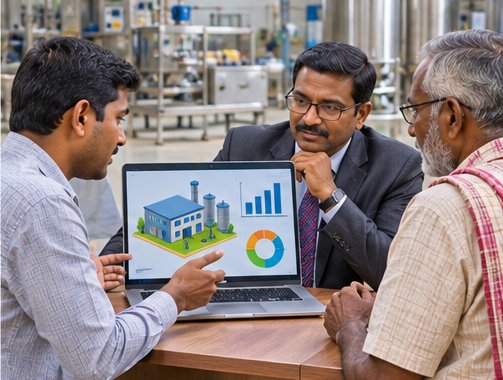
Banks want a proper project report before lending to a new food enterprise, and most small entrepreneurs don't know how to write one.
A step-by-step builder for project reports and bank loan files.
Entrepreneurs producing bank-ready reports quickly and getting loans approved.
| Aim | smart |
|---|
| Programme | Crop & value-chain solutions |
|---|
| Segment | Food Processing & Value Addition |
|---|
| Type | Software / platform module |
|---|
| Grade | Platform grade |
|---|
| Priority | Very high |
|---|
| Duration | 18 months (12 months development plus one season of trials) |
|---|
| Where it fits | Production clusters for millets, pulses, fruits, spices and dairy |
|---|
| Method | Indigenous development; CIDSA Agni |
|---|
| Team role | Digital & data service agent |
|---|
| CIDSA lab | Lab 7 – Agri-Entrepreneurship & Market Lab |
|---|
| Funding route | Scheme support, seed grant and bank credit |
|---|
| Outcome | Co-development with shared IP |
|---|
| Software and tools | CIDSA Farm ERP & Administrative Intelligence Suite, CIDSA Incubation & Innovation Management Platform |
|---|
| Partners to involve | Bank / NBFC / insurer, Government department / mission |
|---|
| Estimated budget | ₹9.1 lakh, released in stages |
|---|
Stages and funding
| L0 · Learn and plan | ₹0.8 lakh · 2 short course seats; 2 lab software tools for 1 month; mentoring and design reviews |
|---|
| L1 · Business plan and first customers | ₹0.5 lakh · Business plan, 10-20 customer commitments, site and licences list |
|---|
| L2 · Asset set-up | ₹5 lakh · Set up the asset base (₹5 lakh before ₹0 lakh scheme support) |
|---|
| L3 · Licences and compliance | ₹0.3 lakh · Licences, registrations, insurance and safety compliance |
|---|
| L4 · Working capital | ₹1.5 lakh · Three months of operating cash for the first customers |
|---|
| L5 · Launch to revenue | ₹1 lakh · Local promotion, demo days, digital listing and customer onboarding |
|---|
Open M-227 in the portal and form a team
M-408Product grade
Fruit pulper and juice extractor yield
Screen, paddle and clearance optimisation
Fruit pulpers leave pulp on the waste, lowering juice yield and profit.
Optimised screens, paddles and clearances.
More pulp and juice from every kilo of fruit.
| Aim | design, product |
|---|
| Programme | Equipment engineering |
|---|
| Segment | Food Processing Equipment |
|---|
| Type | Fruit & vegetable processing |
|---|
| Grade | Product grade |
|---|
| Priority | High |
|---|
| Duration | 18 months (12 months development plus one season of trials) |
|---|
| Where it fits | Processing clusters for grains, pulses, oil, spices and fruit |
|---|
| Method | Instrumented testing & design of experiments; CAD & DFM (TCCAD) |
|---|
| Team role | Processing & production micro-enterprise |
|---|
| CIDSA lab | Lab 4 – Farm Equipment & Innovation Lab |
|---|
| Funding route | Grant first, then milestone-linked seed |
|---|
| Outcome | Co-development with shared IP |
|---|
| Software and tools | MSC Apex Modeller |
|---|
| Partners to involve | Agri university / ICAR institute, Indian OEM / MSME manufacturer, Processor / exporter / retailer |
|---|
| Estimated budget | ₹13.1 lakh, released in stages |
|---|
Stages and funding
| L0 · Learn and specify | ₹2 lakh · 3 short course seats and 1 professional programme seat; 1 lab software tool for 4 months; mentoring and design reviews |
|---|
| L1 · Proof of concept | ₹2.4 lakh · Design, analysis and virtual prototype on CIDSA lab software |
|---|
| L2 · Prototype | ₹2.6 lakh · 2 prototypes built and bench-tested |
|---|
| L3 · Validation and certification | ₹1.8 lakh · Field trials and statutory testing |
|---|
| L4 · Pilot batch | ₹2.3 lakh · 5 pilot units placed with early buyers, half the cost recovered |
|---|
| L5 · Launch to revenue | ₹2 lakh · Launch: dealer or channel onboarding, demos, documentation and first orders |
|---|
Farmer case studies for field reference: Thakkar Hareshbhai Morarajibhai (Kutch), Sushma Gurunath Deshmukh (Sangli), Brajkishore Mehta (Aurangabad), J. C. Sharma (Shimla)
Open M-408 in the portal and form a team
M-409Product grade
Vegetable washer, peeler and cutter line
Water reuse and peel-loss reduction
Vegetable processing lines use a lot of water and lose a lot of good produce as peel.
A washer, peeler and cutter line with water reuse.
Less water used and more usable product.
| Aim | design, product |
|---|
| Programme | Equipment engineering |
|---|
| Segment | Food Processing Equipment |
|---|
| Type | Fruit & vegetable processing |
|---|
| Grade | Product grade |
|---|
| Priority | High |
|---|
| Duration | 18 months (12 months development plus one season of trials) |
|---|
| Where it fits | Processing clusters for grains, pulses, oil, spices and fruit |
|---|
| Method | Process simulation & line balancing; Instrumented testing & design of experiments |
|---|
| Team role | Processing & production micro-enterprise |
|---|
| CIDSA lab | Lab 3 – Digital Agronomy, Crop Modelling & AR/VR Lab |
|---|
| Funding route | Grant first, then milestone-linked seed |
|---|
| Outcome | Co-development with shared IP |
|---|
| Software and tools | Agriculture Equipment Design & Advanced CAE, AI/ML & Generative Engineering Platform for AR/VR Agronomy |
|---|
| Partners to involve | Indian OEM / MSME manufacturer, Processor / exporter / retailer |
|---|
| Estimated budget | ₹13.1 lakh, released in stages |
|---|
Stages and funding
| L0 · Learn and specify | ₹2 lakh · 3 short course seats and 1 professional programme seat; 1 lab software tool for 4 months; mentoring and design reviews |
|---|
| L1 · Proof of concept | ₹2.4 lakh · Design, analysis and virtual prototype on CIDSA lab software |
|---|
| L2 · Prototype | ₹2.6 lakh · 2 prototypes built and bench-tested |
|---|
| L3 · Validation and certification | ₹1.8 lakh · Field trials and statutory testing |
|---|
| L4 · Pilot batch | ₹2.3 lakh · 5 pilot units placed with early buyers, half the cost recovered |
|---|
| L5 · Launch to revenue | ₹2 lakh · Launch: dealer or channel onboarding, demos, documentation and first orders |
|---|
Farmer case studies for field reference: Thakkar Hareshbhai Morarajibhai (Kutch), Sushma Gurunath Deshmukh (Sangli), Brajkishore Mehta (Aurangabad), J. C. Sharma (Shimla)
Open M-409 in the portal and form a team
M-421Research grade
Banana and potato slicer feed and blade study
Uniform slice thickness at higher feed rate
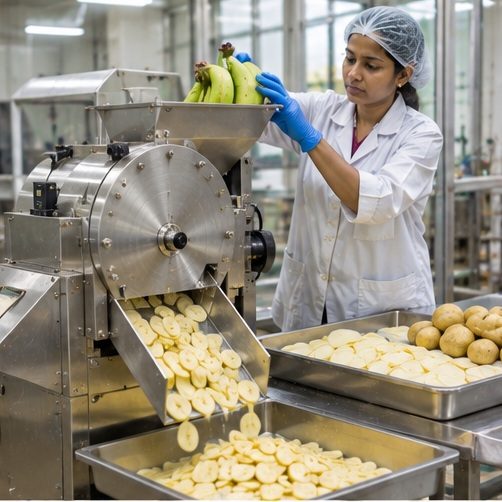
Banana and potato chips sell on looks, and uneven slices fry unevenly. Small slicers give uneven slices when pushed to run faster.
A study and redesign of slicer feed and blade.
Uniform slices at a higher feed rate.
| Aim | analysis, product |
|---|
| Programme | Equipment engineering |
|---|
| Segment | Food Processing Equipment |
|---|
| Type | Frying & snack equipment |
|---|
| Grade | Research grade |
|---|
| Priority | Medium |
|---|
| Duration | 18 months (12 months development plus one season of trials) |
|---|
| Where it fits | Processing clusters for grains, pulses, oil, spices and fruit |
|---|
| Method | Multibody dynamics; Instrumented testing & design of experiments |
|---|
| Team role | Testing & consulting service |
|---|
| CIDSA lab | Lab 1 – Agricultural Automation & IoT Lab |
|---|
| Funding route | Research grant, then licensing |
|---|
| Outcome | Sponsored research consortium |
|---|
| Software and tools | Adams Machinery Module Bundle, Adams Studio Package (Adams View & Adams Solver) |
|---|
| Partners to involve | Indian OEM / MSME manufacturer, Processor / exporter / retailer |
|---|
| Estimated budget | ₹8.5 lakh, released in stages |
|---|
Stages and funding
| L0 · Learn and specify | ₹2.4 lakh · 3 short course seats and 1 professional programme seat; 2 lab software tools for 4 months; mentoring and design reviews |
|---|
| L1 · Proof of concept | ₹1.8 lakh · Design, analysis and virtual prototype on CIDSA lab software |
|---|
| L2 · Prototype | ₹1.2 lakh · 1 prototype built and bench-tested |
|---|
| L3 · Validation and certification | ₹2.3 lakh · Field trials and statutory testing |
|---|
| L5 · Launch to revenue | ₹0.8 lakh · Launch: dealer or channel onboarding, demos, documentation and first orders |
|---|
Farmer case studies for field reference: Thakkar Hareshbhai Morarajibhai (Kutch), Sushma Gurunath Deshmukh (Sangli), Tarawati (Unnao), Tarawati (Unnao)
Open M-421 in the portal and form a team