Grain milling and cleaning: joint development projects
10 projects open for teams, with CIDSA lab support, software access and staged funding. Notes on each project follow the list.
All projects
M-396Product grade
Rice mill sheller and whitener optimisation
Roll gap, speed and whitener settings for higher head rice
Village rice mills break a lot of grain, and broken rice sells for far less than whole rice.
Optimised roll gap, speed and whitener settings.
More whole grain from every bag of paddy.
| Aim | design, product |
|---|
| Programme | Equipment engineering |
|---|
| Segment | Food Processing Equipment |
|---|
| Type | Rice mill |
|---|
| Grade | Product grade |
|---|
| Priority | Very high |
|---|
| Duration | 18 months (12 months development plus one season of trials) |
|---|
| Where it fits | Processing clusters for grains, pulses, oil, spices and fruit |
|---|
| Method | Instrumented testing & design of experiments; SPC & quality analytics (TCQA); IoT telemetry & analytics software |
|---|
| Team role | Processing & production micro-enterprise |
|---|
| CIDSA lab | Lab 2 – Smart Precision Agriculture Lab |
|---|
| Funding route | Grant first, then milestone-linked seed |
|---|
| Outcome | Co-development with shared IP |
|---|
| Software and tools | CIDSA Control Room – Machine Monitoring, CIDSA Agni Ops Platform |
|---|
| Partners to involve | Agri university / ICAR institute, Indian OEM / MSME manufacturer, Processor / exporter / retailer |
|---|
| Estimated budget | ₹8.4 lakh, released in stages |
|---|
Stages and funding
| L0 · Learn and specify | ₹2.4 lakh · 3 short course seats and 1 professional programme seat; 2 lab software tools for 4 months; mentoring and design reviews |
|---|
| L1 · Proof of concept | ₹1.5 lakh · Design, analysis and virtual prototype on CIDSA lab software |
|---|
| L2 · Prototype | ₹1.9 lakh · 1 prototype built and bench-tested |
|---|
| L3 · Validation and certification | ₹1.8 lakh · Field trials and statutory testing |
|---|
| L5 · Launch to revenue | ₹0.8 lakh · Launch: dealer or channel onboarding, demos, documentation and first orders |
|---|
Open M-396 in the portal and form a team
M-397Research grade
Rubber roll life and paddy pre-cleaning study
Roll hardness and cleaning to extend roll life
Rubber rolls in rice mills wear out quickly, adding to running costs.
A study of roll hardness and paddy pre-cleaning.
Longer roll life and lower milling costs.
| Aim | analysis, product |
|---|
| Programme | Equipment engineering |
|---|
| Segment | Food Processing Equipment |
|---|
| Type | Rice mill |
|---|
| Grade | Research grade |
|---|
| Priority | High |
|---|
| Duration | 18 months (12 months development plus one season of trials) |
|---|
| Where it fits | Processing clusters for grains, pulses, oil, spices and fruit |
|---|
| Method | Materials & wear testing; Instrumented testing & design of experiments |
|---|
| Team role | Testing & consulting service |
|---|
| CIDSA lab | Lab 4 – Farm Equipment & Innovation Lab |
|---|
| Funding route | Research grant, then licensing |
|---|
| Outcome | Sponsored research consortium |
|---|
| Software and tools | Marc Complete Package |
|---|
| Partners to involve | Agri university / ICAR institute, Indian OEM / MSME manufacturer, Processor / exporter / retailer |
|---|
| Estimated budget | ₹8.6 lakh, released in stages |
|---|
Stages and funding
| L0 · Learn and specify | ₹2 lakh · 3 short course seats and 1 professional programme seat; 1 lab software tool for 4 months; mentoring and design reviews |
|---|
| L1 · Proof of concept | ₹1.8 lakh · Design, analysis and virtual prototype on CIDSA lab software |
|---|
| L2 · Prototype | ₹1.7 lakh · 1 prototype built and bench-tested |
|---|
| L3 · Validation and certification | ₹2.3 lakh · Field trials and statutory testing |
|---|
| L5 · Launch to revenue | ₹0.8 lakh · Launch: dealer or channel onboarding, demos, documentation and first orders |
|---|
Open M-397 in the portal and form a team
M-398Product grade
Mini dal mill roller redesign
Roller grit and clearance for higher dal recovery
Mini dal mills lose a lot of dal as powder and broken bits, which cuts the mill owner's margin.
A redesign of roller grit and clearance.
Higher dal recovery from every quintal.
| Aim | design, product |
|---|
| Programme | Equipment engineering |
|---|
| Segment | Food Processing Equipment |
|---|
| Type | Dal mill |
|---|
| Grade | Product grade |
|---|
| Priority | Very high |
|---|
| Duration | 18 months (12 months development plus one season of trials) |
|---|
| Where it fits | Processing clusters for grains, pulses, oil, spices and fruit |
|---|
| Method | Instrumented testing & design of experiments; Materials & wear testing |
|---|
| Team role | Processing & production micro-enterprise |
|---|
| CIDSA lab | Lab 5 – Drone Technology & Aerial Imaging Lab |
|---|
| Funding route | Grant first, then milestone-linked seed |
|---|
| Outcome | Co-development with shared IP |
|---|
| Software and tools | Simufact Forming Heat Treatment |
|---|
| Partners to involve | Agri university / ICAR institute, Indian OEM / MSME manufacturer, Processor / exporter / retailer |
|---|
| Estimated budget | ₹17.7 lakh, released in stages |
|---|
Stages and funding
| L0 · Learn and specify | ₹2 lakh · 3 short course seats and 1 professional programme seat; 1 lab software tool for 4 months; mentoring and design reviews |
|---|
| L1 · Proof of concept | ₹2.4 lakh · Design, analysis and virtual prototype on CIDSA lab software |
|---|
| L2 · Prototype | ₹4.8 lakh · 2 prototypes built and bench-tested |
|---|
| L3 · Validation and certification | ₹1.8 lakh · Field trials and statutory testing |
|---|
| L4 · Pilot batch | ₹4.7 lakh · 5 pilot units placed with early buyers, half the cost recovered |
|---|
| L5 · Launch to revenue | ₹2 lakh · Launch: dealer or channel onboarding, demos, documentation and first orders |
|---|
Open M-398 in the portal and form a team
M-399Product grade
Dal mill conditioning unit
Controlled oil-water conditioning for easier dehusking
Pulses that aren't conditioned properly are hard to dehusk and break easily.
A controlled oil-and-water conditioning unit.
Easier dehusking with less breakage.
| Aim | design, product |
|---|
| Programme | Equipment engineering |
|---|
| Segment | Food Processing Equipment |
|---|
| Type | Dal mill |
|---|
| Grade | Product grade |
|---|
| Priority | High |
|---|
| Duration | 18 months (12 months development plus one season of trials) |
|---|
| Where it fits | Processing clusters for grains, pulses, oil, spices and fruit |
|---|
| Method | Thermal & psychrometric modelling; Instrumented testing & design of experiments |
|---|
| Team role | Processing & production micro-enterprise |
|---|
| CIDSA lab | Lab 5 – Drone Technology & Aerial Imaging Lab |
|---|
| Funding route | Grant first, then milestone-linked seed |
|---|
| Outcome | Co-development with shared IP |
|---|
| Software and tools | Cradle CFD (scFLOW Performance Set – 4 Cores) |
|---|
| Partners to involve | Agri university / ICAR institute, Indian OEM / MSME manufacturer, Processor / exporter / retailer |
|---|
| Estimated budget | ₹17.7 lakh, released in stages |
|---|
Stages and funding
| L0 · Learn and specify | ₹2 lakh · 3 short course seats and 1 professional programme seat; 1 lab software tool for 4 months; mentoring and design reviews |
|---|
| L1 · Proof of concept | ₹2.4 lakh · Design, analysis and virtual prototype on CIDSA lab software |
|---|
| L2 · Prototype | ₹4.8 lakh · 2 prototypes built and bench-tested |
|---|
| L3 · Validation and certification | ₹1.8 lakh · Field trials and statutory testing |
|---|
| L4 · Pilot batch | ₹4.7 lakh · 5 pilot units placed with early buyers, half the cost recovered |
|---|
| L5 · Launch to revenue | ₹2 lakh · Launch: dealer or channel onboarding, demos, documentation and first orders |
|---|
Open M-399 in the portal and form a team
M-400Product grade
Millet dehuller impeller optimisation
Impeller speed and liner design by millet type
Millet dehullers that aren't tuned for each millet either break the grain or leave husk on it.
Impeller speed and liner design matched to each millet type.
Clean dehulling with high recovery for every millet.
| Aim | design, product |
|---|
| Programme | Equipment engineering |
|---|
| Segment | Food Processing Equipment |
|---|
| Type | Millet processing |
|---|
| Grade | Product grade |
|---|
| Priority | Very high |
|---|
| Duration | 18 months (12 months development plus one season of trials) |
|---|
| Where it fits | Processing clusters for grains, pulses, oil, spices and fruit |
|---|
| Method | DEM particle / soil–tool simulation; Instrumented testing & design of experiments |
|---|
| Team role | Processing & production micro-enterprise |
|---|
| CIDSA lab | Lab 1 – Agricultural Automation & IoT Lab |
|---|
| Funding route | Grant first, then milestone-linked seed |
|---|
| Outcome | Co-development with shared IP |
|---|
| Software and tools | Adams Machinery Module Bundle |
|---|
| Partners to involve | Agri university / ICAR institute, Engineering institution, Indian OEM / MSME manufacturer |
|---|
| Estimated budget | ₹8 lakh, released in stages |
|---|
Stages and funding
| L0 · Learn and specify | ₹2 lakh · 3 short course seats and 1 professional programme seat; 1 lab software tool for 4 months; mentoring and design reviews |
|---|
| L1 · Proof of concept | ₹1.5 lakh · Design, analysis and virtual prototype on CIDSA lab software |
|---|
| L2 · Prototype | ₹1.9 lakh · 1 prototype built and bench-tested |
|---|
| L3 · Validation and certification | ₹1.8 lakh · Field trials and statutory testing |
|---|
| L5 · Launch to revenue | ₹0.8 lakh · Launch: dealer or channel onboarding, demos, documentation and first orders |
|---|
Open M-400 in the portal and form a team
M-402Product grade
Flour mill heat-rise control
Stone and hammer settings for fineness with nutrition retention
Flour mills heat the flour as they grind, which damages nutrition and flavour.
Stone and hammer settings that control heat while giving the right fineness.
Fine flour that keeps more of its nutrition.
| Aim | design, product |
|---|
| Programme | Equipment engineering |
|---|
| Segment | Food Processing Equipment |
|---|
| Type | Flour & spice grinding |
|---|
| Grade | Product grade |
|---|
| Priority | High |
|---|
| Duration | 18 months (12 months development plus one season of trials) |
|---|
| Where it fits | Processing clusters for grains, pulses, oil, spices and fruit |
|---|
| Method | Thermal & psychrometric modelling; Instrumented testing & design of experiments |
|---|
| Team role | Processing & production micro-enterprise |
|---|
| CIDSA lab | Lab 5 – Drone Technology & Aerial Imaging Lab |
|---|
| Funding route | Grant first, then milestone-linked seed |
|---|
| Outcome | Co-development with shared IP |
|---|
| Software and tools | Cradle CFD (scFLOW Performance Set – 4 Cores) |
|---|
| Partners to involve | Agri university / ICAR institute, Indian OEM / MSME manufacturer |
|---|
| Estimated budget | ₹11.6 lakh, released in stages |
|---|
Stages and funding
| L0 · Learn and specify | ₹2 lakh · 3 short course seats and 1 professional programme seat; 1 lab software tool for 4 months; mentoring and design reviews |
|---|
| L1 · Proof of concept | ₹2.4 lakh · Design, analysis and virtual prototype on CIDSA lab software |
|---|
| L2 · Prototype | ₹1.9 lakh · 2 prototypes built and bench-tested |
|---|
| L3 · Validation and certification | ₹1.8 lakh · Field trials and statutory testing |
|---|
| L4 · Pilot batch | ₹1.5 lakh · 5 pilot units placed with early buyers, half the cost recovered |
|---|
| L5 · Launch to revenue | ₹2 lakh · Launch: dealer or channel onboarding, demos, documentation and first orders |
|---|
Open M-402 in the portal and form a team
M-403Product grade
Spice grinder heat and volatile-oil retention
Pin-mill and hammer-mill cooling options
Grinding spices heats them and drives off the aroma that buyers pay for.
Cooling options for pin mills and hammer mills.
Spice powders that keep more of their aroma and fetch better prices.
| Aim | product |
|---|
| Programme | Equipment engineering |
|---|
| Segment | Food Processing Equipment |
|---|
| Type | Flour & spice grinding |
|---|
| Grade | Product grade |
|---|
| Priority | High |
|---|
| Duration | 24 months |
|---|
| Where it fits | Processing clusters for grains, pulses, oil, spices and fruit |
|---|
| Method | Thermal & psychrometric modelling; CFD flow simulation |
|---|
| Team role | Processing & production micro-enterprise |
|---|
| CIDSA lab | Lab 5 – Drone Technology & Aerial Imaging Lab |
|---|
| Funding route | Grant first, then milestone-linked seed |
|---|
| Outcome | Co-development with shared IP |
|---|
| Software and tools | Cradle CFD (scFLOW Performance Set – 4 Cores) |
|---|
| Partners to involve | Agri university / ICAR institute, Engineering institution, Processor / exporter / retailer |
|---|
| Estimated budget | ₹16 lakh, released in stages |
|---|
Stages and funding
| L0 · Learn and specify | ₹2 lakh · 3 short course seats and 1 professional programme seat; 1 lab software tool for 4 months; mentoring and design reviews |
|---|
| L1 · Proof of concept | ₹2.4 lakh · Design, analysis and virtual prototype on CIDSA lab software |
|---|
| L2 · Prototype | ₹4 lakh · 2 prototypes built and bench-tested |
|---|
| L3 · Validation and certification | ₹1.8 lakh · Field trials and statutory testing |
|---|
| L4 · Pilot batch | ₹3.8 lakh · 5 pilot units placed with early buyers, half the cost recovered |
|---|
| L5 · Launch to revenue | ₹2 lakh · Launch: dealer or channel onboarding, demos, documentation and first orders |
|---|
Farmer case studies for field reference: Kistaiah Chennaiah Kumari (Mancherial)
Open M-403 in the portal and form a team
M-412Product grade
Coconut and groundnut decorticator redesign
Lower kernel breakage with adjustable clearance
Decorticators break coconut and groundnut kernels, and broken kernels sell for much less.
A redesign with adjustable clearance for different nut sizes.
Fewer broken kernels and better prices.
| Aim | design, product |
|---|
| Programme | Equipment engineering |
|---|
| Segment | Food Processing Equipment |
|---|
| Type | Decorticators & nut shellers |
|---|
| Grade | Product grade |
|---|
| Priority | High |
|---|
| Duration | 18 months (12 months development plus one season of trials) |
|---|
| Where it fits | Processing clusters for grains, pulses, oil, spices and fruit |
|---|
| Method | DEM particle / soil–tool simulation; Instrumented testing & design of experiments |
|---|
| Team role | Processing & production micro-enterprise |
|---|
| CIDSA lab | Lab 1 – Agricultural Automation & IoT Lab |
|---|
| Funding route | Grant first, then milestone-linked seed |
|---|
| Outcome | Co-development with shared IP |
|---|
| Software and tools | Adams Machinery Module Bundle |
|---|
| Partners to involve | Agri university / ICAR institute, Indian OEM / MSME manufacturer |
|---|
| Estimated budget | ₹11.6 lakh, released in stages |
|---|
Stages and funding
| L0 · Learn and specify | ₹2 lakh · 3 short course seats and 1 professional programme seat; 1 lab software tool for 4 months; mentoring and design reviews |
|---|
| L1 · Proof of concept | ₹2.4 lakh · Design, analysis and virtual prototype on CIDSA lab software |
|---|
| L2 · Prototype | ₹1.9 lakh · 2 prototypes built and bench-tested |
|---|
| L3 · Validation and certification | ₹1.8 lakh · Field trials and statutory testing |
|---|
| L4 · Pilot batch | ₹1.5 lakh · 5 pilot units placed with early buyers, half the cost recovered |
|---|
| L5 · Launch to revenue | ₹2 lakh · Launch: dealer or channel onboarding, demos, documentation and first orders |
|---|
Farmer case studies for field reference: D.M. Ramesh (Chikkamagaluru), Hariharan T.P. (Pathanamthitta), Saji Eapen (Pathanamthitta), C.H. Salim (Pathanamthitta)
Open M-412 in the portal and form a team
M-413Product grade
Cashew and areca nut sheller cutting mechanism
Blade and feed design for whole-kernel recovery
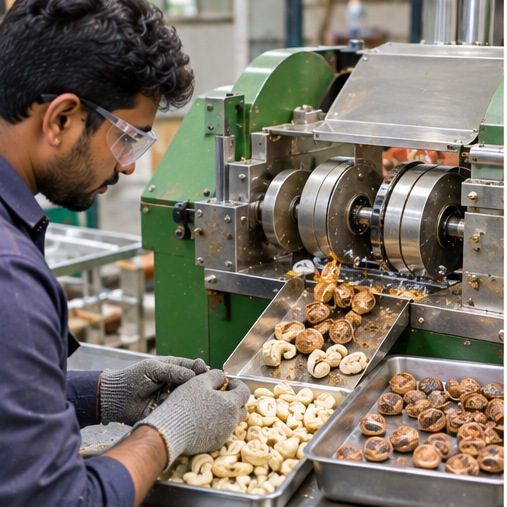
Cashew and areca shelling breaks kernels, and whole kernels earn far more than broken ones.
An improved blade and feed design.
More whole kernels from every batch.
| Aim | design, product |
|---|
| Programme | Equipment engineering |
|---|
| Segment | Food Processing Equipment |
|---|
| Type | Decorticators & nut shellers |
|---|
| Grade | Product grade |
|---|
| Priority | High |
|---|
| Duration | 24 months |
|---|
| Where it fits | Processing clusters for grains, pulses, oil, spices and fruit |
|---|
| Method | Multibody dynamics; Machine vision / AI |
|---|
| Team role | Processing & production micro-enterprise |
|---|
| CIDSA lab | Lab 1 – Agricultural Automation & IoT Lab |
|---|
| Funding route | Grant first, then milestone-linked seed |
|---|
| Outcome | Co-development with shared IP |
|---|
| Software and tools | Adams Machinery Module Bundle, Adams Studio Package (Adams View & Adams Solver) |
|---|
| Partners to involve | Agri university / ICAR institute, Indian OEM / MSME manufacturer, Commodity board / cooperative / mill |
|---|
| Estimated budget | ₹12 lakh, released in stages |
|---|
Stages and funding
| L0 · Learn and specify | ₹2.4 lakh · 3 short course seats and 1 professional programme seat; 2 lab software tools for 4 months; mentoring and design reviews |
|---|
| L1 · Proof of concept | ₹2.4 lakh · Design, analysis and virtual prototype on CIDSA lab software |
|---|
| L2 · Prototype | ₹1.9 lakh · 2 prototypes built and bench-tested |
|---|
| L3 · Validation and certification | ₹1.8 lakh · Field trials and statutory testing |
|---|
| L4 · Pilot batch | ₹1.5 lakh · 5 pilot units placed with early buyers, half the cost recovered |
|---|
| L5 · Launch to revenue | ₹2 lakh · Launch: dealer or channel onboarding, demos, documentation and first orders |
|---|
Farmer case studies for field reference: D.M. Ramesh (Chikkamagaluru), Hariharan T.P. (Pathanamthitta), M.C. Cherian (Pathanamthitta), Devshibhai Meramanbhai Solanki (Gir Somnath)
Open M-413 in the portal and form a team
M-425Service grade
Processing-line layout and balancing
Simulation of flow, buffers and manpower
Processing lines stall at bottlenecks while workers stand idle at other stations.
A simulation of flow, buffers and manpower to lay out and balance the line.
Smoother lines with more output from the same team.
| Aim | design, product, smart |
|---|
| Programme | Equipment engineering |
|---|
| Segment | Food Processing Equipment |
|---|
| Type | Processing plant engineering |
|---|
| Grade | Service grade |
|---|
| Priority | Very high |
|---|
| Duration | 18 months (12 months development plus one season of trials) |
|---|
| Where it fits | Processing clusters for grains, pulses, oil, spices and fruit |
|---|
| Method | Process simulation & line balancing; IoT telemetry & analytics software |
|---|
| Team role | Processing & production micro-enterprise |
|---|
| CIDSA lab | Lab 3 – Digital Agronomy, Crop Modelling & AR/VR Lab |
|---|
| Funding route | Grant first, then milestone-linked seed |
|---|
| Outcome | Service franchise pilot |
|---|
| Software and tools | Agriculture Equipment Design & Advanced CAE, AI/ML & Generative Engineering Platform for AR/VR Agronomy |
|---|
| Partners to involve | Indian OEM / MSME manufacturer, Processor / exporter / retailer |
|---|
| Estimated budget | ₹7.5 lakh, released in stages |
|---|
Stages and funding
| L0 · Learn and specify | ₹2 lakh · 3 short course seats and 1 professional programme seat; 1 lab software tool for 4 months; mentoring and design reviews |
|---|
| L1 · Proof of concept | ₹1.5 lakh · Design, analysis and virtual prototype on CIDSA lab software |
|---|
| L2 · Prototype | ₹1.4 lakh · 1 prototype built and bench-tested |
|---|
| L3 · Validation and certification | ₹1.8 lakh · Field trials and statutory testing |
|---|
| L5 · Launch to revenue | ₹0.8 lakh · Launch: dealer or channel onboarding, demos, documentation and first orders |
|---|
Open M-425 in the portal and form a team