Home › Projects › Millet and value-added foods Millet and value-added foods: joint development projects 5 projects open for teams, with CIDSA lab support, software access and staged funding. Notes on each project follow the list.
All projects
M-097 Venture grade
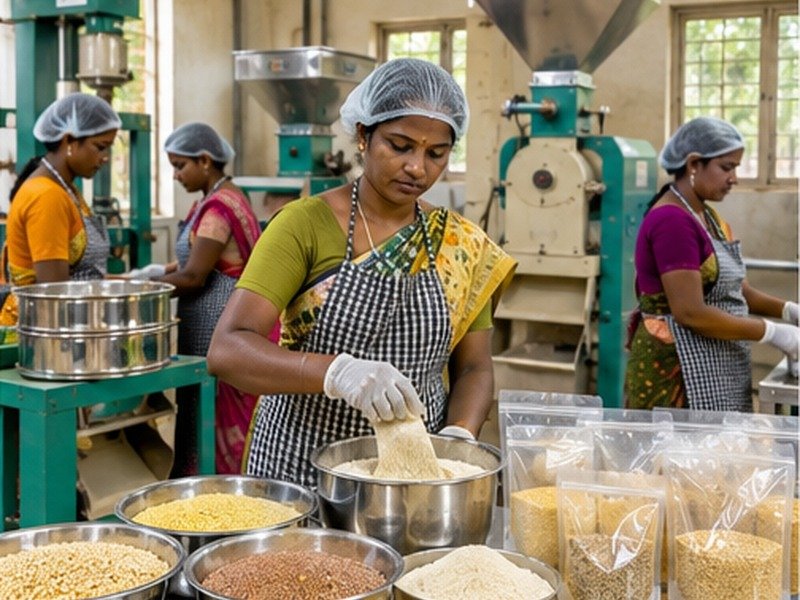
Women-led millet products micro-enterprise
Dehulling, flour and ready-to-cook products under an FPO brand
Women in millet-growing areas do much of the hard processing by hand and sell grain cheap. A small enterprise could turn the same grain into products that earn far more.
A women-led enterprise that dehulls millet and makes flour and ready-to-cook products under an FPO brand.
Steady product sales through shops and FPO channels, with members earning more per kilo of millet than from selling raw grain.
Aim smart Programme Agripreneurship ventures Segment Agri-enterprise models Type Processing enterprise Grade Venture grade Priority Very high Duration 18 months (12 months development plus one season of trials) Where it fits Aspirational districts and FPO clusters in all agro-climatic zones Method Incubation cohort; unit-economics model; pilot with FPOs Team role Processing & production micro-enterprise CIDSA lab Lab 7 – Agri-Entrepreneurship & Market Lab Funding route Scheme support, seed grant and bank credit Outcome Incubated venture Software and tools CIDSA Farm ERP & Administrative Intelligence Suite, CIDSA Incubation & Innovation Management Platform Partners to involve FPO / KVK / farmer network, Processor / exporter / retailer Estimated budget ₹10.3 lakh, released in stages
Stages and funding L0 · Learn and plan ₹0.8 lakh · 2 short course seats; 2 lab software tools for 1 month; mentoring and design reviews L1 · Business plan and first customers ₹0.5 lakh · Business plan, 10-20 customer commitments, site and licences list L2 · Asset set-up ₹5.2 lakh · Set up the asset base (₹8 lakh before ₹2.8 lakh scheme support) L3 · Licences and compliance ₹0.5 lakh · Licences, registrations, insurance and safety compliance L4 · Working capital ₹2 lakh · Three months of operating cash for the first customers L5 · Launch to revenue ₹1.3 lakh · Local promotion, demo days, digital listing and customer onboarding
Farmer case studies for field reference: Kavitha (Erode) (Erode) , Onkar Ji (Chittorgarh) , Manjula P. (Bengaluru Rural) , B. Parvathi (Sangareddy)
Open M-097 in the portal and form a team
M-222 Product grade
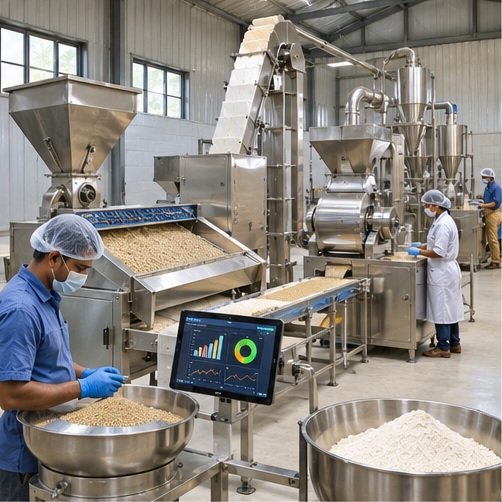
Millet processing cluster line
Cleaning, dehulling, flaking and flour line with OEE tracking
Millet processing units run lines that stop often, and owners can't see where time and output are being lost.
A complete cleaning, dehulling, flaking and flour line with tracking of uptime and output.
A line that runs longer with fewer stops, and clear data on what to fix next.
Aim product Programme Crop & value-chain solutions Segment Food Processing & Value Addition Type Product (hardware) Grade Product grade Priority Very high Duration 18 months (12 months development plus one season of trials) Where it fits Production clusters for millets, pulses, fruits, spices and dairy Method Adapt existing Indian design; CIDSA Agni Team role Processing & production micro-enterprise CIDSA lab Lab 4 – Farm Equipment & Innovation Lab Funding route Grant first, then milestone-linked seed Outcome Technology transfer and adaptation Software and tools MSC Apex Modeller, MSC Nastran LS Productivity Bundle (Nastran LS + Patran) Partners to involve Indian OEM / MSME manufacturer, FPO / KVK / farmer network, Processor / exporter / retailer Estimated budget ₹16.4 lakh, released in stages
Stages and funding L0 · Learn and specify ₹2.4 lakh · 3 short course seats and 1 professional programme seat; 2 lab software tools for 4 months; mentoring and design reviews L1 · Proof of concept ₹2.4 lakh · Design, analysis and virtual prototype on CIDSA lab software L2 · Prototype ₹4 lakh · 2 prototypes built and bench-tested L3 · Validation and certification ₹1.8 lakh · Field trials and statutory testing L4 · Pilot batch ₹3.8 lakh · 5 pilot units placed with early buyers, half the cost recovered L5 · Launch to revenue ₹2 lakh · Launch: dealer or channel onboarding, demos, documentation and first orders
Open M-222 in the portal and form a team
M-225 Research grade
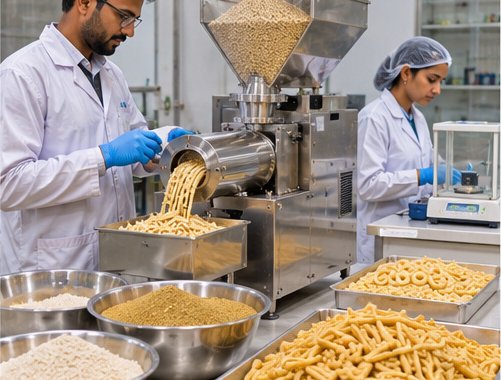
Ready-to-cook millet product R&D
Formulation and extrusion trials with nutrition labelling
Many millet products taste plain or have a poor texture, so shoppers try them once and don't come back.
Recipe and extrusion trials for ready-to-cook millet products, with proper nutrition labels.
Millet products people enjoy enough to buy again, ready for launch.
Aim analysis, smart Programme Crop & value-chain solutions Segment Food Processing & Value Addition Type Service / business model Grade Research grade Priority High Duration 18 months (12 months development plus one season of trials) Where it fits Production clusters for millets, pulses, fruits, spices and dairy Method Indigenous development; CIDSA Agni Team role Testing & consulting service CIDSA lab Lab 3 – Digital Agronomy, Crop Modelling & AR/VR Lab Funding route Research grant, then licensing Outcome Sponsored research consortium Software and tools CIDSA Crop Lifecycle Management Pro, CIDSA Smart Crop Analytics AI Partners to involve Agri university / ICAR institute, Processor / exporter / retailer, Startup / incubator Estimated budget ₹8.7 lakh, released in stages
Stages and funding L0 · Learn and specify ₹2.4 lakh · 3 short course seats and 1 professional programme seat; 2 lab software tools for 4 months; mentoring and design reviews L1 · Proof of concept ₹2.4 lakh · Design, analysis and virtual prototype on CIDSA lab software L2 · Prototype ₹0.8 lakh · 1 prototype built and bench-tested L3 · Validation and certification ₹2.3 lakh · Field trials and statutory testing L5 · Launch to revenue ₹0.8 lakh · Launch: dealer or channel onboarding, demos, documentation and first orders
Farmer case studies for field reference: Onkar Ji (Chittorgarh) , Manjula P. (Bengaluru Rural) , B. Parvathi (Sangareddy) , Manimozhi (Tiruvannamalai)
Open M-225 in the portal and form a team
M-401 Product grade
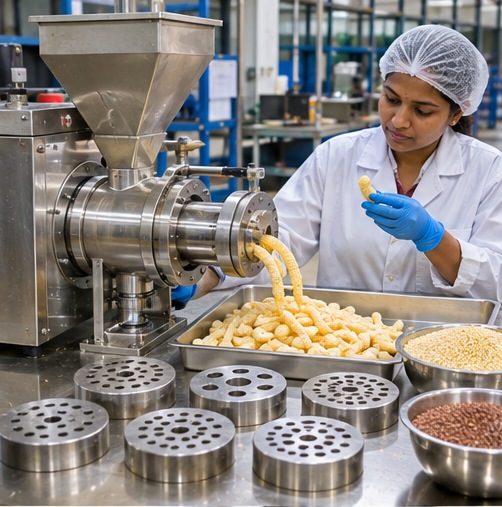
Millet extruder screw and die optimisation
Screw profile for expansion and texture
Millet snacks from small extruders often turn out hard or crumbly, and don't sell.
Screw profile and die design optimised for millets.
Snacks with good crunch and expansion.
Aim design, product Programme Equipment engineering Segment Food Processing Equipment Type Millet processing Grade Product grade Priority Medium Duration 24 months Where it fits Processing clusters for grains, pulses, oil, spices and fruit Method CFD flow simulation; Instrumented testing & design of experiments Team role Processing & production micro-enterprise CIDSA lab Lab 5 – Drone Technology & Aerial Imaging Lab Funding route Grant first, then milestone-linked seed Outcome Co-development with shared IP Software and tools Cradle CFD (scFLOW Performance Set – 4 Cores) Partners to involve Agri university / ICAR institute, Engineering institution, Processor / exporter / retailer Estimated budget ₹8.2 lakh, released in stages
Stages and funding L0 · Learn and specify ₹2 lakh · 3 short course seats and 1 professional programme seat; 1 lab software tool for 4 months; mentoring and design reviews L1 · Proof of concept ₹1.5 lakh · Design, analysis and virtual prototype on CIDSA lab software L2 · Prototype ₹2.1 lakh · 1 prototype built and bench-tested L3 · Validation and certification ₹1.8 lakh · Field trials and statutory testing L5 · Launch to revenue ₹0.8 lakh · Launch: dealer or channel onboarding, demos, documentation and first orders
Farmer case studies for field reference: Onkar Ji (Chittorgarh) , Manjula P. (Bengaluru Rural) , B. Parvathi (Sangareddy) , Manimozhi (Tiruvannamalai)
Open M-401 in the portal and form a team
M-420 Product grade
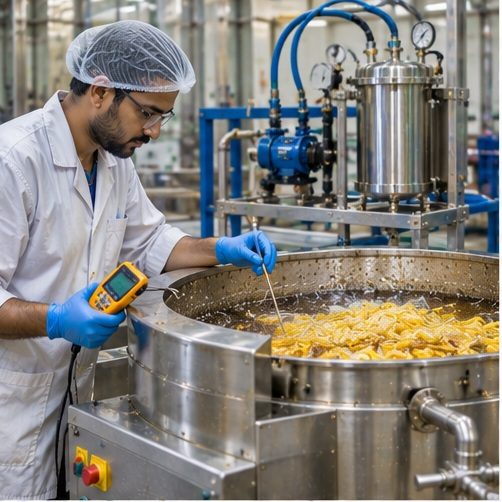
Fryer oil-life and heat-load optimisation
Filtration and temperature control for snack units
Snack units throw away fryer oil too soon, which costs money, or use it too long, which hurts quality and safety.
Oil filtration and temperature control for fryers.
Longer oil life with consistent, safe snack quality.
Aim design, analysis, product Programme Equipment engineering Segment Food Processing Equipment Type Frying & snack equipment Grade Product grade Priority High Duration 18 months (12 months development plus one season of trials) Where it fits Processing clusters for grains, pulses, oil, spices and fruit Method Thermal & psychrometric modelling; Embedded control & model-based design; SPC & quality analytics (TCQA) Team role Processing & production micro-enterprise CIDSA lab Lab 5 – Drone Technology & Aerial Imaging Lab Funding route Grant first, then milestone-linked seed Outcome Co-development with shared IP Software and tools Cradle CFD (scFLOW Performance Set – 4 Cores), Easy5 Basic Package Partners to involve Indian OEM / MSME manufacturer, Processor / exporter / retailer Estimated budget ₹7.7 lakh, released in stages
Stages and funding L0 · Learn and specify ₹2.4 lakh · 3 short course seats and 1 professional programme seat; 2 lab software tools for 4 months; mentoring and design reviews L1 · Proof of concept ₹1.5 lakh · Design, analysis and virtual prototype on CIDSA lab software L2 · Prototype ₹1.2 lakh · 1 prototype built and bench-tested L3 · Validation and certification ₹1.8 lakh · Field trials and statutory testing L5 · Launch to revenue ₹0.8 lakh · Launch: dealer or channel onboarding, demos, documentation and first orders
Open M-420 in the portal and form a team