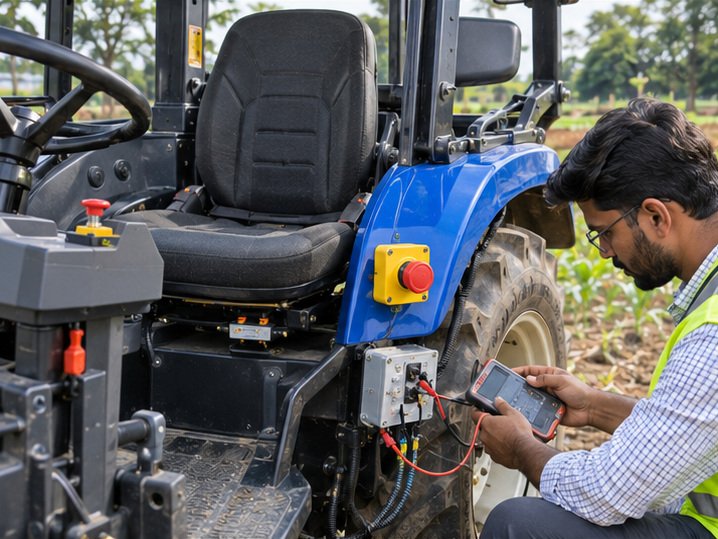
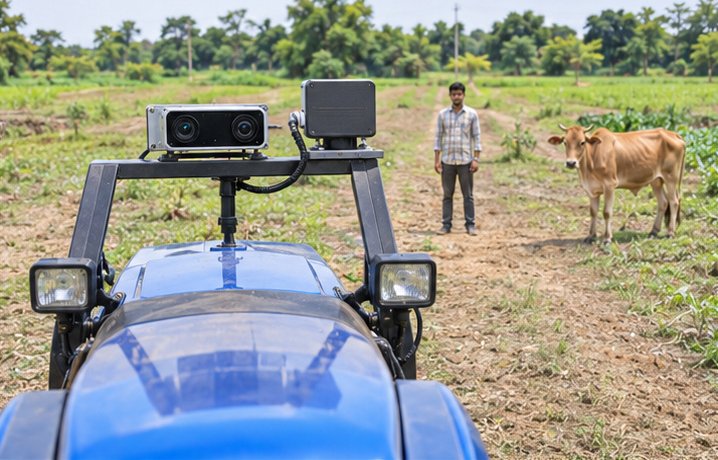
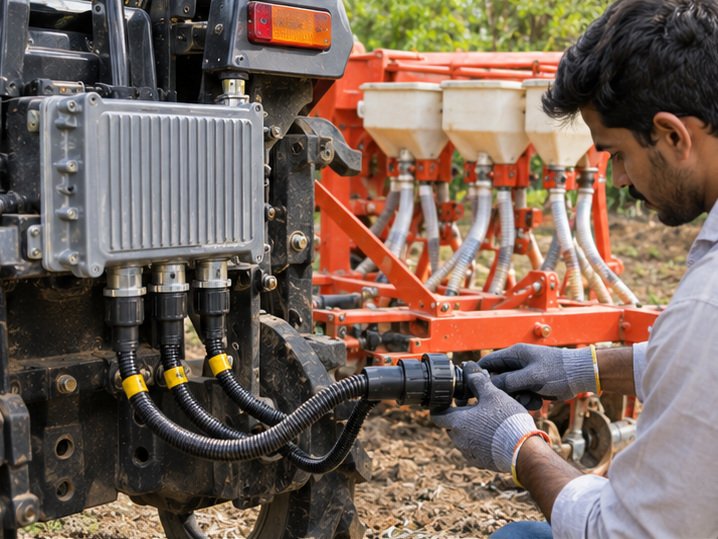
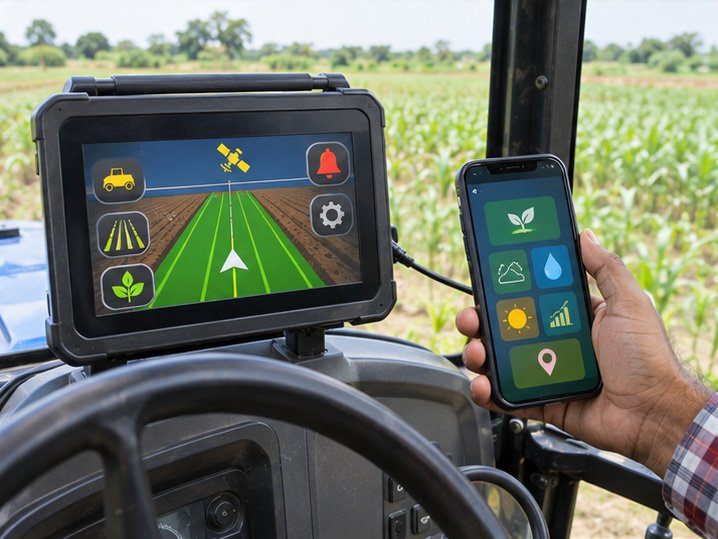
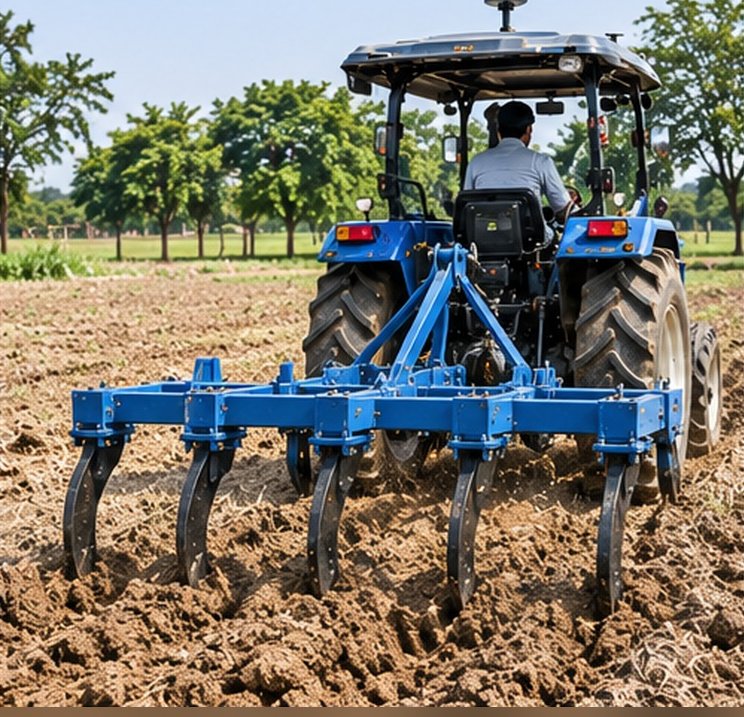
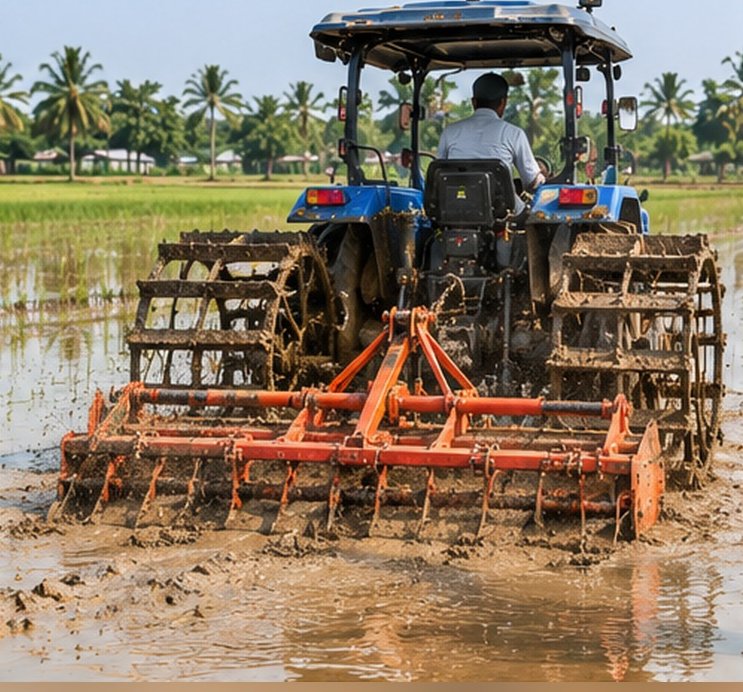
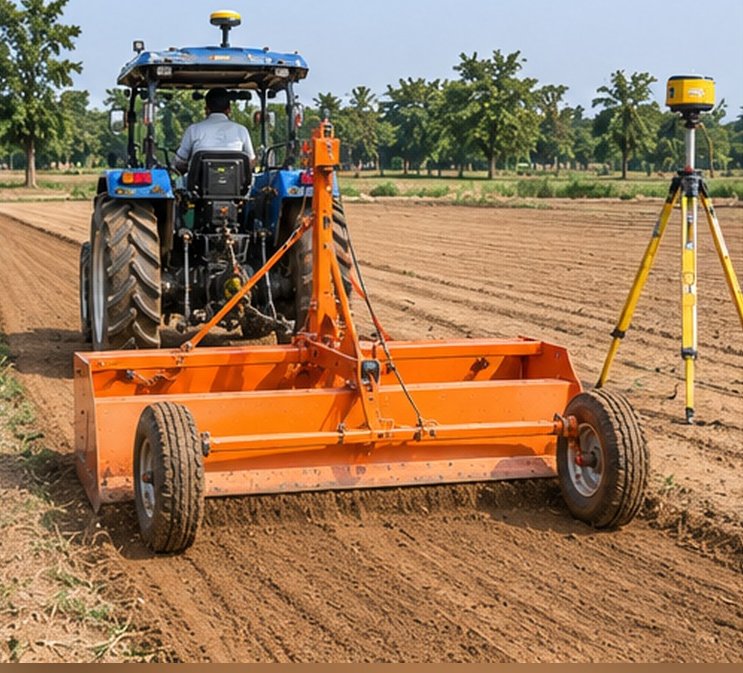
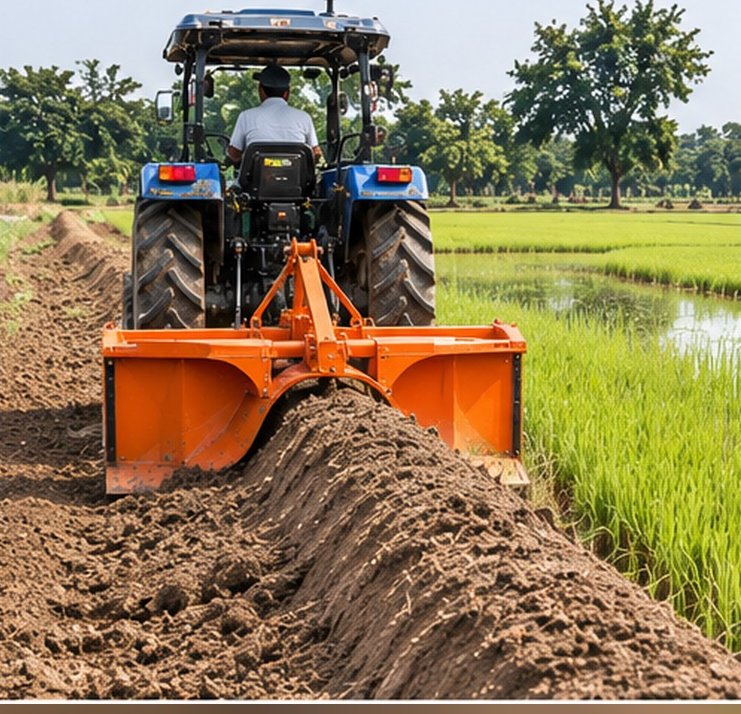
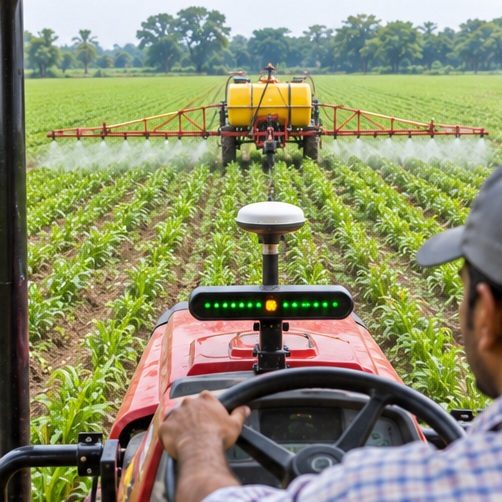
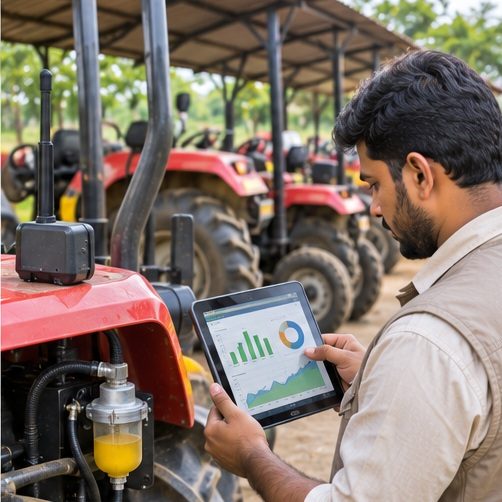
Home › Projects › Tractors and autonomy Tractors and autonomy: joint development projects 99 projects open for teams, with CIDSA lab support, software access and staged funding. Notes on each project follow the list.
All projects
M-001 Product grade
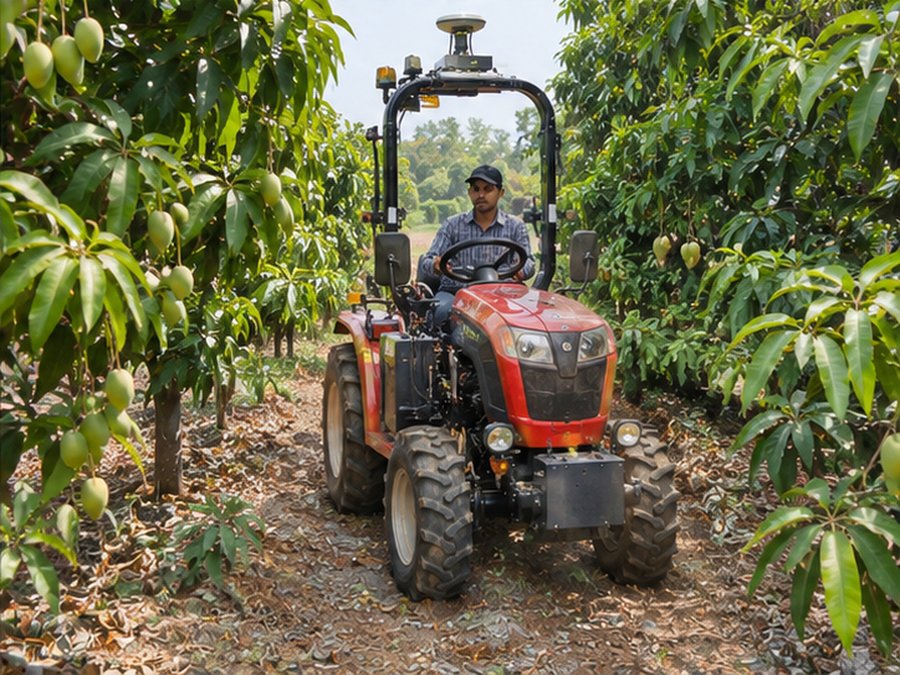
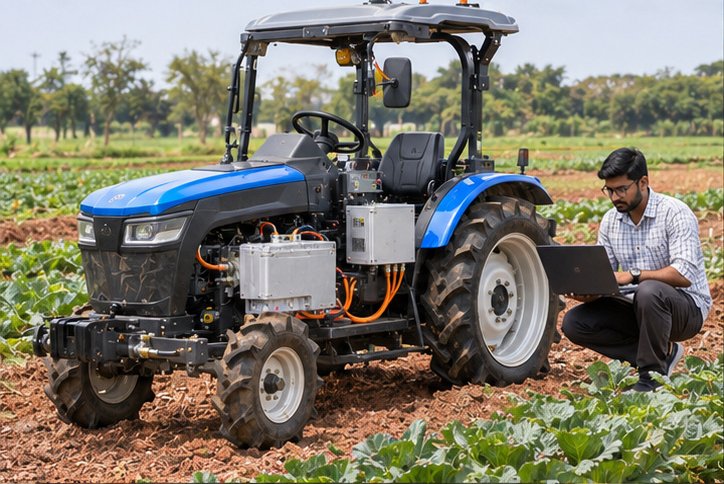
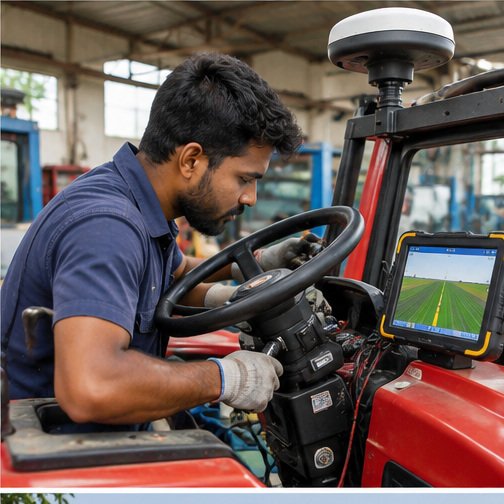
Semi-autonomous kit for mini tractors up to 20 hp
Compact steering and lift automation for orchard lanes, nurseries and polyhouse aisles
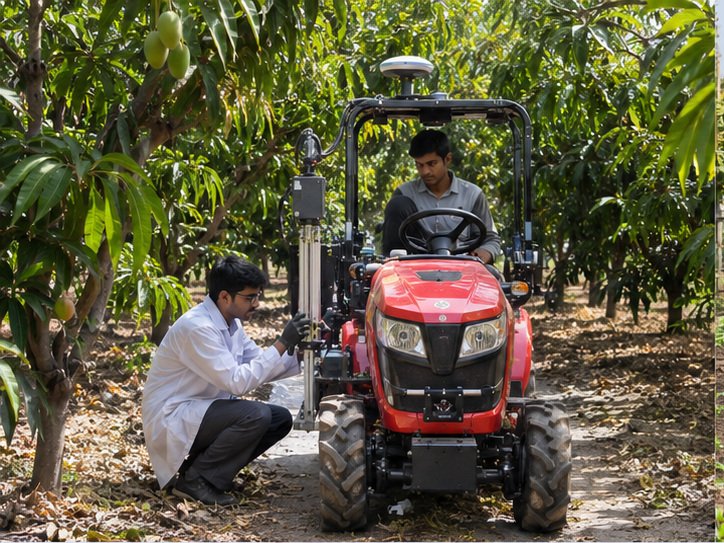
Small tractors do the hard daily work in orchards, nurseries and polyhouses, where rows are tight and a moment's distraction means a scraped trunk or a crushed bed. The driver has to steer, watch the implement and manage the lift all at once, often for hours in the heat, and good drivers are hard to find in peak season.
A compact bolt-on kit for tractors up to 20 hp that holds the line down narrow lanes and raises and lowers the implement by itself, while the driver stays in the seat and in control.
Growers run a full day in tight rows with fewer scrapes and less fatigue, and the kit pays for itself well within its working life at about ₹2.3 lakh fitted.
Aim product, innovation, smart Programme Semi-autonomous tractor Segment Tractor platform by hp class Type Up to 20 hp Grade Product grade Priority High Duration 24 months Where it fits Indo-Gangetic plains, central India, Deccan plateau; orchard and hill belts for the small hp classes Method Embedded control & model-based design; CAD & DFM (TCCAD); Instrumented testing & design of experiments Team role Installer & service dealership CIDSA lab Lab 1 – Agricultural Automation & IoT Lab Funding route Grant first, then milestone-linked seed Outcome Co-development with shared IP Software and tools RTK SW Customization & AgriStack API, Ti10 Display Simulators & Emulators, Adams Ground Vehicle Bundle (Tire Handling & 3D Road) Partners to involve Engineering institution, Indian OEM / MSME manufacturer, Startup / incubator Estimated budget ₹29 lakh, released in stages
Stages and funding L0 · Learn and specify ₹3.4 lakh · 3 short course seats and 1 professional programme seat; 3 lab software tools for 6 months; mentoring and design reviews L1 · Proof of concept ₹2.4 lakh · Design, analysis and virtual prototype on CIDSA lab software L2 · Prototype ₹4.2 lakh · 2 prototypes built and bench-tested L3 · Validation and certification ₹5 lakh · Field trials and statutory testing and certification L4 · Pilot batch ₹8 lakh · 10 pilot units placed with early buyers, half the cost recovered L5 · Launch to revenue ₹6 lakh · Launch: dealer or channel onboarding, demos, documentation and first orders
Farmer case studies for field reference: Ahire (Ahmednagar) , Tekade Patil (Dharashiv) , Sangram Pradhan (Boudh) , Chandrakant Singh (Khagaria)
Open M-001 in the portal and form a team
M-002 Product grade
Semi-autonomous kit for 21–30 hp compact tractors
Auto-steer and headland turn for vineyards, vegetables and inter-cultivation
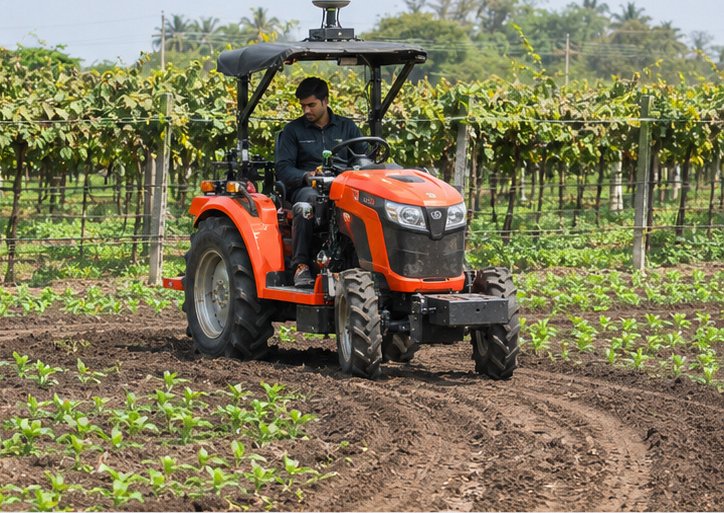
Compact 21–30 hp tractors are the workhorses of vineyards and vegetable farms, but every pass between rows depends on how steady the driver's hands are. Wobbly lines damage plants, waste spray and make the next operation harder, and turning at the end of each row eats time.
An auto-steer kit with automatic headland turns, built for compact tractors working between vines and vegetable rows.
Straighter passes, quicker turns and a driver who finishes the day less tired, at a price well below imported auto-steer.
Aim product, innovation, smart Programme Semi-autonomous tractor Segment Tractor platform by hp class Type 21–30 hp Grade Product grade Priority Very high Duration 18 months (12 months development plus one season of trials) Where it fits Indo-Gangetic plains, central India, Deccan plateau; orchard and hill belts for the small hp classes Method Embedded control & model-based design; CAD & DFM (TCCAD); Instrumented testing & design of experiments Team role Installer & service dealership CIDSA lab Lab 1 – Agricultural Automation & IoT Lab Funding route Grant first, then milestone-linked seed Outcome Co-development with shared IP Software and tools RTK SW Customization & AgriStack API, Ti10 Display Simulators & Emulators, Adams Ground Vehicle Bundle (Tire Handling & 3D Road) Partners to involve Engineering institution, Indian OEM / MSME manufacturer, Agri university / ICAR institute Estimated budget ₹29 lakh, released in stages
Stages and funding L0 · Learn and specify ₹3.4 lakh · 3 short course seats and 1 professional programme seat; 3 lab software tools for 6 months; mentoring and design reviews L1 · Proof of concept ₹2.4 lakh · Design, analysis and virtual prototype on CIDSA lab software L2 · Prototype ₹4.2 lakh · 2 prototypes built and bench-tested L3 · Validation and certification ₹5 lakh · Field trials and statutory testing and certification L4 · Pilot batch ₹8 lakh · 10 pilot units placed with early buyers, half the cost recovered L5 · Launch to revenue ₹6 lakh · Launch: dealer or channel onboarding, demos, documentation and first orders
Open M-002 in the portal and form a team
M-003 Product grade
Semi-autonomous kit for 31–40 hp utility tractors
Steering, lift and PTO automation for small-farm tillage and sowing
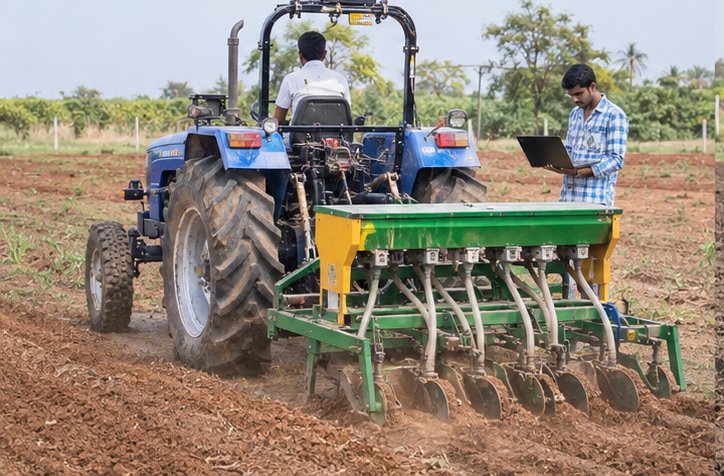
The 31–40 hp utility tractor is the one most Indian smallholders own or hire, and it spends its life on tillage and sowing. Overlaps, skips and uneven depth quietly waste diesel, seed and fertiliser on every field it touches.
A kit that automates steering, implement lift and PTO switching for the most common tractor class on small farms.
Owners and hiring centres cover more acres per day with less diesel and less overlap, and recover the cost of the kit within a few seasons.
Aim product, innovation, smart Programme Semi-autonomous tractor Segment Tractor platform by hp class Type 31–40 hp Grade Product grade Priority Very high Duration 18 months (12 months development plus one season of trials) Where it fits Indo-Gangetic plains, central India, Deccan plateau; orchard and hill belts for the small hp classes Method Embedded control & model-based design; CAD & DFM (TCCAD); Instrumented testing & design of experiments Team role Installer & service dealership CIDSA lab Lab 1 – Agricultural Automation & IoT Lab Funding route Grant first, then milestone-linked seed Outcome Co-development with shared IP Software and tools RTK SW Customization & AgriStack API, Ti10 Display Simulators & Emulators, Adams Ground Vehicle Bundle (Tire Handling & 3D Road) Partners to involve Engineering institution, Indian OEM / MSME manufacturer, Agri university / ICAR institute Estimated budget ₹31.2 lakh, released in stages
Stages and funding L0 · Learn and specify ₹3.4 lakh · 3 short course seats and 1 professional programme seat; 3 lab software tools for 6 months; mentoring and design reviews L1 · Proof of concept ₹2.4 lakh · Design, analysis and virtual prototype on CIDSA lab software L2 · Prototype ₹4.9 lakh · 2 prototypes built and bench-tested L3 · Validation and certification ₹5 lakh · Field trials and statutory testing and certification L4 · Pilot batch ₹9.5 lakh · 10 pilot units placed with early buyers, half the cost recovered L5 · Launch to revenue ₹6 lakh · Launch: dealer or channel onboarding, demos, documentation and first orders
Open M-003 in the portal and form a team
M-004 Product grade
Semi-autonomous kit for 41–50 hp tractors
Full kit with implement controller for rotavator, seed drill and sprayer work
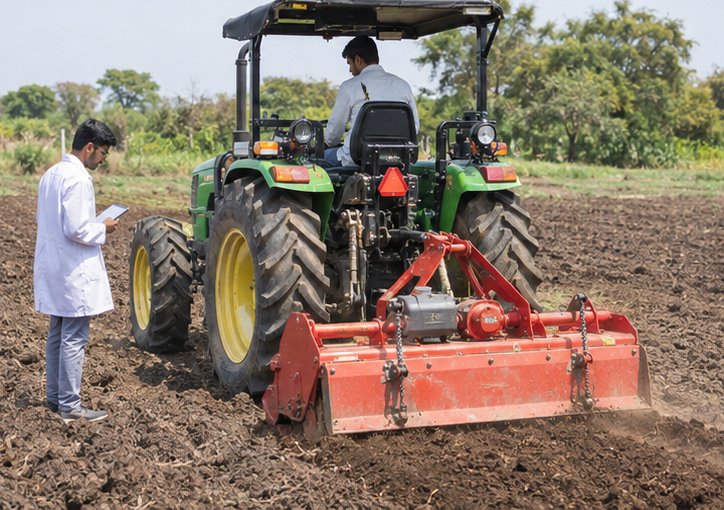
Tractors in the 41–50 hp range pull rotavators, seed drills and sprayers, each needing different speeds, depths and timings. Getting all of that right while steering is hard, and mistakes show up later as patchy germination or wasted spray.
A complete kit with steering plus an implement controller that sets up rotavator, seed drill and sprayer work at the press of a button.
Every implement runs at the right depth and speed from the first pass to the last, with fewer passes and less input wasted.
Aim product, innovation, smart Programme Semi-autonomous tractor Segment Tractor platform by hp class Type 41–50 hp Grade Product grade Priority Very high Duration 18 months (12 months development plus one season of trials) Where it fits Indo-Gangetic plains, central India, Deccan plateau; orchard and hill belts for the small hp classes Method Embedded control & model-based design; CAD & DFM (TCCAD); Instrumented testing & design of experiments Team role Installer & service dealership CIDSA lab Lab 1 – Agricultural Automation & IoT Lab Funding route Grant first, then milestone-linked seed Outcome Co-development with shared IP Software and tools RTK SW Customization & AgriStack API, Ti10 Display Simulators & Emulators, Adams Ground Vehicle Bundle (Tire Handling & 3D Road) Partners to involve Engineering institution, Indian OEM / MSME manufacturer, Agri university / ICAR institute Estimated budget ₹31.2 lakh, released in stages
Stages and funding L0 · Learn and specify ₹3.4 lakh · 3 short course seats and 1 professional programme seat; 3 lab software tools for 6 months; mentoring and design reviews L1 · Proof of concept ₹2.4 lakh · Design, analysis and virtual prototype on CIDSA lab software L2 · Prototype ₹4.9 lakh · 2 prototypes built and bench-tested L3 · Validation and certification ₹5 lakh · Field trials and statutory testing and certification L4 · Pilot batch ₹9.5 lakh · 10 pilot units placed with early buyers, half the cost recovered L5 · Launch to revenue ₹6 lakh · Launch: dealer or channel onboarding, demos, documentation and first orders
Open M-004 in the portal and form a team
M-005 Product grade
Semi-autonomous kit for 51–60 hp tractors
Higher-torque steering and draft-control interface for heavy tillage and baling
Heavy tillage and baling with 51–60 hp tractors put big loads on steering and hitch. Drivers fight the wheel all day, and when draft changes with the soil, depth and fuel use swing with it.
A higher-torque steering kit with a draft-control link, so the tractor holds its line and depth through heavy work.
Steady depth and straight lines in tough soils, with lower fuel use per acre and less strain on the driver.
Aim product, innovation, smart Programme Semi-autonomous tractor Segment Tractor platform by hp class Type 51–60 hp Grade Product grade Priority Very high Duration 24 months Where it fits Indo-Gangetic plains, central India, Deccan plateau; orchard and hill belts for the small hp classes Method Embedded control & model-based design; Multibody dynamics; Instrumented testing & design of experiments Team role Installer & service dealership CIDSA lab Lab 1 – Agricultural Automation & IoT Lab Funding route Grant first, then milestone-linked seed Outcome Co-development with shared IP Software and tools RTK SW Customization & AgriStack API, Ti10 Display Simulators & Emulators, Adams Ground Vehicle Bundle (Tire Handling & 3D Road) Partners to involve Engineering institution, Indian OEM / MSME manufacturer, Agri university / ICAR institute Estimated budget ₹33.4 lakh, released in stages
Stages and funding L0 · Learn and specify ₹3.4 lakh · 3 short course seats and 1 professional programme seat; 3 lab software tools for 6 months; mentoring and design reviews L1 · Proof of concept ₹2.4 lakh · Design, analysis and virtual prototype on CIDSA lab software L2 · Prototype ₹5.6 lakh · 2 prototypes built and bench-tested L3 · Validation and certification ₹5 lakh · Field trials and statutory testing and certification L4 · Pilot batch ₹11 lakh · 10 pilot units placed with early buyers, half the cost recovered L5 · Launch to revenue ₹6 lakh · Launch: dealer or channel onboarding, demos, documentation and first orders
Open M-005 in the portal and form a team
M-006 Product grade
Semi-autonomous kit for 61–75 hp tractors
Electro-hydraulic steering option for laser levelling and reversible ploughing
Laser levelling and reversible ploughing on 61–75 hp tractors demand precision over long hours. A small drift in line or timing means rework, and these big machines cost a lot to run for every extra pass.
An electro-hydraulic steering option tuned for levelling and reversible ploughing on larger tractors.
Fewer repeat passes, cleaner field finish and measurable diesel savings on large-acre contract work.
Aim product, innovation, smart Programme Semi-autonomous tractor Segment Tractor platform by hp class Type 61–75 hp Grade Product grade Priority High Duration 24 months Where it fits Indo-Gangetic plains, central India, Deccan plateau; orchard and hill belts for the small hp classes Method Embedded control & model-based design; Multibody dynamics; Instrumented testing & design of experiments Team role Installer & service dealership CIDSA lab Lab 1 – Agricultural Automation & IoT Lab Funding route Grant first, then milestone-linked seed Outcome Co-development with shared IP Software and tools RTK SW Customization & AgriStack API, Ti10 Display Simulators & Emulators, Adams Ground Vehicle Bundle (Tire Handling & 3D Road) Partners to involve Engineering institution, Indian OEM / MSME manufacturer, Global technology company Estimated budget ₹33.4 lakh, released in stages
Stages and funding L0 · Learn and specify ₹3.4 lakh · 3 short course seats and 1 professional programme seat; 3 lab software tools for 6 months; mentoring and design reviews L1 · Proof of concept ₹2.4 lakh · Design, analysis and virtual prototype on CIDSA lab software L2 · Prototype ₹5.6 lakh · 2 prototypes built and bench-tested L3 · Validation and certification ₹5 lakh · Field trials and statutory testing and certification L4 · Pilot batch ₹11 lakh · 10 pilot units placed with early buyers, half the cost recovered L5 · Launch to revenue ₹6 lakh · Launch: dealer or channel onboarding, demos, documentation and first orders
Open M-006 in the portal and form a team
M-007 Product grade
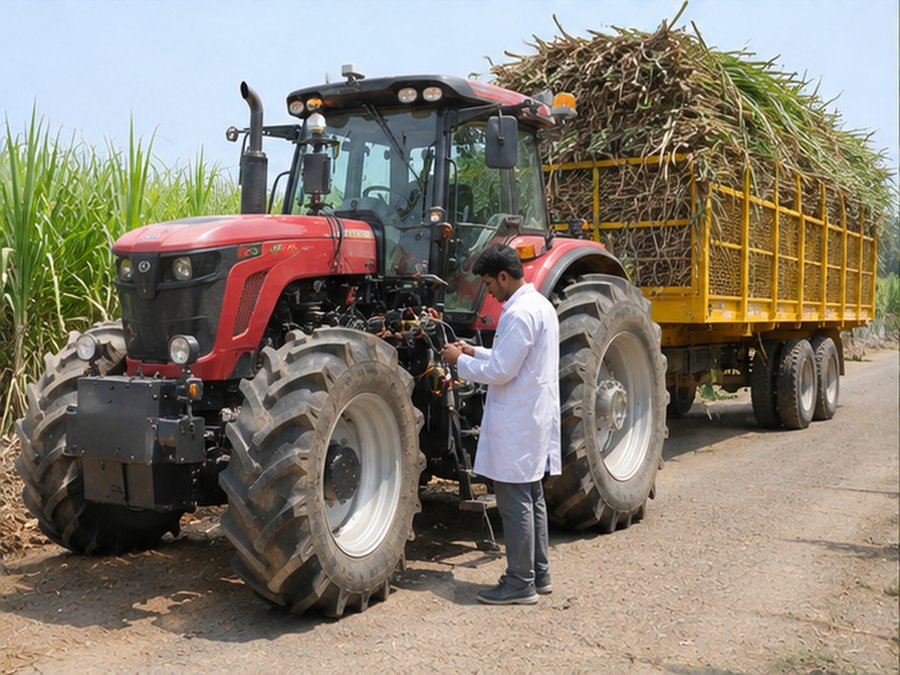
Semi-autonomous interface for tractors above 75 hp
Integration with factory electro-hydraulics for estates and sugarcane haulage
Estates and sugarcane haulage rely on tractors above 75 hp that already come with factory electronics. Bolting on a separate system wastes what is already there and complicates service.
An interface that plugs autonomy features into the tractor's own electro-hydraulics instead of adding parallel hardware.
Big tractors gain guidance and automation without voiding warranties or adding a second control system.
Aim product, innovation, smart Programme Semi-autonomous tractor Segment Tractor platform by hp class Type Above 75 hp Grade Product grade Priority Medium Duration 36 months Where it fits Indo-Gangetic plains, central India, Deccan plateau; orchard and hill belts for the small hp classes Method Embedded control & model-based design; IoT telemetry & analytics software Team role Installer & service dealership CIDSA lab Lab 1 – Agricultural Automation & IoT Lab Funding route Grant first, then milestone-linked seed Outcome Co-development with shared IP Software and tools RTK SW Customization & AgriStack API, Ti10 Display Simulators & Emulators, Adams Ground Vehicle Bundle (Tire Handling & 3D Road) Partners to involve Indian OEM / MSME manufacturer, Global technology company Estimated budget ₹33.4 lakh, released in stages
Stages and funding L0 · Learn and specify ₹3.4 lakh · 3 short course seats and 1 professional programme seat; 3 lab software tools for 6 months; mentoring and design reviews L1 · Proof of concept ₹2.4 lakh · Design, analysis and virtual prototype on CIDSA lab software L2 · Prototype ₹5.6 lakh · 2 prototypes built and bench-tested L3 · Validation and certification ₹5 lakh · Field trials and statutory testing and certification L4 · Pilot batch ₹11 lakh · 10 pilot units placed with early buyers, half the cost recovered L5 · Launch to revenue ₹6 lakh · Launch: dealer or channel onboarding, demos, documentation and first orders
Open M-007 in the portal and form a team
M-008 Product grade
Narrow orchard and vineyard tractor variant
Low-profile sensors and tight-turn planner for narrow tree and vine rows
Orchards and vineyards are planted in narrow rows where a standard tractor barely fits and branches knock sensors off. Turning at the end of each row is a slow, careful shuffle.
A narrow, low-profile variant with protected sensors and a tight-turn planner for tree and vine rows.
Safe, steady runs down narrow rows and noticeably faster row changes, with no damage to trees or vines.
Aim product, innovation, smart Programme Semi-autonomous tractor Segment Tractor platform by hp class Type 20–45 hp narrow Grade Product grade Priority High Duration 24 months Where it fits Indo-Gangetic plains, central India, Deccan plateau; orchard and hill belts for the small hp classes Method Embedded control & model-based design; Machine vision / AI; CAD & DFM (TCCAD) Team role Installer & service dealership CIDSA lab Lab 1 – Agricultural Automation & IoT Lab Funding route Grant first, then milestone-linked seed Outcome Co-development with shared IP Software and tools RTK SW Customization & AgriStack API, Ti10 Display Simulators & Emulators, Adams Ground Vehicle Bundle (Tire Handling & 3D Road) Partners to involve Engineering institution, Indian OEM / MSME manufacturer, Agri university / ICAR institute Estimated budget ₹31.2 lakh, released in stages
Stages and funding L0 · Learn and specify ₹3.4 lakh · 3 short course seats and 1 professional programme seat; 3 lab software tools for 6 months; mentoring and design reviews L1 · Proof of concept ₹2.4 lakh · Design, analysis and virtual prototype on CIDSA lab software L2 · Prototype ₹4.9 lakh · 2 prototypes built and bench-tested L3 · Validation and certification ₹5 lakh · Field trials and statutory testing and certification L4 · Pilot batch ₹9.5 lakh · 10 pilot units placed with early buyers, half the cost recovered L5 · Launch to revenue ₹6 lakh · Launch: dealer or channel onboarding, demos, documentation and first orders
Farmer case studies for field reference: Ahire (Ahmednagar) , Tekade Patil (Dharashiv) , Sangram Pradhan (Boudh) , Chandrakant Singh (Khagaria)
Open M-008 in the portal and form a team
M-009 Research grade
Electric tractor autonomy interface
Drive-by-wire link to electric tractors and the electric farm carrier
Electric tractors and farm carriers are arriving, but each speaks its own electronic language. Without a common link, the autonomy work already done for diesel tractors can't carry across.
A drive-by-wire interface that connects the autonomy stack to electric tractors and the electric farm carrier.
One autonomy system that works on both diesel and electric machines, proven on at least one electric tractor and the carrier.
Aim analysis, innovation, smart Programme Semi-autonomous tractor Segment Tractor platform by hp class Type Electric, small tractor class Grade Research grade Priority Medium Duration 36 months Where it fits Indo-Gangetic plains, central India, Deccan plateau; orchard and hill belts for the small hp classes Method Embedded control & model-based design; Battery & powertrain modelling Team role Testing & consulting service CIDSA lab Lab 1 – Agricultural Automation & IoT Lab Funding route Grant first, then milestone-linked seed Outcome Sponsored research consortium Software and tools RTK SW Customization & AgriStack API, Ti10 Display Simulators & Emulators, Adams Controls Bundle (Controls, Mechatronics & Vibration) Partners to involve Engineering institution, Startup / incubator, Indian OEM / MSME manufacturer Estimated budget ₹31.2 lakh, released in stages
Stages and funding L0 · Learn and specify ₹3.4 lakh · 3 short course seats and 1 professional programme seat; 3 lab software tools for 6 months; mentoring and design reviews L1 · Proof of concept ₹2.4 lakh · Design, analysis and virtual prototype on CIDSA lab software L2 · Prototype ₹4.9 lakh · 2 prototypes built and bench-tested L3 · Validation and certification ₹5 lakh · Field trials and statutory testing and certification L4 · Pilot batch ₹9.5 lakh · 10 pilot units placed with early buyers, half the cost recovered L5 · Launch to revenue ₹6 lakh · Launch: dealer or channel onboarding, demos, documentation and first orders
Open M-009 in the portal and form a team
M-010 Product grade
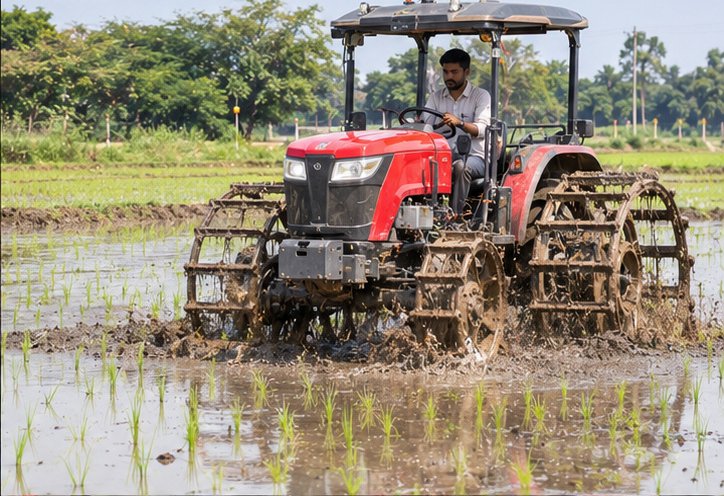
Wet-land paddy variant
Sealed actuators and slip-compensated guidance for puddled fields
In puddled paddy fields the wheels slip, mud splashes everywhere and electronics fail fast. Drivers steer by feel, and a crooked pass means uneven puddling and patchy transplanting.
A wet-land version with sealed actuators and guidance that corrects for wheel slip in puddled fields.
Kits that survive a full wet season and keep puddling and planting lines straight despite slip.
Aim product, innovation, smart Programme Semi-autonomous tractor Segment Tractor platform by hp class Type 35–50 hp with cage wheels Grade Product grade Priority High Duration 24 months Where it fits Indo-Gangetic plains, central India, Deccan plateau; orchard and hill belts for the small hp classes Method Embedded control & model-based design; Instrumented testing & design of experiments; Materials & wear testing Team role Installer & service dealership CIDSA lab Lab 1 – Agricultural Automation & IoT Lab Funding route Grant first, then milestone-linked seed Outcome Co-development with shared IP Software and tools RTK SW Customization & AgriStack API, Ti10 Display Simulators & Emulators, Adams Ground Vehicle Bundle (Tire Handling & 3D Road) Partners to involve Agri university / ICAR institute, Engineering institution, Indian OEM / MSME manufacturer Estimated budget ₹31.2 lakh, released in stages
Stages and funding L0 · Learn and specify ₹3.4 lakh · 3 short course seats and 1 professional programme seat; 3 lab software tools for 6 months; mentoring and design reviews L1 · Proof of concept ₹2.4 lakh · Design, analysis and virtual prototype on CIDSA lab software L2 · Prototype ₹4.9 lakh · 2 prototypes built and bench-tested L3 · Validation and certification ₹5 lakh · Field trials and statutory testing and certification L4 · Pilot batch ₹9.5 lakh · 10 pilot units placed with early buyers, half the cost recovered L5 · Launch to revenue ₹6 lakh · Launch: dealer or channel onboarding, demos, documentation and first orders
Farmer case studies for field reference: Bipadtaran Ghosh (Birbhum) , Ph. Santibala Devi (Imphal West) , Milind Rangrao Patil (Kolhapur) , Dharanidhar Nayak (Cuttack)
Open M-010 in the portal and form a team
M-011 Product grade
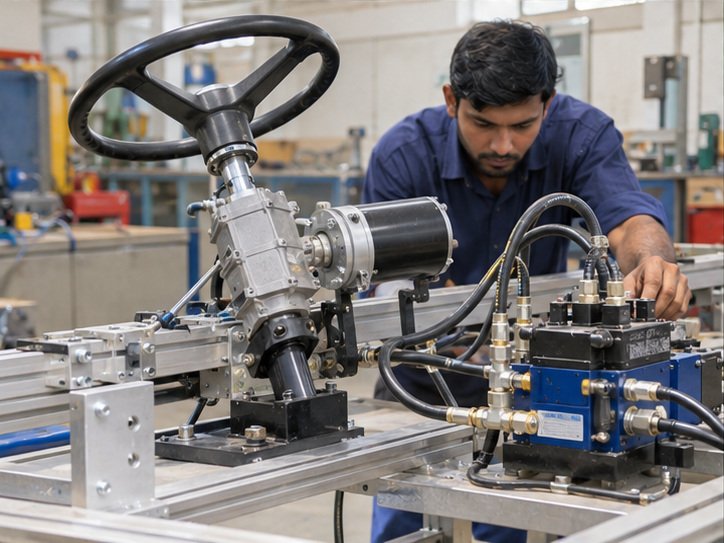
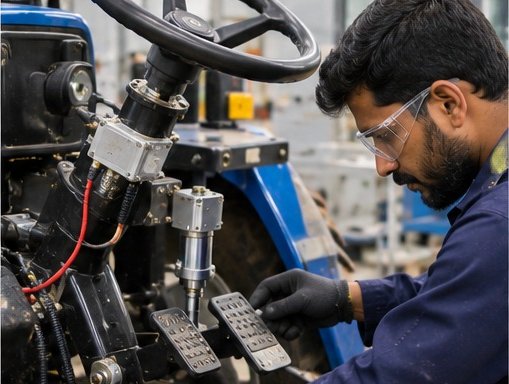
Steering actuator module family
Motor-on-column and hydraulic-valve options sized by hp class
Every tractor class needs a different steering actuator, and designing a new one for each model is slow and expensive. A small, well-tested family of actuators would serve most of the market.
A family of steering actuators, motor-on-column and hydraulic valve, sized for each hp class.
Three or four actuator sizes cover most tractors sold in India, each tested for durability and fitted in under a day.
Aim product, innovation Programme Semi-autonomous tractor Segment Autonomy core stack Type All hp classes Grade Product grade Priority Very high Duration 18 months (12 months development plus one season of trials) Where it fits All tractor-using zones; first trials in Punjab, Haryana, Madhya Pradesh and Karnataka Method Embedded control & model-based design; Multibody dynamics; CAD & DFM (TCCAD) Team role Installer & service dealership CIDSA lab Lab 1 – Agricultural Automation & IoT Lab Funding route Grant first, then milestone-linked seed Outcome Co-development with shared IP Software and tools Adams Controls Bundle (Controls, Mechatronics & Vibration), Adams Ground Vehicle Bundle (Tire Handling & 3D Road) Partners to involve Engineering institution, Indian OEM / MSME manufacturer, Startup / incubator Estimated budget ₹14.9 lakh, released in stages
Stages and funding L0 · Learn and specify ₹3.2 lakh · 3 short course seats and 1 professional programme seat; 2 lab software tools for 8 months; mentoring and design reviews L1 · Proof of concept ₹3.6 lakh · Design, analysis and virtual prototype on CIDSA lab software L2 · Prototype ₹3.3 lakh · 2 prototypes built and bench-tested L3 · Validation and certification ₹2 lakh · Field trials and statutory testing L4 · Pilot batch ₹1.8 lakh · 3 pilot units placed with early buyers, half the cost recovered L5 · Launch to revenue ₹1 lakh · Launch: dealer or channel onboarding, demos, documentation and first orders
Open M-011 in the portal and form a team
M-012 Product grade
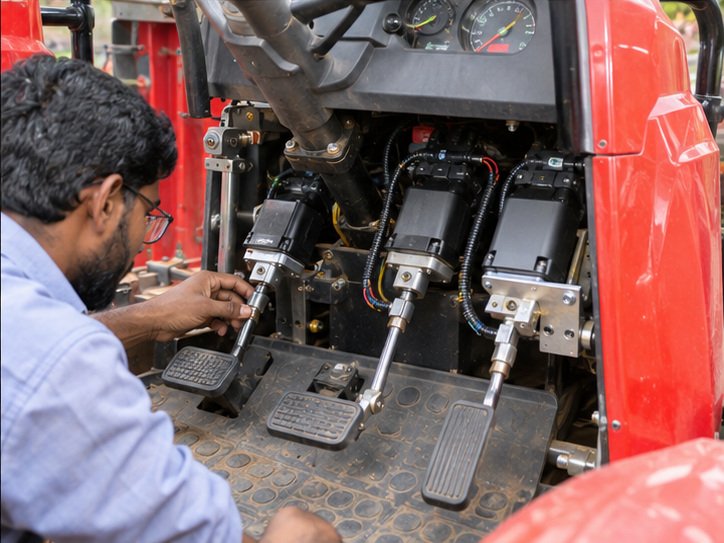
Clutch, brake and throttle actuation kit
Bolt-on actuators for mechanical-transmission tractors
Most Indian tractors still have mechanical clutches, brakes and throttles. Automating them safely is the missing piece that stops semi-autonomous kits from working on the tractors farmers actually own.
Bolt-on actuators for clutch, brake and throttle that fit common mechanical-transmission tractors.
Reliable, overridable control of clutch, brake and throttle on the most popular models, with the driver able to take over instantly.
Aim product, innovation Programme Semi-autonomous tractor Segment Autonomy core stack Type 30–60 hp Grade Product grade Priority Very high Duration 18 months (12 months development plus one season of trials) Where it fits All tractor-using zones; first trials in Punjab, Haryana, Madhya Pradesh and Karnataka Method Embedded control & model-based design; CAD & DFM (TCCAD); Fatigue & durability analysis Team role Installer & service dealership CIDSA lab Lab 1 – Agricultural Automation & IoT Lab Funding route Grant first, then milestone-linked seed Outcome Co-development with shared IP Software and tools Adams Controls Bundle (Controls, Mechatronics & Vibration) Partners to involve Engineering institution, Indian OEM / MSME manufacturer Estimated budget ₹14.1 lakh, released in stages
Stages and funding L0 · Learn and specify ₹2.4 lakh · 3 short course seats and 1 professional programme seat; 1 lab software tool for 8 months; mentoring and design reviews L1 · Proof of concept ₹3.6 lakh · Design, analysis and virtual prototype on CIDSA lab software L2 · Prototype ₹3.3 lakh · 2 prototypes built and bench-tested L3 · Validation and certification ₹2 lakh · Field trials and statutory testing L4 · Pilot batch ₹1.8 lakh · 3 pilot units placed with early buyers, half the cost recovered L5 · Launch to revenue ₹1 lakh · Launch: dealer or channel onboarding, demos, documentation and first orders
Open M-012 in the portal and form a team
M-013 Product grade
Electro-hydraulic lift and depth-control interface
Automatic implement raise, lower and depth hold
Raising, lowering and holding implement depth is one of the most repetitive jobs a driver does, and it is often done by eye. Depth that wanders means uneven tillage, seeding and fuel use.
An electro-hydraulic interface that lifts the implement at headlands and holds a set depth through the field.
Consistent working depth across the field and no more manual lift at every turn.
Aim product, innovation Programme Semi-autonomous tractor Segment Autonomy core stack Type 30–75 hp Grade Product grade Priority Very high Duration 18 months (12 months development plus one season of trials) Where it fits All tractor-using zones; first trials in Punjab, Haryana, Madhya Pradesh and Karnataka Method Embedded control & model-based design; Multibody dynamics; Instrumented testing & design of experiments Team role Installer & service dealership CIDSA lab Lab 1 – Agricultural Automation & IoT Lab Funding route Grant first, then milestone-linked seed Outcome Co-development with shared IP Software and tools Adams Controls Bundle (Controls, Mechatronics & Vibration), Adams Studio Package (Adams View & Adams Solver) Partners to involve Engineering institution, Indian OEM / MSME manufacturer Estimated budget ₹14.9 lakh, released in stages
Stages and funding L0 · Learn and specify ₹3.2 lakh · 3 short course seats and 1 professional programme seat; 2 lab software tools for 8 months; mentoring and design reviews L1 · Proof of concept ₹3.6 lakh · Design, analysis and virtual prototype on CIDSA lab software L2 · Prototype ₹3.3 lakh · 2 prototypes built and bench-tested L3 · Validation and certification ₹2 lakh · Field trials and statutory testing L4 · Pilot batch ₹1.8 lakh · 3 pilot units placed with early buyers, half the cost recovered L5 · Launch to revenue ₹1 lakh · Launch: dealer or channel onboarding, demos, documentation and first orders
Open M-013 in the portal and form a team
M-014 Product grade
PTO engage and load-monitoring module
Automatic PTO switching with overload and stall protection
PTO-driven implements jam, stall and break when overloaded, and drivers often notice too late. Engaging and disengaging the PTO at every headland is another job competing for attention.
A module that switches the PTO automatically and cuts drive on overload or stall.
Fewer broken shafts and gearboxes, and a PTO that is always on when it should be and off when it should not.
Aim product, innovation, smart Programme Semi-autonomous tractor Segment Autonomy core stack Type 30–75 hp Grade Product grade Priority High Duration 18 months (12 months development plus one season of trials) Where it fits All tractor-using zones; first trials in Punjab, Haryana, Madhya Pradesh and Karnataka Method Embedded control & model-based design; Instrumented testing & design of experiments Team role Installer & service dealership CIDSA lab Lab 1 – Agricultural Automation & IoT Lab Funding route Grant first, then milestone-linked seed Outcome Co-development with shared IP Software and tools Adams Machinery Module Bundle, Adams Controls Bundle (Controls, Mechatronics & Vibration) Partners to involve Engineering institution, Indian OEM / MSME manufacturer Estimated budget ₹14.9 lakh, released in stages
Stages and funding L0 · Learn and specify ₹3.2 lakh · 3 short course seats and 1 professional programme seat; 2 lab software tools for 8 months; mentoring and design reviews L1 · Proof of concept ₹3.6 lakh · Design, analysis and virtual prototype on CIDSA lab software L2 · Prototype ₹3.3 lakh · 2 prototypes built and bench-tested L3 · Validation and certification ₹2 lakh · Field trials and statutory testing L4 · Pilot batch ₹1.8 lakh · 3 pilot units placed with early buyers, half the cost recovered L5 · Launch to revenue ₹1 lakh · Launch: dealer or channel onboarding, demos, documentation and first orders
Open M-014 in the portal and form a team
M-015 Product grade
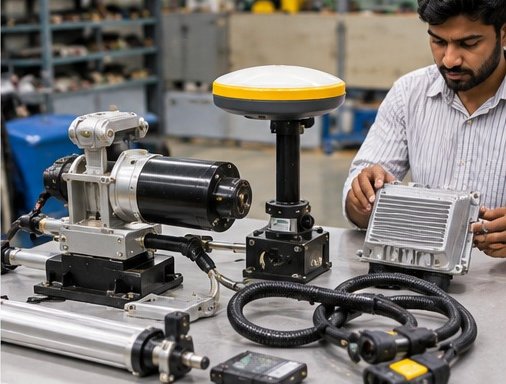
GNSS-RTK and inertial positioning unit
Low-cost receiver with dropout handling under tree cover
Accurate positioning is the heart of any guidance system, but imported receivers are costly and lose signal under trees. Orchards and tree-lined fields are exactly where Indian farmers need guidance most.
A low-cost GNSS-RTK receiver with inertial backup that keeps position through short signal drop-outs.
Pass-to-pass accuracy good enough for row work, holding up under tree cover, at a fraction of imported receiver cost.
Aim product, innovation Programme Semi-autonomous tractor Segment Autonomy core stack Type All hp classes Grade Product grade Priority Very high Duration 18 months (12 months development plus one season of trials) Where it fits All tractor-using zones; first trials in Punjab, Haryana, Madhya Pradesh and Karnataka Method Embedded control & model-based design; Instrumented testing & design of experiments Team role Installer & service dealership CIDSA lab Lab 1 – Agricultural Automation & IoT Lab Funding route Grant first, then milestone-linked seed Outcome Co-development with shared IP Software and tools RTK SW Customization & AgriStack API Partners to involve Engineering institution, Startup / incubator Estimated budget ₹14.1 lakh, released in stages
Stages and funding L0 · Learn and specify ₹2.4 lakh · 3 short course seats and 1 professional programme seat; 1 lab software tool for 8 months; mentoring and design reviews L1 · Proof of concept ₹3.6 lakh · Design, analysis and virtual prototype on CIDSA lab software L2 · Prototype ₹3.3 lakh · 2 prototypes built and bench-tested L3 · Validation and certification ₹2 lakh · Field trials and statutory testing L4 · Pilot batch ₹1.8 lakh · 3 pilot units placed with early buyers, half the cost recovered L5 · Launch to revenue ₹1 lakh · Launch: dealer or channel onboarding, demos, documentation and first orders
Open M-015 in the portal and form a team
M-016 Platform grade
Headland auto-turn and path planner
Turn patterns for small, irregular Indian plots
Indian plots are small and oddly shaped, so a large share of field time is spent turning. Turn patterns written for big rectangular fields elsewhere simply don't fit.
A headland planner that picks the right turn pattern for small, irregular plots and runs it automatically.
Noticeably less time and diesel spent in headlands, with no missed strips along field edges.
Aim innovation, smart Programme Semi-autonomous tractor Segment Autonomy core stack Type All hp classes Grade Platform grade Priority Very high Duration 18 months (12 months development plus one season of trials) Where it fits All tractor-using zones; first trials in Punjab, Haryana, Madhya Pradesh and Karnataka Method Embedded control & model-based design; IoT telemetry & analytics software Team role Installer & service dealership CIDSA lab Lab 2 – Smart Precision Agriculture Lab Funding route Grant first, then milestone-linked seed Outcome Co-development with shared IP Software and tools CIDSA Smart Tractor Path Optimization, CIDSA Autonomous Farm Navigation System Partners to involve Engineering institution, Startup / incubator Estimated budget ₹14.9 lakh, released in stages
Stages and funding L0 · Learn and specify ₹3.2 lakh · 3 short course seats and 1 professional programme seat; 2 lab software tools for 8 months; mentoring and design reviews L1 · Proof of concept ₹3.6 lakh · Design, analysis and virtual prototype on CIDSA lab software L2 · Prototype ₹3.3 lakh · 2 prototypes built and bench-tested L3 · Validation and certification ₹2 lakh · Field trials and statutory testing L4 · Pilot batch ₹1.8 lakh · 3 pilot units placed with early buyers, half the cost recovered L5 · Launch to revenue ₹1 lakh · Launch: dealer or channel onboarding, demos, documentation and first orders
Open M-016 in the portal and form a team
M-017 Product grade
Operator-override safety loop
Emergency stop, seat switch, remote stop and geofence
Farmers will only trust a self-steering tractor if they know they can stop it instantly, from the seat or from outside. Safety has to be built in from the start, not added later.
A safety loop with emergency stop, seat switch, remote stop and geofence that overrides everything else.
The tractor always stops within a safe distance when any stop is triggered, verified in repeatable tests.
Aim product, innovation, smart Programme Semi-autonomous tractor Segment Autonomy core stack Type All hp classes Grade Product grade Priority Very high Duration 18 months (12 months development plus one season of trials) Where it fits All tractor-using zones; first trials in Punjab, Haryana, Madhya Pradesh and Karnataka Method Embedded control & model-based design; Ergonomic assessment; Instrumented testing & design of experiments Team role Installer & service dealership CIDSA lab Lab 1 – Agricultural Automation & IoT Lab Funding route Grant first, then milestone-linked seed Outcome Co-development with shared IP Software and tools Ti10 Display Simulators & Emulators, Adams Controls Bundle (Controls, Mechatronics & Vibration) Partners to involve Engineering institution, Indian OEM / MSME manufacturer, Government department / mission Estimated budget ₹15.9 lakh, released in stages
Stages and funding L0 · Learn and specify ₹3.2 lakh · 3 short course seats and 1 professional programme seat; 2 lab software tools for 8 months; mentoring and design reviews L1 · Proof of concept ₹3.6 lakh · Design, analysis and virtual prototype on CIDSA lab software L2 · Prototype ₹3.3 lakh · 2 prototypes built and bench-tested L3 · Validation and certification ₹3 lakh · Field trials and statutory testing L4 · Pilot batch ₹1.8 lakh · 3 pilot units placed with early buyers, half the cost recovered L5 · Launch to revenue ₹1 lakh · Launch: dealer or channel onboarding, demos, documentation and first orders
Open M-017 in the portal and form a team
M-018 Research grade
Person and animal detection system
Camera and radar obstacle sensing with automatic stop
Fields are shared with people, children and animals who walk in front of machines without warning. A tractor that steers itself must be able to see them and stop.
Camera and radar sensing that spots people and animals in the tractor's path and brings it to a stop.
Reliable detection in dust, glare and crop cover, with very few false stops that would annoy drivers.
Aim analysis, innovation Programme Semi-autonomous tractor Segment Autonomy core stack Type All hp classes Grade Research grade Priority Very high Duration 24 months Where it fits All tractor-using zones; first trials in Punjab, Haryana, Madhya Pradesh and Karnataka Method Machine vision / AI; Embedded control & model-based design Team role Testing & consulting service CIDSA lab Lab 8 – Farm Intelligence & Robotics Lab Funding route Grant first, then milestone-linked seed Outcome Sponsored research consortium Software and tools CIDSA Autonomous Farm Navigation System, CIDSA Smart Crop Analytics AI Partners to involve Engineering institution, Startup / incubator, Agri university / ICAR institute Estimated budget ₹14.9 lakh, released in stages
Stages and funding L0 · Learn and specify ₹3.2 lakh · 3 short course seats and 1 professional programme seat; 2 lab software tools for 8 months; mentoring and design reviews L1 · Proof of concept ₹3.6 lakh · Design, analysis and virtual prototype on CIDSA lab software L2 · Prototype ₹3.3 lakh · 2 prototypes built and bench-tested L3 · Validation and certification ₹2 lakh · Field trials and statutory testing L4 · Pilot batch ₹1.8 lakh · 3 pilot units placed with early buyers, half the cost recovered L5 · Launch to revenue ₹1 lakh · Launch: dealer or channel onboarding, demos, documentation and first orders
Open M-018 in the portal and form a team
M-019 Product grade
Universal implement controller and connector
One controller and plug standard for Indian implements
Indian implements come from hundreds of local makers, each with its own wiring, or none at all. Without a common plug and controller, automation stops at the hitch.
One implement controller and connector standard that local makers can adopt cheaply.
Implements from several makers working with the same controller, and at least a few manufacturers adopting the standard.
Aim product, innovation Programme Semi-autonomous tractor Segment Autonomy core stack Type All hp classes Grade Product grade Priority Very high Duration 18 months (12 months development plus one season of trials) Where it fits All tractor-using zones; first trials in Punjab, Haryana, Madhya Pradesh and Karnataka Method Embedded control & model-based design; Tolerance stack-up & standardisation; CAD & DFM (TCCAD) Team role Installer & service dealership CIDSA lab Lab 1 – Agricultural Automation & IoT Lab Funding route Grant first, then milestone-linked seed Outcome Co-development with shared IP Software and tools Ti10 Display Simulators & Emulators Partners to involve Indian OEM / MSME manufacturer, Engineering institution, Startup / incubator Estimated budget ₹14.1 lakh, released in stages
Stages and funding L0 · Learn and specify ₹2.4 lakh · 3 short course seats and 1 professional programme seat; 1 lab software tool for 8 months; mentoring and design reviews L1 · Proof of concept ₹3.6 lakh · Design, analysis and virtual prototype on CIDSA lab software L2 · Prototype ₹3.3 lakh · 2 prototypes built and bench-tested L3 · Validation and certification ₹2 lakh · Field trials and statutory testing L4 · Pilot batch ₹1.8 lakh · 3 pilot units placed with early buyers, half the cost recovered L5 · Launch to revenue ₹1 lakh · Launch: dealer or channel onboarding, demos, documentation and first orders
Open M-019 in the portal and form a team
M-020 Platform grade
In-cab display and mobile app in Indian languages
Job set-up, guidance view and alerts for operators
Most operators are more comfortable in their own language, and complex screens put them off. If the display is confusing, the best automation goes unused.
An in-cab display and mobile app in Indian languages for job set-up, guidance and alerts.
Operators set up and run a job on their own after a short demonstration, in the language they prefer.
Aim innovation, smart Programme Semi-autonomous tractor Segment Autonomy core stack Type All hp classes Grade Platform grade Priority High Duration 18 months (12 months development plus one season of trials) Where it fits All tractor-using zones; first trials in Punjab, Haryana, Madhya Pradesh and Karnataka Method IoT telemetry & analytics software; Ergonomic assessment Team role Installer & service dealership CIDSA lab Lab 1 – Agricultural Automation & IoT Lab Funding route Grant first, then milestone-linked seed Outcome Co-development with shared IP Software and tools Ti10 Display Simulators & Emulators Partners to involve Startup / incubator, Indian OEM / MSME manufacturer Estimated budget ₹14.1 lakh, released in stages
Stages and funding L0 · Learn and specify ₹2.4 lakh · 3 short course seats and 1 professional programme seat; 1 lab software tool for 8 months; mentoring and design reviews L1 · Proof of concept ₹3.6 lakh · Design, analysis and virtual prototype on CIDSA lab software L2 · Prototype ₹3.3 lakh · 2 prototypes built and bench-tested L3 · Validation and certification ₹2 lakh · Field trials and statutory testing L4 · Pilot batch ₹1.8 lakh · 3 pilot units placed with early buyers, half the cost recovered L5 · Launch to revenue ₹1 lakh · Launch: dealer or channel onboarding, demos, documentation and first orders
Open M-020 in the portal and form a team
M-021 Platform grade
Fleet telemetry linked to the Agni Ops Platform
Area, fuel, hours and alerts for owners and hiring centres
Tractor owners and hiring centres rarely know exactly how many acres were done, how much diesel was used or where a machine sat idle. That makes billing, maintenance and planning guesswork.
Fleet telemetry that reports area, fuel, hours and alerts into the Agni Ops Platform.
Owners can see each machine's work and costs every day and bill hirers on recorded acres.
Aim innovation, smart Programme Semi-autonomous tractor Segment Autonomy core stack Type All hp classes Grade Platform grade Priority Very high Duration 18 months (12 months development plus one season of trials) Where it fits All tractor-using zones; first trials in Punjab, Haryana, Madhya Pradesh and Karnataka Method IoT telemetry & analytics software Team role Installer & service dealership CIDSA lab Lab 2 – Smart Precision Agriculture Lab Funding route Grant first, then milestone-linked seed Outcome Co-development with shared IP Software and tools CIDSA Control Room – Machine Monitoring, CIDSA Agni Ops Platform, CIDSA Smart Equipment Planning Suite Partners to involve Indian OEM / MSME manufacturer, FPO / KVK / farmer network, Bank / NBFC / insurer Estimated budget ₹15.7 lakh, released in stages
Stages and funding L0 · Learn and specify ₹4 lakh · 3 short course seats and 1 professional programme seat; 3 lab software tools for 8 months; mentoring and design reviews L1 · Proof of concept ₹3.6 lakh · Design, analysis and virtual prototype on CIDSA lab software L2 · Prototype ₹3.3 lakh · 2 prototypes built and bench-tested L3 · Validation and certification ₹2 lakh · Field trials and statutory testing L4 · Pilot batch ₹1.8 lakh · 3 pilot units placed with early buyers, half the cost recovered L5 · Launch to revenue ₹1 lakh · Launch: dealer or channel onboarding, demos, documentation and first orders
Open M-021 in the portal and form a team
M-022 Platform grade
Field boundary and guidance-line mapping linked to Akasha
Boundary capture and line planning from satellite and walk-around
Guidance only works once the field boundary and lines are known, and walking every plot with a GPS is slow. Satellite views exist but are not linked to the tractor.
Boundary capture and guidance-line planning from satellite images and a quick walk-around, linked to the Akasha map platform.
A new field is ready for guided work in minutes, with boundaries that match the ground.
Aim innovation, smart Programme Semi-autonomous tractor Segment Autonomy core stack Type All hp classes Grade Platform grade Priority High Duration 18 months (12 months development plus one season of trials) Where it fits All tractor-using zones; first trials in Punjab, Haryana, Madhya Pradesh and Karnataka Method IoT telemetry & analytics software; Machine vision / AI Team role Installer & service dealership CIDSA lab Lab 6 – Geospatial Intelligence & Remote Sensing Lab Funding route Grant first, then milestone-linked seed Outcome Co-development with shared IP Software and tools GIS, Remote Sensing & Photogrammetry Education Kit (ERDAS Imagine Pro, GeoMedia), CIDSA Farm Layout & Zoning Pro, CIDSA Agri Digital Asset Hub Partners to involve Engineering institution, Startup / incubator Estimated budget ₹13.9 lakh, released in stages
Stages and funding L0 · Learn and specify ₹4 lakh · 3 short course seats and 1 professional programme seat; 3 lab software tools for 8 months; mentoring and design reviews L1 · Proof of concept ₹1.8 lakh · Design, analysis and virtual prototype on CIDSA lab software L2 · Prototype ₹3.3 lakh · 2 prototypes built and bench-tested L3 · Validation and certification ₹2 lakh · Field trials and statutory testing L4 · Pilot batch ₹1.8 lakh · 3 pilot units placed with early buyers, half the cost recovered L5 · Launch to revenue ₹1 lakh · Launch: dealer or channel onboarding, demos, documentation and first orders
Open M-022 in the portal and form a team
M-023 Product grade
Retrofit installation jig and calibration procedure
Model-wise mounting brackets and a standard calibration routine
A retrofit kit is only as good as its installation, and every tractor model needs different brackets and settings. Without a standard method, quality depends on who installs it.
Model-wise mounting jigs and a standard calibration routine that any trained technician can follow.
Installations completed in a set time with consistent accuracy, whichever technician does the job.
Aim product, innovation Programme Semi-autonomous tractor Segment Autonomy core stack Type By tractor model Grade Product grade Priority Very high Duration 18 months (12 months development plus one season of trials) Where it fits All tractor-using zones; first trials in Punjab, Haryana, Madhya Pradesh and Karnataka Method CAD & DFM (TCCAD); Tolerance stack-up & standardisation; Instrumented testing & design of experiments Team role Installer & service dealership CIDSA lab Lab 4 – Farm Equipment & Innovation Lab Funding route Grant first, then milestone-linked seed Outcome Co-development with shared IP Software and tools MSC Apex Modeller, Simufact Welding Hub Partners to involve Indian OEM / MSME manufacturer, Engineering institution Estimated budget ₹14.9 lakh, released in stages
Stages and funding L0 · Learn and specify ₹3.2 lakh · 3 short course seats and 1 professional programme seat; 2 lab software tools for 8 months; mentoring and design reviews L1 · Proof of concept ₹3.6 lakh · Design, analysis and virtual prototype on CIDSA lab software L2 · Prototype ₹3.3 lakh · 2 prototypes built and bench-tested L3 · Validation and certification ₹2 lakh · Field trials and statutory testing L4 · Pilot batch ₹1.8 lakh · 3 pilot units placed with early buyers, half the cost recovered L5 · Launch to revenue ₹1 lakh · Launch: dealer or channel onboarding, demos, documentation and first orders
Open M-023 in the portal and form a team
M-024 Research grade
Safety validation protocol for semi-autonomous tractors
Test cases for stopping distance, geofence breach and override
There is no agreed way in India to test whether a semi-autonomous tractor is safe. Without one, buyers, insurers and regulators have nothing to rely on.
A test protocol covering stopping distance, geofence breach and operator override.
A protocol that test centres can run and that kits must pass before they reach farmers.
Aim analysis, innovation Programme Semi-autonomous tractor Segment Autonomy core stack Type All hp classes Grade Research grade Priority Very high Duration 18 months (12 months development plus one season of trials) Where it fits All tractor-using zones; first trials in Punjab, Haryana, Madhya Pradesh and Karnataka Method Instrumented testing & design of experiments; Ergonomic assessment Team role Testing & consulting service CIDSA lab Lab 1 – Agricultural Automation & IoT Lab Funding route Grant first, then milestone-linked seed Outcome Sponsored research consortium Software and tools Ti10 Display Simulators & Emulators Partners to involve Agri university / ICAR institute, Engineering institution, Government department / mission Estimated budget ₹13.3 lakh, released in stages
Stages and funding L0 · Learn and specify ₹2.4 lakh · 3 short course seats and 1 professional programme seat; 1 lab software tool for 8 months; mentoring and design reviews L1 · Proof of concept ₹1.8 lakh · Design, analysis and virtual prototype on CIDSA lab software L2 · Prototype ₹3.3 lakh · 2 prototypes built and bench-tested L3 · Validation and certification ₹3 lakh · Field trials and statutory testing L4 · Pilot batch ₹1.8 lakh · 3 pilot units placed with early buyers, half the cost recovered L5 · Launch to revenue ₹1 lakh · Launch: dealer or channel onboarding, demos, documentation and first orders
Open M-024 in the portal and form a team
M-025 Research grade
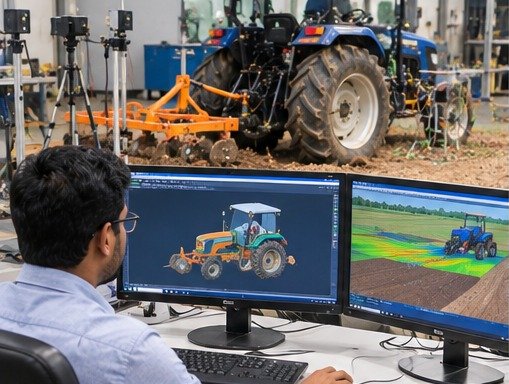
Tractor–implement digital twin for control tuning
Simulation of steering, draft and turn behaviour before field trials
Tuning steering and draft control on real fields is slow, weather-dependent and wears out machines. Many problems could be caught on a computer first.
A digital twin of tractor and implement that simulates steering, draft and turns before field trials.
Control settings tuned in simulation that need only small changes once in the field, cutting trial time.
Aim analysis, innovation, smart Programme Semi-autonomous tractor Segment Autonomy core stack Type All hp classes Grade Research grade Priority High Duration 24 months Where it fits All tractor-using zones; first trials in Punjab, Haryana, Madhya Pradesh and Karnataka Method Multibody dynamics; Embedded control & model-based design Team role Testing & consulting service CIDSA lab Lab 1 – Agricultural Automation & IoT Lab Funding route Grant first, then milestone-linked seed Outcome Sponsored research consortium Software and tools Adams Studio Package (Adams View & Adams Solver), Adams Ground Vehicle Bundle (Tire Handling & 3D Road), Adams Controls Bundle (Controls, Mechatronics & Vibration) Partners to involve Engineering institution, Global technology company Estimated budget ₹15.7 lakh, released in stages
Stages and funding L0 · Learn and specify ₹4 lakh · 3 short course seats and 1 professional programme seat; 3 lab software tools for 8 months; mentoring and design reviews L1 · Proof of concept ₹3.6 lakh · Design, analysis and virtual prototype on CIDSA lab software L2 · Prototype ₹3.3 lakh · 2 prototypes built and bench-tested L3 · Validation and certification ₹2 lakh · Field trials and statutory testing L4 · Pilot batch ₹1.8 lakh · 3 pilot units placed with early buyers, half the cost recovered L5 · Launch to revenue ₹1 lakh · Launch: dealer or channel onboarding, demos, documentation and first orders
Open M-025 in the portal and form a team
M-026 Research grade
Steering and pedal force survey across hp classes
Measured actuation loads on common tractor models
Actuators are often over- or under-sized because nobody has measured the real forces needed to steer and press pedals on common Indian tractors.
A survey measuring steering and pedal forces across popular models and hp classes.
A published load dataset that the actuator and kit designs are sized from.
Aim analysis, innovation Programme Semi-autonomous tractor Segment Autonomy core stack Type All hp classes Grade Research grade Priority Very high Duration 18 months (12 months development plus one season of trials) Where it fits All tractor-using zones; first trials in Punjab, Haryana, Madhya Pradesh and Karnataka Method Instrumented testing & design of experiments; Multibody dynamics Team role Testing & consulting service CIDSA lab Lab 1 – Agricultural Automation & IoT Lab Funding route Grant first, then milestone-linked seed Outcome Sponsored research consortium Software and tools Adams Ground Vehicle Bundle (Tire Handling & 3D Road) Partners to involve Agri university / ICAR institute, Engineering institution, Indian OEM / MSME manufacturer Estimated budget ₹12.3 lakh, released in stages
Stages and funding L0 · Learn and specify ₹2.4 lakh · 3 short course seats and 1 professional programme seat; 1 lab software tool for 8 months; mentoring and design reviews L1 · Proof of concept ₹1.8 lakh · Design, analysis and virtual prototype on CIDSA lab software L2 · Prototype ₹3.3 lakh · 2 prototypes built and bench-tested L3 · Validation and certification ₹2 lakh · Field trials and statutory testing L4 · Pilot batch ₹1.8 lakh · 3 pilot units placed with early buyers, half the cost recovered L5 · Launch to revenue ₹1 lakh · Launch: dealer or channel onboarding, demos, documentation and first orders
Open M-026 in the portal and form a team
M-027 Product grade
Autonomy kit should-cost and localisation plan
Cost model and local sourcing for actuators, receiver and controller
Imported actuators, receivers and controllers make autonomy kits too expensive for most Indian farmers. Nobody has worked out exactly what the kit should cost if built here.
A should-cost model and local sourcing plan for every major kit component.
A clear path to bring the kit price down through Indian suppliers, with named vendors for key parts.
Aim product, innovation Programme Semi-autonomous tractor Segment Autonomy core stack Type All hp classes Grade Product grade Priority Very high Duration 18 months (12 months development plus one season of trials) Where it fits All tractor-using zones; first trials in Punjab, Haryana, Madhya Pradesh and Karnataka Method Value engineering & should-costing; 3D scanning & reverse engineering Team role Installer & service dealership CIDSA lab Lab 4 – Farm Equipment & Innovation Lab Funding route Grant first, then milestone-linked seed Outcome Co-development with shared IP Partners to involve Indian OEM / MSME manufacturer, Engineering institution, Startup / incubator Estimated budget ₹13.3 lakh, released in stages
Stages and funding L0 · Learn and specify ₹1.6 lakh · 3 short course seats and 1 professional programme seat; 0 lab software tools for 8 months; mentoring and design reviews L1 · Proof of concept ₹3.6 lakh · Design, analysis and virtual prototype on CIDSA lab software L2 · Prototype ₹3.3 lakh · 2 prototypes built and bench-tested L3 · Validation and certification ₹2 lakh · Field trials and statutory testing L4 · Pilot batch ₹1.8 lakh · 3 pilot units placed with early buyers, half the cost recovered L5 · Launch to revenue ₹1 lakh · Launch: dealer or channel onboarding, demos, documentation and first orders
Open M-027 in the portal and form a team
M-028 Training grade
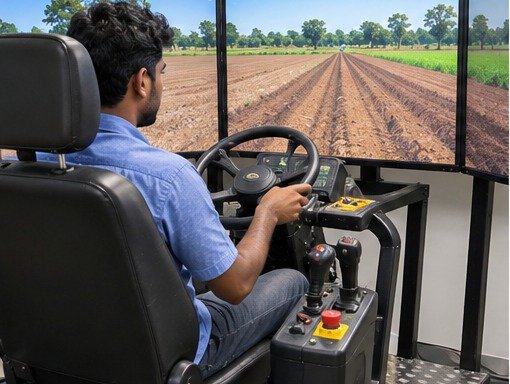
Semi-autonomous tractor operator simulator module
Simulator lessons on set-up, supervision and override
Operators need to learn how to set up and supervise a semi-autonomous tractor without risking a real machine. Learning on the job is slow and unsafe.
Simulator lessons covering set-up, supervision and safe override.
Trainees complete the simulator course and handle a real semi-autonomous tractor confidently from day one.
Aim innovation Programme Semi-autonomous tractor Segment Autonomy core stack Type All hp classes Grade Training grade Priority High Duration 18 months (12 months development plus one season of trials) Where it fits All tractor-using zones; first trials in Punjab, Haryana, Madhya Pradesh and Karnataka Method IoT telemetry & analytics software; Ergonomic assessment Team role Training & certification centre CIDSA lab Lab 1 – Agricultural Automation & IoT Lab Funding route Grant first, then milestone-linked seed Outcome Curriculum partnership Software and tools Ti10 Display Simulators & Emulators Partners to involve Indian OEM / MSME manufacturer, Government department / mission Estimated budget ₹14.1 lakh, released in stages
Stages and funding L0 · Learn and specify ₹2.4 lakh · 3 short course seats and 1 professional programme seat; 1 lab software tool for 8 months; mentoring and design reviews L1 · Proof of concept ₹3.6 lakh · Design, analysis and virtual prototype on CIDSA lab software L2 · Prototype ₹3.3 lakh · 2 prototypes built and bench-tested L3 · Validation and certification ₹2 lakh · Field trials and statutory testing L4 · Pilot batch ₹1.8 lakh · 3 pilot units placed with early buyers, half the cost recovered L5 · Launch to revenue ₹1 lakh · Launch: dealer or channel onboarding, demos, documentation and first orders
Open M-028 in the portal and form a team
M-029 Product grade
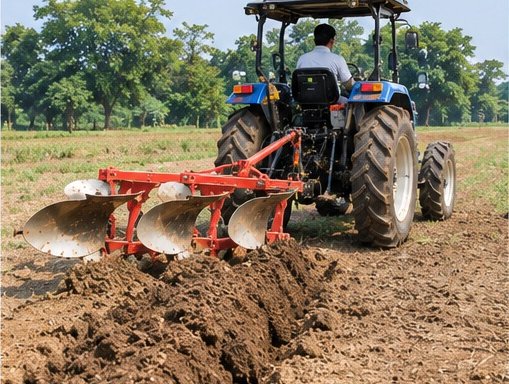
Semi-autonomous integration: mouldboard plough
Automatic lift and lower at headlands with depth hold and furrow-following guidance
Mouldboard ploughing needs the plough raised and lowered at every headland and the next furrow followed closely. Done by hand all day, it is tiring and uneven.
An integration pack that lifts and lowers the plough at headlands, holds depth and follows the previous furrow.
Even furrows and fewer missed strips, with the driver freed from constant lever work.
Aim product, innovation, smart Programme Semi-autonomous tractor Segment Implement integration Type 35–55 hp Grade Product grade Priority High Duration 24 months Where it fits Rice–wheat belt, black-soil central India, rainfed Deccan, sugarcane and cotton tracts Method Embedded control & model-based design; Instrumented testing & design of experiments Team role Custom-hire & field service provider CIDSA lab Lab 1 – Agricultural Automation & IoT Lab Funding route Grant first, then milestone-linked seed Outcome Co-development with shared IP Software and tools Ti10 Display Simulators & Emulators, Adams Controls Bundle (Controls, Mechatronics & Vibration), Adams Ground Vehicle Bundle (Tire Handling & 3D Road) Partners to involve Agri university / ICAR institute, Engineering institution, Indian OEM / MSME manufacturer Estimated budget ₹8 lakh, released in stages
Stages and funding L0 · Learn and specify ₹1.7 lakh · 2 short course seats; 3 lab software tools for 3 months; mentoring and design reviews L1 · Proof of concept ₹0.9 lakh · Design, analysis and virtual prototype on CIDSA lab software L2 · Prototype ₹1.2 lakh · 1 prototype built and bench-tested L3 · Validation and certification ₹1.7 lakh · Field trials and statutory testing L4 · Pilot batch ₹1.5 lakh · 5 pilot units placed with early buyers, half the cost recovered L5 · Launch to revenue ₹1 lakh · Launch: dealer or channel onboarding, demos, documentation and first orders
Open M-029 in the portal and form a team
M-030 Product grade
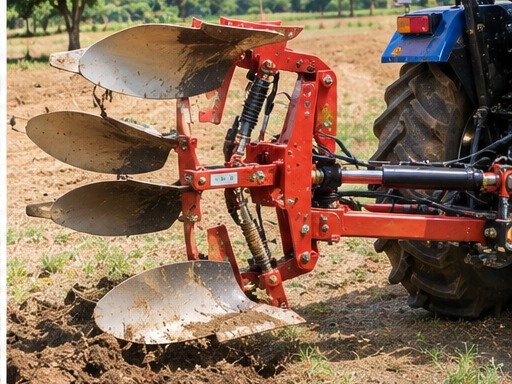
Semi-autonomous integration: reversible plough
Automatic turnover at each headland with alternate-pass guidance
A reversible plough has to be turned over at every headland, and the next pass has to line up exactly. Get it wrong and you leave ridges or dead furrows.
An integration pack that turns the plough over automatically and guides alternate passes.
Clean, level ploughing with no dead furrows and quicker turns at each headland.
Aim product, innovation, smart Programme Semi-autonomous tractor Segment Implement integration Type 45–75 hp Grade Product grade Priority High Duration 24 months Where it fits Rice–wheat belt, black-soil central India, rainfed Deccan, sugarcane and cotton tracts Method Embedded control & model-based design; Instrumented testing & design of experiments Team role Custom-hire & field service provider CIDSA lab Lab 1 – Agricultural Automation & IoT Lab Funding route Grant first, then milestone-linked seed Outcome Co-development with shared IP Software and tools Ti10 Display Simulators & Emulators, Adams Controls Bundle (Controls, Mechatronics & Vibration), Adams Ground Vehicle Bundle (Tire Handling & 3D Road) Partners to involve Agri university / ICAR institute, Engineering institution, Indian OEM / MSME manufacturer Estimated budget ₹8 lakh, released in stages
Stages and funding L0 · Learn and specify ₹1.7 lakh · 2 short course seats; 3 lab software tools for 3 months; mentoring and design reviews L1 · Proof of concept ₹0.9 lakh · Design, analysis and virtual prototype on CIDSA lab software L2 · Prototype ₹1.2 lakh · 1 prototype built and bench-tested L3 · Validation and certification ₹1.7 lakh · Field trials and statutory testing L4 · Pilot batch ₹1.5 lakh · 5 pilot units placed with early buyers, half the cost recovered L5 · Launch to revenue ₹1 lakh · Launch: dealer or channel onboarding, demos, documentation and first orders
Open M-030 in the portal and form a team
M-031 Product grade
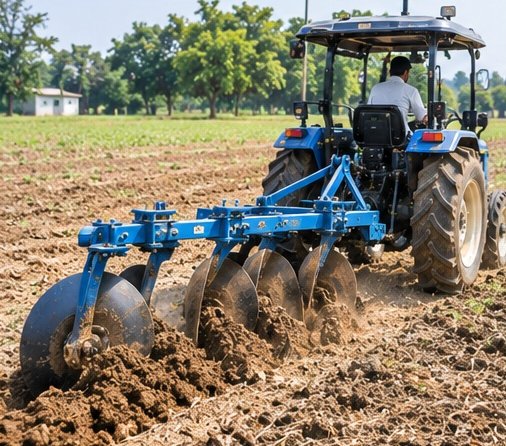
Semi-autonomous integration: disc plough
Depth hold and slip-based speed control in hard soils
In hard, dry soils a disc plough bounces and the wheels slip, so depth and speed keep changing. Drivers slow right down to compensate.
An integration pack that holds depth and adjusts speed based on wheel slip in hard ground.
Steady ploughing depth in tough soils with less slip and less diesel per acre.
Aim product, innovation, smart Programme Semi-autonomous tractor Segment Implement integration Type 40–60 hp Grade Product grade Priority Medium Duration 24 months Where it fits Rice–wheat belt, black-soil central India, rainfed Deccan, sugarcane and cotton tracts Method Embedded control & model-based design; Instrumented testing & design of experiments Team role Custom-hire & field service provider CIDSA lab Lab 1 – Agricultural Automation & IoT Lab Funding route Grant first, then milestone-linked seed Outcome Co-development with shared IP Software and tools Ti10 Display Simulators & Emulators, Adams Controls Bundle (Controls, Mechatronics & Vibration), Adams Ground Vehicle Bundle (Tire Handling & 3D Road) Partners to involve Agri university / ICAR institute, Engineering institution, Indian OEM / MSME manufacturer Estimated budget ₹8 lakh, released in stages
Stages and funding L0 · Learn and specify ₹1.7 lakh · 2 short course seats; 3 lab software tools for 3 months; mentoring and design reviews L1 · Proof of concept ₹0.9 lakh · Design, analysis and virtual prototype on CIDSA lab software L2 · Prototype ₹1.2 lakh · 1 prototype built and bench-tested L3 · Validation and certification ₹1.7 lakh · Field trials and statutory testing L4 · Pilot batch ₹1.5 lakh · 5 pilot units placed with early buyers, half the cost recovered L5 · Launch to revenue ₹1 lakh · Launch: dealer or channel onboarding, demos, documentation and first orders
Open M-031 in the portal and form a team
M-032 Product grade
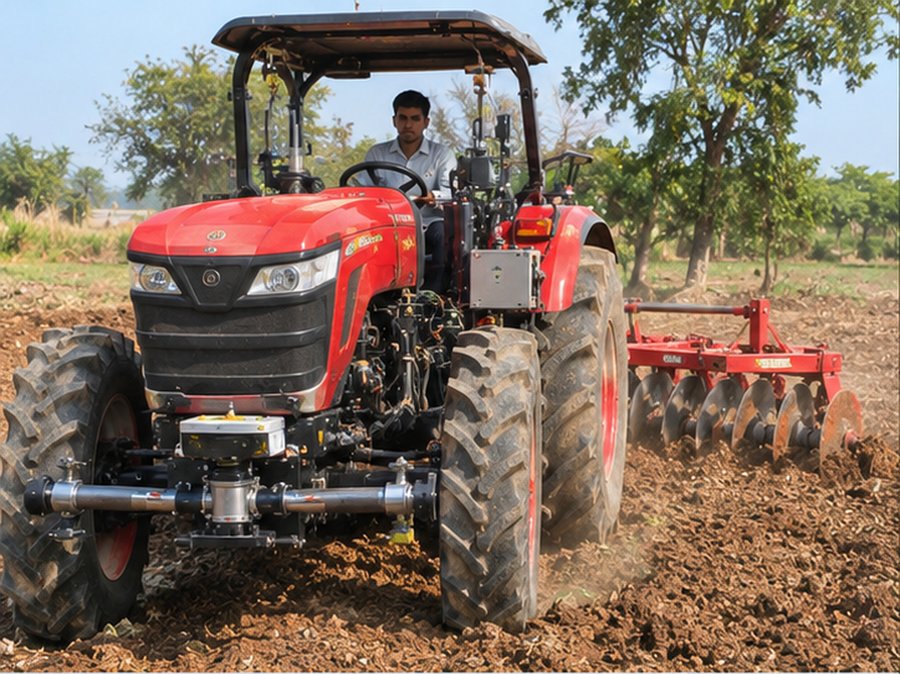
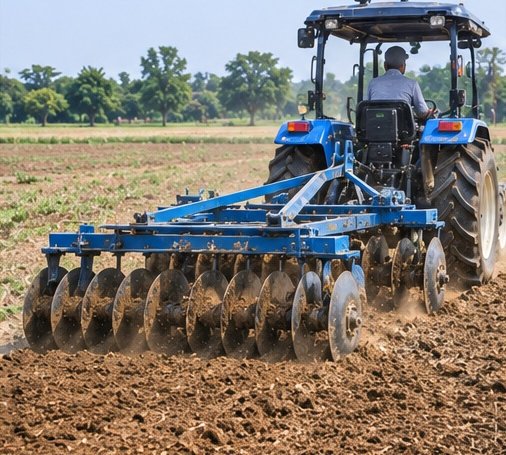
Semi-autonomous integration: disc harrow
Overlap-free passes with automatic lift at turns
Disc harrowing is often done twice over the same ground because overlaps are hard to judge by eye. That wastes time and fuel and overworks the soil.
Guidance for overlap-free passes, with automatic lift at turns.
Fewer passes and less overlap, measured as saved hours and diesel per acre.
Aim product, innovation, smart Programme Semi-autonomous tractor Segment Implement integration Type 35–60 hp Grade Product grade Priority High Duration 18 months (12 months development plus one season of trials) Where it fits Rice–wheat belt, black-soil central India, rainfed Deccan, sugarcane and cotton tracts Method Embedded control & model-based design; Instrumented testing & design of experiments Team role Custom-hire & field service provider CIDSA lab Lab 1 – Agricultural Automation & IoT Lab Funding route Grant first, then milestone-linked seed Outcome Co-development with shared IP Software and tools Ti10 Display Simulators & Emulators, Adams Controls Bundle (Controls, Mechatronics & Vibration), Adams Ground Vehicle Bundle (Tire Handling & 3D Road) Partners to involve Agri university / ICAR institute, Engineering institution, Indian OEM / MSME manufacturer Estimated budget ₹8 lakh, released in stages
Stages and funding L0 · Learn and specify ₹1.7 lakh · 2 short course seats; 3 lab software tools for 3 months; mentoring and design reviews L1 · Proof of concept ₹0.9 lakh · Design, analysis and virtual prototype on CIDSA lab software L2 · Prototype ₹1.2 lakh · 1 prototype built and bench-tested L3 · Validation and certification ₹1.7 lakh · Field trials and statutory testing L4 · Pilot batch ₹1.5 lakh · 5 pilot units placed with early buyers, half the cost recovered L5 · Launch to revenue ₹1 lakh · Launch: dealer or channel onboarding, demos, documentation and first orders
Open M-032 in the portal and form a team
M-033 Product grade
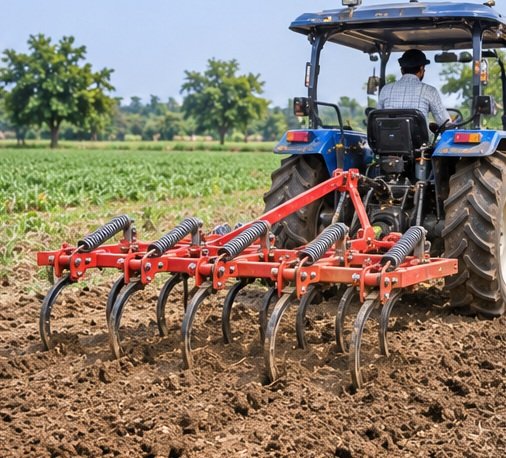
Semi-autonomous integration: spring-tyne cultivator
Straight-line guidance with depth hold and automatic lift
Spring-tyne cultivators need straight lines and steady depth to do a good job, but drivers drift over a long day.
Straight-line guidance with depth hold and automatic lift for cultivators.
Uniform cultivation across the field with less driver fatigue.
Aim product, innovation, smart Programme Semi-autonomous tractor Segment Implement integration Type 25–50 hp Grade Product grade Priority Very high Duration 18 months (12 months development plus one season of trials) Where it fits Rice–wheat belt, black-soil central India, rainfed Deccan, sugarcane and cotton tracts Method Embedded control & model-based design; Instrumented testing & design of experiments Team role Custom-hire & field service provider CIDSA lab Lab 1 – Agricultural Automation & IoT Lab Funding route Grant first, then milestone-linked seed Outcome Co-development with shared IP Software and tools Ti10 Display Simulators & Emulators, Adams Controls Bundle (Controls, Mechatronics & Vibration), Adams Ground Vehicle Bundle (Tire Handling & 3D Road) Partners to involve Agri university / ICAR institute, Engineering institution, Indian OEM / MSME manufacturer Estimated budget ₹8 lakh, released in stages
Stages and funding L0 · Learn and specify ₹1.7 lakh · 2 short course seats; 3 lab software tools for 3 months; mentoring and design reviews L1 · Proof of concept ₹0.9 lakh · Design, analysis and virtual prototype on CIDSA lab software L2 · Prototype ₹1.2 lakh · 1 prototype built and bench-tested L3 · Validation and certification ₹1.7 lakh · Field trials and statutory testing L4 · Pilot batch ₹1.5 lakh · 5 pilot units placed with early buyers, half the cost recovered L5 · Launch to revenue ₹1 lakh · Launch: dealer or channel onboarding, demos, documentation and first orders
Open M-033 in the portal and form a team
M-034 Product grade
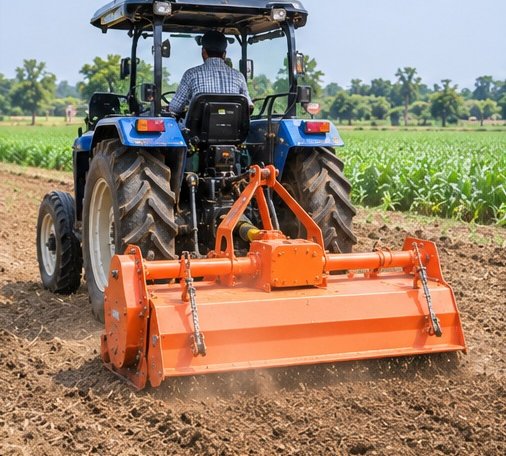
Semi-autonomous integration: rotavator
PTO engage on entry, automatic lift at headland and load-based speed control
Rotavators are the most used implement on Indian farms, and the most abused. PTO left running at turns, speeds too high for the load and repeat passes waste fuel and wear the machine.
An integration pack that engages the PTO on entry, lifts at headlands and slows the tractor when load climbs.
Better tilth in fewer passes, lower fuel use and longer blade and gearbox life.
Aim product, innovation, smart Programme Semi-autonomous tractor Segment Implement integration Type 35–60 hp Grade Product grade Priority Very high Duration 18 months (12 months development plus one season of trials) Where it fits Rice–wheat belt, black-soil central India, rainfed Deccan, sugarcane and cotton tracts Method Embedded control & model-based design; Instrumented testing & design of experiments Team role Custom-hire & field service provider CIDSA lab Lab 1 – Agricultural Automation & IoT Lab Funding route Grant first, then milestone-linked seed Outcome Co-development with shared IP Software and tools Ti10 Display Simulators & Emulators, Adams Machinery Module Bundle, Adams Controls Bundle (Controls, Mechatronics & Vibration) Partners to involve Agri university / ICAR institute, Engineering institution, Indian OEM / MSME manufacturer Estimated budget ₹8 lakh, released in stages
Stages and funding L0 · Learn and specify ₹1.7 lakh · 2 short course seats; 3 lab software tools for 3 months; mentoring and design reviews L1 · Proof of concept ₹0.9 lakh · Design, analysis and virtual prototype on CIDSA lab software L2 · Prototype ₹1.2 lakh · 1 prototype built and bench-tested L3 · Validation and certification ₹1.7 lakh · Field trials and statutory testing L4 · Pilot batch ₹1.5 lakh · 5 pilot units placed with early buyers, half the cost recovered L5 · Launch to revenue ₹1 lakh · Launch: dealer or channel onboarding, demos, documentation and first orders
Open M-034 in the portal and form a team
M-035 Product grade
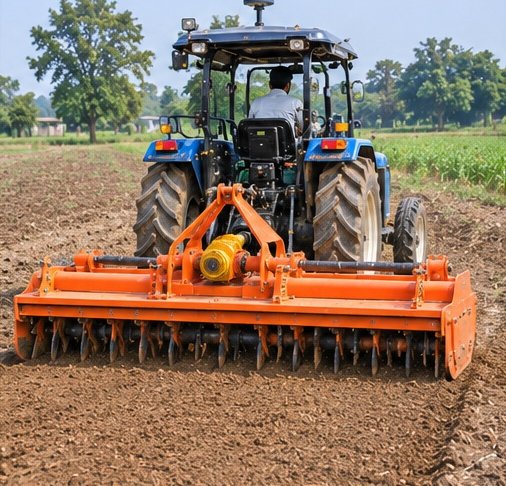
Semi-autonomous integration: power harrow
PTO load monitoring with speed matching for uniform tilth
A power harrow only gives a fine, even seedbed if forward speed matches rotor load. That balance is hard to hold by feel.
PTO load monitoring that matches tractor speed to the power harrow's needs.
A consistent seedbed across the field without overloading the harrow.
Aim product, innovation, smart Programme Semi-autonomous tractor Segment Implement integration Type 50–75 hp Grade Product grade Priority Medium Duration 24 months Where it fits Rice–wheat belt, black-soil central India, rainfed Deccan, sugarcane and cotton tracts Method Embedded control & model-based design; Instrumented testing & design of experiments Team role Custom-hire & field service provider CIDSA lab Lab 1 – Agricultural Automation & IoT Lab Funding route Grant first, then milestone-linked seed Outcome Co-development with shared IP Software and tools Ti10 Display Simulators & Emulators, Adams Machinery Module Bundle, Adams Controls Bundle (Controls, Mechatronics & Vibration) Partners to involve Agri university / ICAR institute, Engineering institution, Indian OEM / MSME manufacturer Estimated budget ₹8 lakh, released in stages
Stages and funding L0 · Learn and specify ₹1.7 lakh · 2 short course seats; 3 lab software tools for 3 months; mentoring and design reviews L1 · Proof of concept ₹0.9 lakh · Design, analysis and virtual prototype on CIDSA lab software L2 · Prototype ₹1.2 lakh · 1 prototype built and bench-tested L3 · Validation and certification ₹1.7 lakh · Field trials and statutory testing L4 · Pilot batch ₹1.5 lakh · 5 pilot units placed with early buyers, half the cost recovered L5 · Launch to revenue ₹1 lakh · Launch: dealer or channel onboarding, demos, documentation and first orders
Open M-035 in the portal and form a team
M-036 Product grade
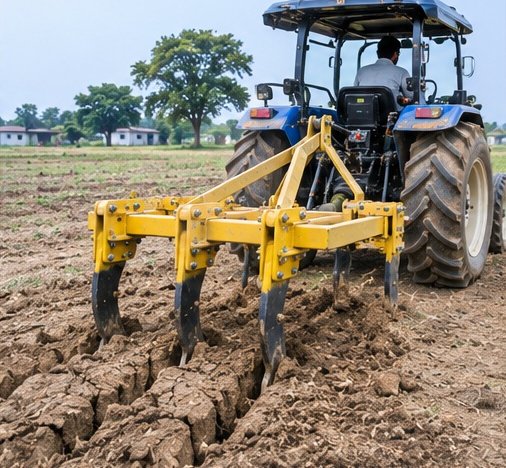
Semi-autonomous integration: subsoiler
Draft-limited depth control with slip alarm
Subsoiling breaks hard pans but puts huge draft on the tractor. Too deep and the wheels spin; too shallow and the pan stays.
Draft-limited depth control with a slip alarm for subsoiling.
The target depth reached without stalling, and measurable improvement in the hard pan.
Aim product, innovation, smart Programme Semi-autonomous tractor Segment Implement integration Type 55–75 hp Grade Product grade Priority Medium Duration 24 months Where it fits Rice–wheat belt, black-soil central India, rainfed Deccan, sugarcane and cotton tracts Method Embedded control & model-based design; Instrumented testing & design of experiments Team role Custom-hire & field service provider CIDSA lab Lab 1 – Agricultural Automation & IoT Lab Funding route Grant first, then milestone-linked seed Outcome Co-development with shared IP Software and tools Ti10 Display Simulators & Emulators, Adams Controls Bundle (Controls, Mechatronics & Vibration), Adams Ground Vehicle Bundle (Tire Handling & 3D Road) Partners to involve Agri university / ICAR institute, Engineering institution, Indian OEM / MSME manufacturer Estimated budget ₹8 lakh, released in stages
Stages and funding L0 · Learn and specify ₹1.7 lakh · 2 short course seats; 3 lab software tools for 3 months; mentoring and design reviews L1 · Proof of concept ₹0.9 lakh · Design, analysis and virtual prototype on CIDSA lab software L2 · Prototype ₹1.2 lakh · 1 prototype built and bench-tested L3 · Validation and certification ₹1.7 lakh · Field trials and statutory testing L4 · Pilot batch ₹1.5 lakh · 5 pilot units placed with early buyers, half the cost recovered L5 · Launch to revenue ₹1 lakh · Launch: dealer or channel onboarding, demos, documentation and first orders
Open M-036 in the portal and form a team
M-037 Product grade
Semi-autonomous integration: chisel plough
Depth hold and pass spacing for compaction-breaking patterns
Chisel ploughing works best in planned patterns at the right depth and spacing, which is hard to hold over a big field.
Depth hold and pass-spacing guidance for compaction-breaking chisel patterns.
Even pass spacing and depth across the field, recorded for the farmer.
Aim product, innovation, smart Programme Semi-autonomous tractor Segment Implement integration Type 45–75 hp Grade Product grade Priority Medium Duration 36 months Where it fits Rice–wheat belt, black-soil central India, rainfed Deccan, sugarcane and cotton tracts Method Embedded control & model-based design; Instrumented testing & design of experiments Team role Custom-hire & field service provider CIDSA lab Lab 1 – Agricultural Automation & IoT Lab Funding route Grant first, then milestone-linked seed Outcome Co-development with shared IP Software and tools Ti10 Display Simulators & Emulators, Adams Controls Bundle (Controls, Mechatronics & Vibration), Adams Ground Vehicle Bundle (Tire Handling & 3D Road) Partners to involve Agri university / ICAR institute, Engineering institution, Indian OEM / MSME manufacturer Estimated budget ₹8 lakh, released in stages
Stages and funding L0 · Learn and specify ₹1.7 lakh · 2 short course seats; 3 lab software tools for 3 months; mentoring and design reviews L1 · Proof of concept ₹0.9 lakh · Design, analysis and virtual prototype on CIDSA lab software L2 · Prototype ₹1.2 lakh · 1 prototype built and bench-tested L3 · Validation and certification ₹1.7 lakh · Field trials and statutory testing L4 · Pilot batch ₹1.5 lakh · 5 pilot units placed with early buyers, half the cost recovered L5 · Launch to revenue ₹1 lakh · Launch: dealer or channel onboarding, demos, documentation and first orders
Open M-037 in the portal and form a team
M-038 Product grade
Semi-autonomous integration: puddler
Coverage-map guidance so wet fields are puddled without repeat passes
In a flooded field it is almost impossible to see where you have already puddled, so drivers go over the same ground again and again.
Coverage-map guidance so every part of the wet field is puddled once.
Less repeat puddling, saved hours and water, and a more even field for transplanting.
Aim product, innovation, smart Programme Semi-autonomous tractor Segment Implement integration Type 30–50 hp Grade Product grade Priority High Duration 24 months Where it fits Rice–wheat belt, black-soil central India, rainfed Deccan, sugarcane and cotton tracts Method Embedded control & model-based design; Instrumented testing & design of experiments Team role Custom-hire & field service provider CIDSA lab Lab 1 – Agricultural Automation & IoT Lab Funding route Grant first, then milestone-linked seed Outcome Co-development with shared IP Software and tools Ti10 Display Simulators & Emulators, Adams Machinery Module Bundle, Adams Controls Bundle (Controls, Mechatronics & Vibration) Partners to involve Agri university / ICAR institute, Engineering institution, Indian OEM / MSME manufacturer Estimated budget ₹8 lakh, released in stages
Stages and funding L0 · Learn and specify ₹1.7 lakh · 2 short course seats; 3 lab software tools for 3 months; mentoring and design reviews L1 · Proof of concept ₹0.9 lakh · Design, analysis and virtual prototype on CIDSA lab software L2 · Prototype ₹1.2 lakh · 1 prototype built and bench-tested L3 · Validation and certification ₹1.7 lakh · Field trials and statutory testing L4 · Pilot batch ₹1.5 lakh · 5 pilot units placed with early buyers, half the cost recovered L5 · Launch to revenue ₹1 lakh · Launch: dealer or channel onboarding, demos, documentation and first orders
Farmer case studies for field reference: Bipadtaran Ghosh (Birbhum) , Ph. Santibala Devi (Imphal West) , Milind Rangrao Patil (Kolhapur) , Dharanidhar Nayak (Cuttack)
Open M-038 in the portal and form a team
M-039 Product grade
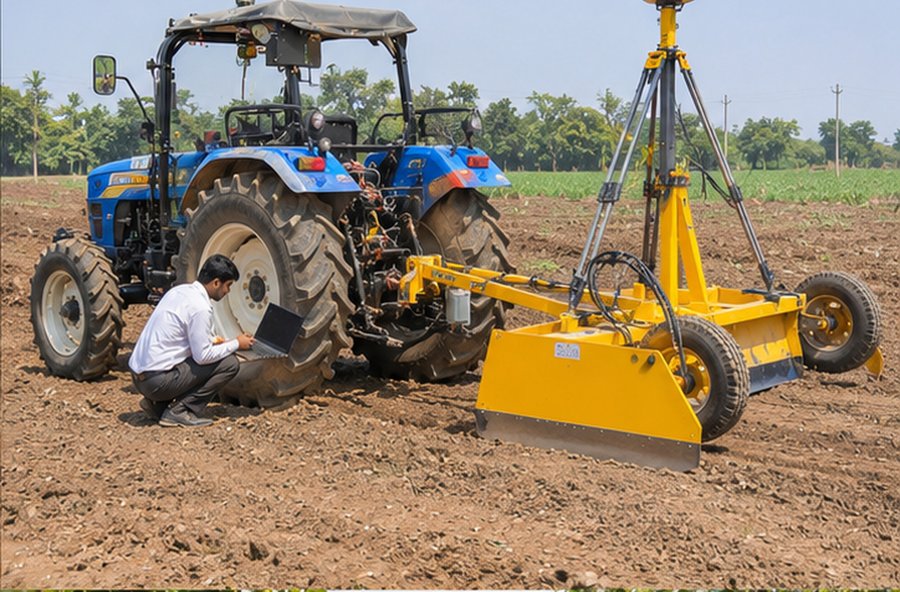
Semi-autonomous integration: laser land leveller
Guidance paths planned from the cut-fill map with bucket control hand-off
Laser levelling saves water, but planning the passes from the cut-and-fill map is skilled work and mistakes are costly.
Guidance paths planned from the cut-fill map, handing bucket control to the laser system.
Fields levelled in fewer passes with the same or better finish.
Aim product, innovation, smart Programme Semi-autonomous tractor Segment Implement integration Type 50–75 hp Grade Product grade Priority Very high Duration 18 months (12 months development plus one season of trials) Where it fits Rice–wheat belt, black-soil central India, rainfed Deccan, sugarcane and cotton tracts Method Embedded control & model-based design; Instrumented testing & design of experiments Team role Custom-hire & field service provider CIDSA lab Lab 1 – Agricultural Automation & IoT Lab Funding route Grant first, then milestone-linked seed Outcome Co-development with shared IP Software and tools Ti10 Display Simulators & Emulators, Adams Controls Bundle (Controls, Mechatronics & Vibration), Adams Ground Vehicle Bundle (Tire Handling & 3D Road) Partners to involve Agri university / ICAR institute, Engineering institution, Indian OEM / MSME manufacturer Estimated budget ₹8 lakh, released in stages
Stages and funding L0 · Learn and specify ₹1.7 lakh · 2 short course seats; 3 lab software tools for 3 months; mentoring and design reviews L1 · Proof of concept ₹0.9 lakh · Design, analysis and virtual prototype on CIDSA lab software L2 · Prototype ₹1.2 lakh · 1 prototype built and bench-tested L3 · Validation and certification ₹1.7 lakh · Field trials and statutory testing L4 · Pilot batch ₹1.5 lakh · 5 pilot units placed with early buyers, half the cost recovered L5 · Launch to revenue ₹1 lakh · Launch: dealer or channel onboarding, demos, documentation and first orders
Open M-039 in the portal and form a team
M-040 Product grade
Semi-autonomous integration: bund former
Boundary-following guidance for uniform bunds
Bunds hold water and mark plots, but uneven, wandering bunds leak and waste land.
Boundary-following guidance for straight, uniform bunds.
Uniform bunds built faster, with less soil moved by hand afterwards.
Aim product, innovation, smart Programme Semi-autonomous tractor Segment Implement integration Type 30–45 hp Grade Product grade Priority Medium Duration 24 months Where it fits Rice–wheat belt, black-soil central India, rainfed Deccan, sugarcane and cotton tracts Method Embedded control & model-based design; Instrumented testing & design of experiments Team role Custom-hire & field service provider CIDSA lab Lab 1 – Agricultural Automation & IoT Lab Funding route Grant first, then milestone-linked seed Outcome Co-development with shared IP Software and tools Ti10 Display Simulators & Emulators, Adams Controls Bundle (Controls, Mechatronics & Vibration), Adams Ground Vehicle Bundle (Tire Handling & 3D Road) Partners to involve Agri university / ICAR institute, Engineering institution, Indian OEM / MSME manufacturer Estimated budget ₹8 lakh, released in stages
Stages and funding L0 · Learn and specify ₹1.7 lakh · 2 short course seats; 3 lab software tools for 3 months; mentoring and design reviews L1 · Proof of concept ₹0.9 lakh · Design, analysis and virtual prototype on CIDSA lab software L2 · Prototype ₹1.2 lakh · 1 prototype built and bench-tested L3 · Validation and certification ₹1.7 lakh · Field trials and statutory testing L4 · Pilot batch ₹1.5 lakh · 5 pilot units placed with early buyers, half the cost recovered L5 · Launch to revenue ₹1 lakh · Launch: dealer or channel onboarding, demos, documentation and first orders
Open M-040 in the portal and form a team
M-041 Product grade
Semi-autonomous integration: ridger
Equal ridge spacing with matched return passes
Ridges that vary in spacing make planting, weeding and harvesting harder all season.
Guidance that keeps ridge spacing equal and lines up return passes.
Even ridges across the field that later machines can follow without adjustment.
Aim product, innovation, smart Programme Semi-autonomous tractor Segment Implement integration Type 30–50 hp Grade Product grade Priority High Duration 18 months (12 months development plus one season of trials) Where it fits Rice–wheat belt, black-soil central India, rainfed Deccan, sugarcane and cotton tracts Method Embedded control & model-based design; Instrumented testing & design of experiments Team role Custom-hire & field service provider CIDSA lab Lab 1 – Agricultural Automation & IoT Lab Funding route Grant first, then milestone-linked seed Outcome Co-development with shared IP Software and tools Ti10 Display Simulators & Emulators, Adams Controls Bundle (Controls, Mechatronics & Vibration), Adams Ground Vehicle Bundle (Tire Handling & 3D Road) Partners to involve Agri university / ICAR institute, Engineering institution, Indian OEM / MSME manufacturer Estimated budget ₹8 lakh, released in stages
Stages and funding L0 · Learn and specify ₹1.7 lakh · 2 short course seats; 3 lab software tools for 3 months; mentoring and design reviews L1 · Proof of concept ₹0.9 lakh · Design, analysis and virtual prototype on CIDSA lab software L2 · Prototype ₹1.2 lakh · 1 prototype built and bench-tested L3 · Validation and certification ₹1.7 lakh · Field trials and statutory testing L4 · Pilot batch ₹1.5 lakh · 5 pilot units placed with early buyers, half the cost recovered L5 · Launch to revenue ₹1 lakh · Launch: dealer or channel onboarding, demos, documentation and first orders
Open M-041 in the portal and form a team
M-042 Product grade
Semi-autonomous integration: raised-bed maker
Repeatable bed lines stored for later planting and spraying
Raised beds help drainage and yield, but if the bed lines aren't recorded, planting and spraying can't follow them precisely.
Repeatable bed-making with the lines saved for later planting and spraying.
Beds made once and used by every later operation without re-marking.
Aim product, innovation, smart Programme Semi-autonomous tractor Segment Implement integration Type 35–55 hp Grade Product grade Priority Very high Duration 18 months (12 months development plus one season of trials) Where it fits Rice–wheat belt, black-soil central India, rainfed Deccan, sugarcane and cotton tracts Method Embedded control & model-based design; Instrumented testing & design of experiments Team role Custom-hire & field service provider CIDSA lab Lab 1 – Agricultural Automation & IoT Lab Funding route Grant first, then milestone-linked seed Outcome Co-development with shared IP Software and tools Ti10 Display Simulators & Emulators, Adams Controls Bundle (Controls, Mechatronics & Vibration), Adams Ground Vehicle Bundle (Tire Handling & 3D Road) Partners to involve Agri university / ICAR institute, Engineering institution, Indian OEM / MSME manufacturer Estimated budget ₹8 lakh, released in stages
Stages and funding L0 · Learn and specify ₹1.7 lakh · 2 short course seats; 3 lab software tools for 3 months; mentoring and design reviews L1 · Proof of concept ₹0.9 lakh · Design, analysis and virtual prototype on CIDSA lab software L2 · Prototype ₹1.2 lakh · 1 prototype built and bench-tested L3 · Validation and certification ₹1.7 lakh · Field trials and statutory testing L4 · Pilot batch ₹1.5 lakh · 5 pilot units placed with early buyers, half the cost recovered L5 · Launch to revenue ₹1 lakh · Launch: dealer or channel onboarding, demos, documentation and first orders
Open M-042 in the portal and form a team
M-043 Product grade
Semi-autonomous integration: post-hole digger
Stop-and-go positioning on a planting grid with auger cycle control
Digging pits for orchards and fences on a grid is slow, and spacing by eye leads to crooked rows that are hard to manage for decades.
Stop-and-go positioning on a planting grid with automatic auger cycles.
Accurate planting grids dug faster than by hand-marked methods.
Aim product, innovation, smart Programme Semi-autonomous tractor Segment Implement integration Type 35–50 hp Grade Product grade Priority High Duration 24 months Where it fits Rice–wheat belt, black-soil central India, rainfed Deccan, sugarcane and cotton tracts Method Embedded control & model-based design; Instrumented testing & design of experiments Team role Custom-hire & field service provider CIDSA lab Lab 1 – Agricultural Automation & IoT Lab Funding route Grant first, then milestone-linked seed Outcome Co-development with shared IP Software and tools Ti10 Display Simulators & Emulators, Adams Machinery Module Bundle, Adams Controls Bundle (Controls, Mechatronics & Vibration) Partners to involve Agri university / ICAR institute, Engineering institution, Indian OEM / MSME manufacturer Estimated budget ₹8 lakh, released in stages
Stages and funding L0 · Learn and specify ₹1.7 lakh · 2 short course seats; 3 lab software tools for 3 months; mentoring and design reviews L1 · Proof of concept ₹0.9 lakh · Design, analysis and virtual prototype on CIDSA lab software L2 · Prototype ₹1.2 lakh · 1 prototype built and bench-tested L3 · Validation and certification ₹1.7 lakh · Field trials and statutory testing L4 · Pilot batch ₹1.5 lakh · 5 pilot units placed with early buyers, half the cost recovered L5 · Launch to revenue ₹1 lakh · Launch: dealer or channel onboarding, demos, documentation and first orders
Open M-043 in the portal and form a team
M-044 Product grade
Semi-autonomous integration: trencher
Straight trench lines with depth logging for pipe and drip mains
Trenches for pipes and drip mains need to be straight and at the right depth, but are often dug by eye.
Straight trench guidance with depth logging for pipe and drip mains.
Straight, correctly deep trenches with a record of depth along the line.
Aim product, innovation, smart Programme Semi-autonomous tractor Segment Implement integration Type 45–75 hp Grade Product grade Priority Medium Duration 36 months Where it fits Rice–wheat belt, black-soil central India, rainfed Deccan, sugarcane and cotton tracts Method Embedded control & model-based design; Instrumented testing & design of experiments Team role Custom-hire & field service provider CIDSA lab Lab 1 – Agricultural Automation & IoT Lab Funding route Grant first, then milestone-linked seed Outcome Co-development with shared IP Software and tools Ti10 Display Simulators & Emulators, Adams Controls Bundle (Controls, Mechatronics & Vibration), Adams Ground Vehicle Bundle (Tire Handling & 3D Road) Partners to involve Agri university / ICAR institute, Engineering institution, Indian OEM / MSME manufacturer Estimated budget ₹8 lakh, released in stages
Stages and funding L0 · Learn and specify ₹1.7 lakh · 2 short course seats; 3 lab software tools for 3 months; mentoring and design reviews L1 · Proof of concept ₹0.9 lakh · Design, analysis and virtual prototype on CIDSA lab software L2 · Prototype ₹1.2 lakh · 1 prototype built and bench-tested L3 · Validation and certification ₹1.7 lakh · Field trials and statutory testing L4 · Pilot batch ₹1.5 lakh · 5 pilot units placed with early buyers, half the cost recovered L5 · Launch to revenue ₹1 lakh · Launch: dealer or channel onboarding, demos, documentation and first orders
Open M-044 in the portal and form a team
M-045 Product grade
Semi-autonomous integration: seed-cum-fertiliser drill
Row-to-row guidance, automatic lift and seed-rate logging
Seed-cum-fertiliser drills are only as good as the rows they make. Overlaps and gaps mean wasted seed or empty patches, and nobody knows the actual seed rate used.
Row-to-row guidance, automatic lift and seed-rate logging for the drill.
Even rows with no gaps or double-sown strips, and a seed-rate record for every field.
Aim product, innovation, smart Programme Semi-autonomous tractor Segment Implement integration Type 30–50 hp Grade Product grade Priority Very high Duration 18 months (12 months development plus one season of trials) Where it fits Rice–wheat belt, black-soil central India, rainfed Deccan, sugarcane and cotton tracts Method Embedded control & model-based design; Instrumented testing & design of experiments Team role Custom-hire & field service provider CIDSA lab Lab 1 – Agricultural Automation & IoT Lab Funding route Grant first, then milestone-linked seed Outcome Co-development with shared IP Software and tools Ti10 Display Simulators & Emulators, Adams Controls Bundle (Controls, Mechatronics & Vibration), Adams Ground Vehicle Bundle (Tire Handling & 3D Road) Partners to involve Agri university / ICAR institute, Engineering institution, Indian OEM / MSME manufacturer Estimated budget ₹8 lakh, released in stages
Stages and funding L0 · Learn and specify ₹1.7 lakh · 2 short course seats; 3 lab software tools for 3 months; mentoring and design reviews L1 · Proof of concept ₹0.9 lakh · Design, analysis and virtual prototype on CIDSA lab software L2 · Prototype ₹1.2 lakh · 1 prototype built and bench-tested L3 · Validation and certification ₹1.7 lakh · Field trials and statutory testing L4 · Pilot batch ₹1.5 lakh · 5 pilot units placed with early buyers, half the cost recovered L5 · Launch to revenue ₹1 lakh · Launch: dealer or channel onboarding, demos, documentation and first orders
Open M-045 in the portal and form a team
M-046 Product grade
Semi-autonomous integration: zero-till drill
Guidance between previous stubble rows with blockage alerts
Zero-till sowing into stubble saves cost and soil, but blocked tines and rows that wander off the old stubble lines spoil it.
Guidance between previous stubble rows with blockage alerts.
Clean zero-till rows and blockages spotted within seconds rather than at the end of the field.
Aim product, innovation, smart Programme Semi-autonomous tractor Segment Implement integration Type 40–55 hp Grade Product grade Priority Very high Duration 18 months (12 months development plus one season of trials) Where it fits Rice–wheat belt, black-soil central India, rainfed Deccan, sugarcane and cotton tracts Method Embedded control & model-based design; Instrumented testing & design of experiments Team role Custom-hire & field service provider CIDSA lab Lab 1 – Agricultural Automation & IoT Lab Funding route Grant first, then milestone-linked seed Outcome Co-development with shared IP Software and tools Ti10 Display Simulators & Emulators, Adams Controls Bundle (Controls, Mechatronics & Vibration), Adams Ground Vehicle Bundle (Tire Handling & 3D Road) Partners to involve Agri university / ICAR institute, Engineering institution, Indian OEM / MSME manufacturer Estimated budget ₹8 lakh, released in stages
Stages and funding L0 · Learn and specify ₹1.7 lakh · 2 short course seats; 3 lab software tools for 3 months; mentoring and design reviews L1 · Proof of concept ₹0.9 lakh · Design, analysis and virtual prototype on CIDSA lab software L2 · Prototype ₹1.2 lakh · 1 prototype built and bench-tested L3 · Validation and certification ₹1.7 lakh · Field trials and statutory testing L4 · Pilot batch ₹1.5 lakh · 5 pilot units placed with early buyers, half the cost recovered L5 · Launch to revenue ₹1 lakh · Launch: dealer or channel onboarding, demos, documentation and first orders
Open M-046 in the portal and form a team
M-047 Product grade
Semi-autonomous integration: happy seeder
PTO and forward-speed matching in heavy residue with coverage map
The happy seeder lets farmers sow wheat without burning rice straw, but it struggles in heavy residue if PTO and forward speed are wrong.
PTO and forward-speed matching for the happy seeder, with a coverage map.
Reliable sowing through heavy residue, helping more farmers stop burning stubble.
Aim product, innovation, smart Programme Semi-autonomous tractor Segment Implement integration Type 50–60 hp Grade Product grade Priority Very high Duration 18 months (12 months development plus one season of trials) Where it fits Rice–wheat belt, black-soil central India, rainfed Deccan, sugarcane and cotton tracts Method Embedded control & model-based design; Instrumented testing & design of experiments Team role Custom-hire & field service provider CIDSA lab Lab 1 – Agricultural Automation & IoT Lab Funding route Grant first, then milestone-linked seed Outcome Co-development with shared IP Software and tools Ti10 Display Simulators & Emulators, Adams Machinery Module Bundle, Adams Controls Bundle (Controls, Mechatronics & Vibration) Partners to involve Agri university / ICAR institute, Engineering institution, Indian OEM / MSME manufacturer Estimated budget ₹8 lakh, released in stages
Stages and funding L0 · Learn and specify ₹1.7 lakh · 2 short course seats; 3 lab software tools for 3 months; mentoring and design reviews L1 · Proof of concept ₹0.9 lakh · Design, analysis and virtual prototype on CIDSA lab software L2 · Prototype ₹1.2 lakh · 1 prototype built and bench-tested L3 · Validation and certification ₹1.7 lakh · Field trials and statutory testing L4 · Pilot batch ₹1.5 lakh · 5 pilot units placed with early buyers, half the cost recovered L5 · Launch to revenue ₹1 lakh · Launch: dealer or channel onboarding, demos, documentation and first orders
Open M-047 in the portal and form a team
M-048 Product grade
Semi-autonomous integration: pneumatic precision planter
Section shut-off at headlands and singulation data on the display
Precision planters waste seed at headlands and point rows, and farmers can't see when singulation is failing.
Section shut-off at headlands and singulation data on the display.
Seed saved at headlands and missed or double drops caught as they happen.
Aim product, innovation, smart Programme Semi-autonomous tractor Segment Implement integration Type 45–60 hp Grade Product grade Priority Very high Duration 24 months Where it fits Rice–wheat belt, black-soil central India, rainfed Deccan, sugarcane and cotton tracts Method Embedded control & model-based design; Instrumented testing & design of experiments Team role Custom-hire & field service provider CIDSA lab Lab 1 – Agricultural Automation & IoT Lab Funding route Grant first, then milestone-linked seed Outcome Co-development with shared IP Software and tools Ti10 Display Simulators & Emulators, Adams Controls Bundle (Controls, Mechatronics & Vibration), Adams Ground Vehicle Bundle (Tire Handling & 3D Road) Partners to involve Agri university / ICAR institute, Engineering institution, Indian OEM / MSME manufacturer Estimated budget ₹8 lakh, released in stages
Stages and funding L0 · Learn and specify ₹1.7 lakh · 2 short course seats; 3 lab software tools for 3 months; mentoring and design reviews L1 · Proof of concept ₹0.9 lakh · Design, analysis and virtual prototype on CIDSA lab software L2 · Prototype ₹1.2 lakh · 1 prototype built and bench-tested L3 · Validation and certification ₹1.7 lakh · Field trials and statutory testing L4 · Pilot batch ₹1.5 lakh · 5 pilot units placed with early buyers, half the cost recovered L5 · Launch to revenue ₹1 lakh · Launch: dealer or channel onboarding, demos, documentation and first orders
Open M-048 in the portal and form a team
M-049 Product grade
Semi-autonomous integration: multi-crop inclined-plate planter
Guidance and seed-drop monitoring across plate changes
Multi-crop planters change plates for each crop, and seed drop is easy to get wrong after a change.
Guidance and seed-drop monitoring that works across plate changes.
Correct seed drop confirmed for every crop the planter is used for.
Aim product, innovation, smart Programme Semi-autonomous tractor Segment Implement integration Type 35–50 hp Grade Product grade Priority High Duration 18 months (12 months development plus one season of trials) Where it fits Rice–wheat belt, black-soil central India, rainfed Deccan, sugarcane and cotton tracts Method Embedded control & model-based design; Instrumented testing & design of experiments Team role Custom-hire & field service provider CIDSA lab Lab 1 – Agricultural Automation & IoT Lab Funding route Grant first, then milestone-linked seed Outcome Co-development with shared IP Software and tools Ti10 Display Simulators & Emulators, Adams Controls Bundle (Controls, Mechatronics & Vibration), Adams Ground Vehicle Bundle (Tire Handling & 3D Road) Partners to involve Agri university / ICAR institute, Engineering institution, Indian OEM / MSME manufacturer Estimated budget ₹8 lakh, released in stages
Stages and funding L0 · Learn and specify ₹1.7 lakh · 2 short course seats; 3 lab software tools for 3 months; mentoring and design reviews L1 · Proof of concept ₹0.9 lakh · Design, analysis and virtual prototype on CIDSA lab software L2 · Prototype ₹1.2 lakh · 1 prototype built and bench-tested L3 · Validation and certification ₹1.7 lakh · Field trials and statutory testing L4 · Pilot batch ₹1.5 lakh · 5 pilot units placed with early buyers, half the cost recovered L5 · Launch to revenue ₹1 lakh · Launch: dealer or channel onboarding, demos, documentation and first orders
Open M-049 in the portal and form a team
M-050 Product grade
Semi-autonomous integration: raised-bed planter
Planting on stored bed lines with depth-wheel monitoring
Planting on raised beds needs the planter to sit exactly on the bed, at the right depth.
Planting on stored bed lines with depth-wheel monitoring.
Seeds placed on the bed centre at the right depth, bed after bed.
Aim product, innovation, smart Programme Semi-autonomous tractor Segment Implement integration Type 40–55 hp Grade Product grade Priority Very high Duration 18 months (12 months development plus one season of trials) Where it fits Rice–wheat belt, black-soil central India, rainfed Deccan, sugarcane and cotton tracts Method Embedded control & model-based design; Instrumented testing & design of experiments Team role Custom-hire & field service provider CIDSA lab Lab 1 – Agricultural Automation & IoT Lab Funding route Grant first, then milestone-linked seed Outcome Co-development with shared IP Software and tools Ti10 Display Simulators & Emulators, Adams Controls Bundle (Controls, Mechatronics & Vibration), Adams Ground Vehicle Bundle (Tire Handling & 3D Road) Partners to involve Agri university / ICAR institute, Engineering institution, Indian OEM / MSME manufacturer Estimated budget ₹8 lakh, released in stages
Stages and funding L0 · Learn and specify ₹1.7 lakh · 2 short course seats; 3 lab software tools for 3 months; mentoring and design reviews L1 · Proof of concept ₹0.9 lakh · Design, analysis and virtual prototype on CIDSA lab software L2 · Prototype ₹1.2 lakh · 1 prototype built and bench-tested L3 · Validation and certification ₹1.7 lakh · Field trials and statutory testing L4 · Pilot batch ₹1.5 lakh · 5 pilot units placed with early buyers, half the cost recovered L5 · Launch to revenue ₹1 lakh · Launch: dealer or channel onboarding, demos, documentation and first orders
Open M-050 in the portal and form a team
M-051 Product grade
Semi-autonomous integration: direct-seeded rice drill
Straight rows for later mechanical weeding with seed-rate control
Direct-seeded rice saves water and labour, but crooked rows make later mechanical weeding nearly impossible.
Straight-row guidance with seed-rate control for direct-seeded rice drills.
Rows straight enough for mechanical weeders to follow, at a controlled seed rate.
Aim product, innovation, smart Programme Semi-autonomous tractor Segment Implement integration Type 35–50 hp Grade Product grade Priority Very high Duration 18 months (12 months development plus one season of trials) Where it fits Rice–wheat belt, black-soil central India, rainfed Deccan, sugarcane and cotton tracts Method Embedded control & model-based design; Instrumented testing & design of experiments Team role Custom-hire & field service provider CIDSA lab Lab 1 – Agricultural Automation & IoT Lab Funding route Grant first, then milestone-linked seed Outcome Co-development with shared IP Software and tools Ti10 Display Simulators & Emulators, Adams Controls Bundle (Controls, Mechatronics & Vibration), Adams Ground Vehicle Bundle (Tire Handling & 3D Road) Partners to involve Agri university / ICAR institute, Engineering institution, Indian OEM / MSME manufacturer Estimated budget ₹8 lakh, released in stages
Stages and funding L0 · Learn and specify ₹1.7 lakh · 2 short course seats; 3 lab software tools for 3 months; mentoring and design reviews L1 · Proof of concept ₹0.9 lakh · Design, analysis and virtual prototype on CIDSA lab software L2 · Prototype ₹1.2 lakh · 1 prototype built and bench-tested L3 · Validation and certification ₹1.7 lakh · Field trials and statutory testing L4 · Pilot batch ₹1.5 lakh · 5 pilot units placed with early buyers, half the cost recovered L5 · Launch to revenue ₹1 lakh · Launch: dealer or channel onboarding, demos, documentation and first orders
Open M-051 in the portal and form a team
M-052 Product grade
Semi-autonomous integration: potato planter
Ridge-line guidance and miss detection
Potato planting needs ridges in line and every seed tuber in place. Misses mean lost yield that only shows up at harvest.
Ridge-line guidance and miss detection for potato planters.
Straight ridges and missed drops caught during planting, not at harvest.
Aim product, innovation, smart Programme Semi-autonomous tractor Segment Implement integration Type 40–55 hp Grade Product grade Priority High Duration 24 months Where it fits Rice–wheat belt, black-soil central India, rainfed Deccan, sugarcane and cotton tracts Method Embedded control & model-based design; Instrumented testing & design of experiments Team role Custom-hire & field service provider CIDSA lab Lab 1 – Agricultural Automation & IoT Lab Funding route Grant first, then milestone-linked seed Outcome Co-development with shared IP Software and tools Ti10 Display Simulators & Emulators, Adams Controls Bundle (Controls, Mechatronics & Vibration), Adams Ground Vehicle Bundle (Tire Handling & 3D Road) Partners to involve Agri university / ICAR institute, Engineering institution, Indian OEM / MSME manufacturer Estimated budget ₹8 lakh, released in stages
Stages and funding L0 · Learn and specify ₹1.7 lakh · 2 short course seats; 3 lab software tools for 3 months; mentoring and design reviews L1 · Proof of concept ₹0.9 lakh · Design, analysis and virtual prototype on CIDSA lab software L2 · Prototype ₹1.2 lakh · 1 prototype built and bench-tested L3 · Validation and certification ₹1.7 lakh · Field trials and statutory testing L4 · Pilot batch ₹1.5 lakh · 5 pilot units placed with early buyers, half the cost recovered L5 · Launch to revenue ₹1 lakh · Launch: dealer or channel onboarding, demos, documentation and first orders
Open M-052 in the portal and form a team
M-053 Product grade
Semi-autonomous integration: sugarcane planter
Furrow guidance with sett-drop and fertiliser monitoring
Sugarcane planting puts setts and fertiliser in deep furrows over long days. Drivers can't see whether setts and fertiliser are actually dropping.
Furrow guidance with sett-drop and fertiliser monitoring for sugarcane planters.
Straight furrows with confirmed sett and fertiliser placement along every row.
Aim product, innovation, smart Programme Semi-autonomous tractor Segment Implement integration Type 45–60 hp Grade Product grade Priority High Duration 24 months Where it fits Rice–wheat belt, black-soil central India, rainfed Deccan, sugarcane and cotton tracts Method Embedded control & model-based design; Instrumented testing & design of experiments Team role Custom-hire & field service provider CIDSA lab Lab 1 – Agricultural Automation & IoT Lab Funding route Grant first, then milestone-linked seed Outcome Co-development with shared IP Software and tools Ti10 Display Simulators & Emulators, Adams Controls Bundle (Controls, Mechatronics & Vibration), Adams Ground Vehicle Bundle (Tire Handling & 3D Road) Partners to involve Agri university / ICAR institute, Engineering institution, Indian OEM / MSME manufacturer Estimated budget ₹8 lakh, released in stages
Stages and funding L0 · Learn and specify ₹1.7 lakh · 2 short course seats; 3 lab software tools for 3 months; mentoring and design reviews L1 · Proof of concept ₹0.9 lakh · Design, analysis and virtual prototype on CIDSA lab software L2 · Prototype ₹1.2 lakh · 1 prototype built and bench-tested L3 · Validation and certification ₹1.7 lakh · Field trials and statutory testing L4 · Pilot batch ₹1.5 lakh · 5 pilot units placed with early buyers, half the cost recovered L5 · Launch to revenue ₹1 lakh · Launch: dealer or channel onboarding, demos, documentation and first orders
Farmer case studies for field reference: Jagbir Singh (Karnal) , Jagbir Singh (Karnal) , Sanjeev Kumar (Bulandshahr) , Man Singh Gurjar (Hoshangabad)
Open M-053 in the portal and form a team
M-054 Product grade
Semi-autonomous integration: vegetable transplanter
Creep-speed control and straight beds for following weeders
Vegetable transplanters run at a crawl, and the beds they leave must be straight for weeders that follow.
Creep-speed control and straight-bed guidance for vegetable transplanters.
Even transplant spacing and straight beds that weeders can follow.
Aim product, innovation, smart Programme Semi-autonomous tractor Segment Implement integration Type 25–45 hp Grade Product grade Priority Very high Duration 24 months Where it fits Rice–wheat belt, black-soil central India, rainfed Deccan, sugarcane and cotton tracts Method Embedded control & model-based design; Instrumented testing & design of experiments Team role Custom-hire & field service provider CIDSA lab Lab 1 – Agricultural Automation & IoT Lab Funding route Grant first, then milestone-linked seed Outcome Co-development with shared IP Software and tools Ti10 Display Simulators & Emulators, Adams Controls Bundle (Controls, Mechatronics & Vibration), Adams Ground Vehicle Bundle (Tire Handling & 3D Road) Partners to involve Agri university / ICAR institute, Engineering institution, Indian OEM / MSME manufacturer Estimated budget ₹8 lakh, released in stages
Stages and funding L0 · Learn and specify ₹1.7 lakh · 2 short course seats; 3 lab software tools for 3 months; mentoring and design reviews L1 · Proof of concept ₹0.9 lakh · Design, analysis and virtual prototype on CIDSA lab software L2 · Prototype ₹1.2 lakh · 1 prototype built and bench-tested L3 · Validation and certification ₹1.7 lakh · Field trials and statutory testing L4 · Pilot batch ₹1.5 lakh · 5 pilot units placed with early buyers, half the cost recovered L5 · Launch to revenue ₹1 lakh · Launch: dealer or channel onboarding, demos, documentation and first orders
Open M-054 in the portal and form a team
M-055 Product grade
Semi-autonomous integration: mulch and drip-line layer
Bed-centre guidance with film-tension and speed control
Laying mulch film and drip lines needs the tractor centred on the bed and the film kept at the right tension. Too loose and it flaps away; too tight and it tears.
Bed-centre guidance with film-tension and speed control for mulch and drip-line layers.
Film laid tight and centred on every bed, with fewer tears and less wasted film.
Aim product, innovation, smart Programme Semi-autonomous tractor Segment Implement integration Type 25–45 hp Grade Product grade Priority High Duration 18 months (12 months development plus one season of trials) Where it fits Rice–wheat belt, black-soil central India, rainfed Deccan, sugarcane and cotton tracts Method Embedded control & model-based design; Instrumented testing & design of experiments Team role Custom-hire & field service provider CIDSA lab Lab 1 – Agricultural Automation & IoT Lab Funding route Grant first, then milestone-linked seed Outcome Co-development with shared IP Software and tools Ti10 Display Simulators & Emulators, Adams Controls Bundle (Controls, Mechatronics & Vibration), Adams Ground Vehicle Bundle (Tire Handling & 3D Road) Partners to involve Agri university / ICAR institute, Engineering institution, Indian OEM / MSME manufacturer Estimated budget ₹8 lakh, released in stages
Stages and funding L0 · Learn and specify ₹1.7 lakh · 2 short course seats; 3 lab software tools for 3 months; mentoring and design reviews L1 · Proof of concept ₹0.9 lakh · Design, analysis and virtual prototype on CIDSA lab software L2 · Prototype ₹1.2 lakh · 1 prototype built and bench-tested L3 · Validation and certification ₹1.7 lakh · Field trials and statutory testing L4 · Pilot batch ₹1.5 lakh · 5 pilot units placed with early buyers, half the cost recovered L5 · Launch to revenue ₹1 lakh · Launch: dealer or channel onboarding, demos, documentation and first orders
Farmer case studies for field reference: Vinod Kumar (Nawada) , A farmer of Gumla (Gumla) , S. Vanitha Jayanthi (Theni) , Ramu Pucchakayala (Anantapur)
Open M-055 in the portal and form a team
M-056 Product grade
Semi-autonomous integration: inter-row cultivator
Guidance on planting lines so blades run close to the crop
Inter-row cultivators can only work close to the crop if the tractor follows the planting lines exactly. Otherwise drivers stay wide and weeds survive.
Guidance on stored planting lines so cultivator blades run close to the crop.
Weeding closer to the row without damaging plants.
Aim product, innovation, smart Programme Semi-autonomous tractor Segment Implement integration Type 20–40 hp Grade Product grade Priority Very high Duration 18 months (12 months development plus one season of trials) Where it fits Rice–wheat belt, black-soil central India, rainfed Deccan, sugarcane and cotton tracts Method Embedded control & model-based design; Instrumented testing & design of experiments Team role Custom-hire & field service provider CIDSA lab Lab 2 – Smart Precision Agriculture Lab Funding route Grant first, then milestone-linked seed Outcome Co-development with shared IP Software and tools CIDSA Precision Micro Intervention System, CIDSA Smart Tractor Path Optimization, CIDSA Autonomous Farm Navigation System Partners to involve Agri university / ICAR institute, Engineering institution, Indian OEM / MSME manufacturer Estimated budget ₹8 lakh, released in stages
Stages and funding L0 · Learn and specify ₹1.7 lakh · 2 short course seats; 3 lab software tools for 3 months; mentoring and design reviews L1 · Proof of concept ₹0.9 lakh · Design, analysis and virtual prototype on CIDSA lab software L2 · Prototype ₹1.2 lakh · 1 prototype built and bench-tested L3 · Validation and certification ₹1.7 lakh · Field trials and statutory testing L4 · Pilot batch ₹1.5 lakh · 5 pilot units placed with early buyers, half the cost recovered L5 · Launch to revenue ₹1 lakh · Launch: dealer or channel onboarding, demos, documentation and first orders
Open M-056 in the portal and form a team
M-057 Product grade
Semi-autonomous integration: tractor-mounted rotary weeder
Row-following with PTO control and automatic lift
Rotary weeders need steady row-following and timely PTO control, which is tiring to manage by hand.
Row-following with PTO control and automatic lift for tractor-mounted rotary weeders.
Clean inter-row weeding with less crop damage and less driver effort.
Aim product, innovation, smart Programme Semi-autonomous tractor Segment Implement integration Type 20–35 hp Grade Product grade Priority High Duration 18 months (12 months development plus one season of trials) Where it fits Rice–wheat belt, black-soil central India, rainfed Deccan, sugarcane and cotton tracts Method Embedded control & model-based design; Instrumented testing & design of experiments Team role Custom-hire & field service provider CIDSA lab Lab 2 – Smart Precision Agriculture Lab Funding route Grant first, then milestone-linked seed Outcome Co-development with shared IP Software and tools CIDSA Precision Micro Intervention System, CIDSA Smart Tractor Path Optimization, CIDSA Autonomous Farm Navigation System Partners to involve Agri university / ICAR institute, Engineering institution, Indian OEM / MSME manufacturer Estimated budget ₹8 lakh, released in stages
Stages and funding L0 · Learn and specify ₹1.7 lakh · 2 short course seats; 3 lab software tools for 3 months; mentoring and design reviews L1 · Proof of concept ₹0.9 lakh · Design, analysis and virtual prototype on CIDSA lab software L2 · Prototype ₹1.2 lakh · 1 prototype built and bench-tested L3 · Validation and certification ₹1.7 lakh · Field trials and statutory testing L4 · Pilot batch ₹1.5 lakh · 5 pilot units placed with early buyers, half the cost recovered L5 · Launch to revenue ₹1 lakh · Launch: dealer or channel onboarding, demos, documentation and first orders
Open M-057 in the portal and form a team
M-058 Product grade
Semi-autonomous integration: AI intra-row weeder
Tractor speed and line shared with the camera-guided weeder
A camera-guided weeder works best when the tractor moves at a steady speed along the row and shares that data.
A link that shares tractor speed and line with the AI intra-row weeder.
The weeder hits more weeds and fewer crop plants because it knows exactly where the tractor is.
Aim product, innovation, smart Programme Semi-autonomous tractor Segment Implement integration Type 25–45 hp Grade Product grade Priority Very high Duration 24 months Where it fits Rice–wheat belt, black-soil central India, rainfed Deccan, sugarcane and cotton tracts Method Embedded control & model-based design; Instrumented testing & design of experiments Team role Custom-hire & field service provider CIDSA lab Lab 8 – Farm Intelligence & Robotics Lab Funding route Grant first, then milestone-linked seed Outcome Co-development with shared IP Software and tools CIDSA Autonomous Farm Navigation System, CIDSA Precision Micro Intervention System, Ti10 Display Simulators & Emulators Partners to involve Agri university / ICAR institute, Engineering institution, Indian OEM / MSME manufacturer Estimated budget ₹8 lakh, released in stages
Stages and funding L0 · Learn and specify ₹1.7 lakh · 2 short course seats; 3 lab software tools for 3 months; mentoring and design reviews L1 · Proof of concept ₹0.9 lakh · Design, analysis and virtual prototype on CIDSA lab software L2 · Prototype ₹1.2 lakh · 1 prototype built and bench-tested L3 · Validation and certification ₹1.7 lakh · Field trials and statutory testing L4 · Pilot batch ₹1.5 lakh · 5 pilot units placed with early buyers, half the cost recovered L5 · Launch to revenue ₹1 lakh · Launch: dealer or channel onboarding, demos, documentation and first orders
Open M-058 in the portal and form a team
M-059 Product grade
Semi-autonomous integration: boom sprayer
Section control, overlap avoidance and speed-linked flow
Boom sprayers overlap at every turn and spray the same patch twice, wasting chemicals and harming crops. Flow rarely matches actual speed.
Section control, overlap avoidance and speed-linked flow for boom sprayers.
Measurably less chemical used per acre with even coverage.
Aim product, innovation, smart Programme Semi-autonomous tractor Segment Implement integration Type 25–50 hp Grade Product grade Priority Very high Duration 18 months (12 months development plus one season of trials) Where it fits Rice–wheat belt, black-soil central India, rainfed Deccan, sugarcane and cotton tracts Method Embedded control & model-based design; Instrumented testing & design of experiments Team role Custom-hire & field service provider CIDSA lab Lab 2 – Smart Precision Agriculture Lab Funding route Grant first, then milestone-linked seed Outcome Co-development with shared IP Software and tools CIDSA Precision Micro Intervention System, CIDSA Smart Tractor Path Optimization, CIDSA Autonomous Farm Navigation System Partners to involve Agri university / ICAR institute, Engineering institution, Indian OEM / MSME manufacturer Estimated budget ₹8 lakh, released in stages
Stages and funding L0 · Learn and specify ₹1.7 lakh · 2 short course seats; 3 lab software tools for 3 months; mentoring and design reviews L1 · Proof of concept ₹0.9 lakh · Design, analysis and virtual prototype on CIDSA lab software L2 · Prototype ₹1.2 lakh · 1 prototype built and bench-tested L3 · Validation and certification ₹1.7 lakh · Field trials and statutory testing L4 · Pilot batch ₹1.5 lakh · 5 pilot units placed with early buyers, half the cost recovered L5 · Launch to revenue ₹1 lakh · Launch: dealer or channel onboarding, demos, documentation and first orders
Open M-059 in the portal and form a team
M-060 Product grade
Semi-autonomous integration: spot-spray boom
Guidance and speed data feeding camera-triggered nozzles
Spot-spray booms only work if the camera system knows exactly where the boom is and how fast it is moving.
Guidance and speed data feeding camera-triggered nozzles on spot-spray booms.
Accurate spot spraying that hits weeds and saves most of the chemical a blanket spray would use.
Aim product, innovation, smart Programme Semi-autonomous tractor Segment Implement integration Type 25–50 hp Grade Product grade Priority Very high Duration 24 months Where it fits Rice–wheat belt, black-soil central India, rainfed Deccan, sugarcane and cotton tracts Method Embedded control & model-based design; Instrumented testing & design of experiments Team role Custom-hire & field service provider CIDSA lab Lab 2 – Smart Precision Agriculture Lab Funding route Grant first, then milestone-linked seed Outcome Co-development with shared IP Software and tools CIDSA Precision Micro Intervention System, CIDSA Smart Tractor Path Optimization, CIDSA Autonomous Farm Navigation System Partners to involve Agri university / ICAR institute, Engineering institution, Indian OEM / MSME manufacturer Estimated budget ₹8 lakh, released in stages
Stages and funding L0 · Learn and specify ₹1.7 lakh · 2 short course seats; 3 lab software tools for 3 months; mentoring and design reviews L1 · Proof of concept ₹0.9 lakh · Design, analysis and virtual prototype on CIDSA lab software L2 · Prototype ₹1.2 lakh · 1 prototype built and bench-tested L3 · Validation and certification ₹1.7 lakh · Field trials and statutory testing L4 · Pilot batch ₹1.5 lakh · 5 pilot units placed with early buyers, half the cost recovered L5 · Launch to revenue ₹1 lakh · Launch: dealer or channel onboarding, demos, documentation and first orders
Open M-060 in the portal and form a team
M-061 Product grade
Semi-autonomous integration: orchard air-blast sprayer
Row-end fan and nozzle switching with tree-row guidance
Air-blast sprayers in orchards keep spraying at the end of each row and into gaps between trees, so a lot of chemical lands on the ground or drifts away. Drivers also have to hold a steady line between trees for hours.
Tree-row guidance with automatic fan and nozzle switching at row ends for orchard air-blast sprayers.
Less chemical wasted at row ends and gaps, with even cover on every tree.
Aim product, innovation, smart Programme Semi-autonomous tractor Segment Implement integration Type 20–45 hp Grade Product grade Priority Very high Duration 24 months Where it fits Rice–wheat belt, black-soil central India, rainfed Deccan, sugarcane and cotton tracts Method Embedded control & model-based design; Instrumented testing & design of experiments Team role Custom-hire & field service provider CIDSA lab Lab 2 – Smart Precision Agriculture Lab Funding route Grant first, then milestone-linked seed Outcome Co-development with shared IP Software and tools CIDSA Precision Micro Intervention System, CIDSA Smart Tractor Path Optimization, CIDSA Autonomous Farm Navigation System Partners to involve Agri university / ICAR institute, Engineering institution, Indian OEM / MSME manufacturer Estimated budget ₹8 lakh, released in stages
Stages and funding L0 · Learn and specify ₹1.7 lakh · 2 short course seats; 3 lab software tools for 3 months; mentoring and design reviews L1 · Proof of concept ₹0.9 lakh · Design, analysis and virtual prototype on CIDSA lab software L2 · Prototype ₹1.2 lakh · 1 prototype built and bench-tested L3 · Validation and certification ₹1.7 lakh · Field trials and statutory testing L4 · Pilot batch ₹1.5 lakh · 5 pilot units placed with early buyers, half the cost recovered L5 · Launch to revenue ₹1 lakh · Launch: dealer or channel onboarding, demos, documentation and first orders
Open M-061 in the portal and form a team
M-062 Product grade
Semi-autonomous integration: fertiliser broadcaster
Swath-width guidance and border spreading control
Fertiliser broadcasters throw an uneven pattern, and without guidance the next pass overlaps or leaves stripes that show up in the crop. Field borders get too much or too little.
Swath-width guidance and border spreading control for broadcasters.
Even fertiliser across the field, with no visible striping and less fertiliser wasted on borders.
Aim product, innovation, smart Programme Semi-autonomous tractor Segment Implement integration Type 25–45 hp Grade Product grade Priority High Duration 18 months (12 months development plus one season of trials) Where it fits Rice–wheat belt, black-soil central India, rainfed Deccan, sugarcane and cotton tracts Method Embedded control & model-based design; Instrumented testing & design of experiments Team role Custom-hire & field service provider CIDSA lab Lab 2 – Smart Precision Agriculture Lab Funding route Grant first, then milestone-linked seed Outcome Co-development with shared IP Software and tools CIDSA Precision Micro Intervention System, CIDSA Smart Tractor Path Optimization, CIDSA Autonomous Farm Navigation System Partners to involve Agri university / ICAR institute, Engineering institution, Indian OEM / MSME manufacturer Estimated budget ₹8 lakh, released in stages
Stages and funding L0 · Learn and specify ₹1.7 lakh · 2 short course seats; 3 lab software tools for 3 months; mentoring and design reviews L1 · Proof of concept ₹0.9 lakh · Design, analysis and virtual prototype on CIDSA lab software L2 · Prototype ₹1.2 lakh · 1 prototype built and bench-tested L3 · Validation and certification ₹1.7 lakh · Field trials and statutory testing L4 · Pilot batch ₹1.5 lakh · 5 pilot units placed with early buyers, half the cost recovered L5 · Launch to revenue ₹1 lakh · Launch: dealer or channel onboarding, demos, documentation and first orders
Open M-062 in the portal and form a team
M-063 Product grade
Semi-autonomous integration: side-dress fertiliser applicator
Row guidance with rate control from prescription maps
Side-dressing fertiliser close to the row at the right rate pays off, but rates are rarely adjusted to what each part of the field actually needs.
Row guidance with rate control from prescription maps for side-dress applicators.
Fertiliser placed close to the row at the rate each zone needs, with a record of what went where.
Aim product, innovation, smart Programme Semi-autonomous tractor Segment Implement integration Type 25–45 hp Grade Product grade Priority High Duration 24 months Where it fits Rice–wheat belt, black-soil central India, rainfed Deccan, sugarcane and cotton tracts Method Embedded control & model-based design; Instrumented testing & design of experiments Team role Custom-hire & field service provider CIDSA lab Lab 2 – Smart Precision Agriculture Lab Funding route Grant first, then milestone-linked seed Outcome Co-development with shared IP Software and tools CIDSA Precision Micro Intervention System, CIDSA Smart Tractor Path Optimization, CIDSA Autonomous Farm Navigation System Partners to involve Agri university / ICAR institute, Engineering institution, Indian OEM / MSME manufacturer Estimated budget ₹8 lakh, released in stages
Stages and funding L0 · Learn and specify ₹1.7 lakh · 2 short course seats; 3 lab software tools for 3 months; mentoring and design reviews L1 · Proof of concept ₹0.9 lakh · Design, analysis and virtual prototype on CIDSA lab software L2 · Prototype ₹1.2 lakh · 1 prototype built and bench-tested L3 · Validation and certification ₹1.7 lakh · Field trials and statutory testing L4 · Pilot batch ₹1.5 lakh · 5 pilot units placed with early buyers, half the cost recovered L5 · Launch to revenue ₹1 lakh · Launch: dealer or channel onboarding, demos, documentation and first orders
Open M-063 in the portal and form a team
M-064 Product grade
Semi-autonomous integration: manure spreader
Coverage mapping and PTO control for even application
Spreading farmyard manure evenly is hard, so some patches get a heavy dose and others get none. Farmers rarely know how much went on each field.
Coverage mapping and PTO control for even manure spreading.
Manure spread evenly across the whole field with a map of what was applied.
Aim product, innovation, smart Programme Semi-autonomous tractor Segment Implement integration Type 45–60 hp Grade Product grade Priority Medium Duration 24 months Where it fits Rice–wheat belt, black-soil central India, rainfed Deccan, sugarcane and cotton tracts Method Embedded control & model-based design; Instrumented testing & design of experiments Team role Custom-hire & field service provider CIDSA lab Lab 2 – Smart Precision Agriculture Lab Funding route Grant first, then milestone-linked seed Outcome Co-development with shared IP Software and tools CIDSA Precision Micro Intervention System, CIDSA Smart Tractor Path Optimization, CIDSA Autonomous Farm Navigation System Partners to involve Agri university / ICAR institute, Engineering institution, Indian OEM / MSME manufacturer Estimated budget ₹8 lakh, released in stages
Stages and funding L0 · Learn and specify ₹1.7 lakh · 2 short course seats; 3 lab software tools for 3 months; mentoring and design reviews L1 · Proof of concept ₹0.9 lakh · Design, analysis and virtual prototype on CIDSA lab software L2 · Prototype ₹1.2 lakh · 1 prototype built and bench-tested L3 · Validation and certification ₹1.7 lakh · Field trials and statutory testing L4 · Pilot batch ₹1.5 lakh · 5 pilot units placed with early buyers, half the cost recovered L5 · Launch to revenue ₹1 lakh · Launch: dealer or channel onboarding, demos, documentation and first orders
Open M-064 in the portal and form a team
M-065 Product grade
Semi-autonomous integration: slurry tanker
Application-rate logging and no-spread zone geofencing
Slurry from dairies is a valuable fertiliser, but it is often dumped in the same places or near water. Nobody records how much went where.
Application-rate logging with no-spread zones near wells, ponds and drains.
Slurry applied at a known rate, kept away from water sources, and logged for each field.
Aim product, innovation, smart Programme Semi-autonomous tractor Segment Implement integration Type 45–60 hp Grade Product grade Priority Medium Duration 36 months Where it fits Rice–wheat belt, black-soil central India, rainfed Deccan, sugarcane and cotton tracts Method Embedded control & model-based design; Instrumented testing & design of experiments Team role Custom-hire & field service provider CIDSA lab Lab 2 – Smart Precision Agriculture Lab Funding route Grant first, then milestone-linked seed Outcome Co-development with shared IP Software and tools CIDSA Precision Micro Intervention System, CIDSA Smart Tractor Path Optimization, CIDSA Autonomous Farm Navigation System Partners to involve Agri university / ICAR institute, Engineering institution, Indian OEM / MSME manufacturer Estimated budget ₹8 lakh, released in stages
Stages and funding L0 · Learn and specify ₹1.7 lakh · 2 short course seats; 3 lab software tools for 3 months; mentoring and design reviews L1 · Proof of concept ₹0.9 lakh · Design, analysis and virtual prototype on CIDSA lab software L2 · Prototype ₹1.2 lakh · 1 prototype built and bench-tested L3 · Validation and certification ₹1.7 lakh · Field trials and statutory testing L4 · Pilot batch ₹1.5 lakh · 5 pilot units placed with early buyers, half the cost recovered L5 · Launch to revenue ₹1 lakh · Launch: dealer or channel onboarding, demos, documentation and first orders
Open M-065 in the portal and form a team
M-066 Product grade
Semi-autonomous integration: front-mounted reaper
Crop-edge following with cutter-bar height control
A front-mounted reaper has to follow the crop edge closely and cut at the right height. Drift off the edge and you leave strips standing; cut too high or low and you lose grain or straw.
Crop-edge following with cutter-bar height control for front-mounted reapers.
Cleaner cutting with fewer missed strips and steady stubble height.
Aim product, innovation, smart Programme Semi-autonomous tractor Segment Implement integration Type 20–35 hp Grade Product grade Priority High Duration 24 months Where it fits Rice–wheat belt, black-soil central India, rainfed Deccan, sugarcane and cotton tracts Method Embedded control & model-based design; Instrumented testing & design of experiments Team role Custom-hire & field service provider CIDSA lab Lab 1 – Agricultural Automation & IoT Lab Funding route Grant first, then milestone-linked seed Outcome Co-development with shared IP Software and tools Ti10 Display Simulators & Emulators, Adams Machinery Module Bundle, Adams Controls Bundle (Controls, Mechatronics & Vibration) Partners to involve Agri university / ICAR institute, Engineering institution, Indian OEM / MSME manufacturer Estimated budget ₹8 lakh, released in stages
Stages and funding L0 · Learn and specify ₹1.7 lakh · 2 short course seats; 3 lab software tools for 3 months; mentoring and design reviews L1 · Proof of concept ₹0.9 lakh · Design, analysis and virtual prototype on CIDSA lab software L2 · Prototype ₹1.2 lakh · 1 prototype built and bench-tested L3 · Validation and certification ₹1.7 lakh · Field trials and statutory testing L4 · Pilot batch ₹1.5 lakh · 5 pilot units placed with early buyers, half the cost recovered L5 · Launch to revenue ₹1 lakh · Launch: dealer or channel onboarding, demos, documentation and first orders
Open M-066 in the portal and form a team
M-067 Product grade
Semi-autonomous integration: reaper-binder
Guidance along the standing crop edge with bundle-drop logging
A reaper-binder has to stay right on the standing crop edge while it ties and drops bundles. A tired driver drifts and bundles fall where they are hard to collect.
Guidance along the standing crop edge with logging of where bundles are dropped.
Steady cutting along the edge and a bundle map that speeds up collection.
Aim product, innovation, smart Programme Semi-autonomous tractor Segment Implement integration Type 35–45 hp Grade Product grade Priority Medium Duration 36 months Where it fits Rice–wheat belt, black-soil central India, rainfed Deccan, sugarcane and cotton tracts Method Embedded control & model-based design; Instrumented testing & design of experiments Team role Custom-hire & field service provider CIDSA lab Lab 1 – Agricultural Automation & IoT Lab Funding route Grant first, then milestone-linked seed Outcome Co-development with shared IP Software and tools Ti10 Display Simulators & Emulators, Adams Machinery Module Bundle, Adams Controls Bundle (Controls, Mechatronics & Vibration) Partners to involve Agri university / ICAR institute, Engineering institution, Indian OEM / MSME manufacturer Estimated budget ₹8 lakh, released in stages
Stages and funding L0 · Learn and specify ₹1.7 lakh · 2 short course seats; 3 lab software tools for 3 months; mentoring and design reviews L1 · Proof of concept ₹0.9 lakh · Design, analysis and virtual prototype on CIDSA lab software L2 · Prototype ₹1.2 lakh · 1 prototype built and bench-tested L3 · Validation and certification ₹1.7 lakh · Field trials and statutory testing L4 · Pilot batch ₹1.5 lakh · 5 pilot units placed with early buyers, half the cost recovered L5 · Launch to revenue ₹1 lakh · Launch: dealer or channel onboarding, demos, documentation and first orders
Open M-067 in the portal and form a team
M-068 Product grade
Semi-autonomous integration: straw reaper
Windrow-following guidance with PTO load control
Straw reapers must follow the windrow left by the combine while the PTO handles changing loads. Uneven windrows make this tiring and slow.
Windrow-following guidance with PTO load control for straw reapers.
More straw collected per hour with fewer blockages, giving farmers an alternative to burning.
Aim product, innovation, smart Programme Semi-autonomous tractor Segment Implement integration Type 45–60 hp Grade Product grade Priority High Duration 24 months Where it fits Rice–wheat belt, black-soil central India, rainfed Deccan, sugarcane and cotton tracts Method Embedded control & model-based design; Instrumented testing & design of experiments Team role Custom-hire & field service provider CIDSA lab Lab 1 – Agricultural Automation & IoT Lab Funding route Grant first, then milestone-linked seed Outcome Co-development with shared IP Software and tools Ti10 Display Simulators & Emulators, Adams Machinery Module Bundle, Adams Controls Bundle (Controls, Mechatronics & Vibration) Partners to involve Agri university / ICAR institute, Engineering institution, Indian OEM / MSME manufacturer Estimated budget ₹8 lakh, released in stages
Stages and funding L0 · Learn and specify ₹1.7 lakh · 2 short course seats; 3 lab software tools for 3 months; mentoring and design reviews L1 · Proof of concept ₹0.9 lakh · Design, analysis and virtual prototype on CIDSA lab software L2 · Prototype ₹1.2 lakh · 1 prototype built and bench-tested L3 · Validation and certification ₹1.7 lakh · Field trials and statutory testing L4 · Pilot batch ₹1.5 lakh · 5 pilot units placed with early buyers, half the cost recovered L5 · Launch to revenue ₹1 lakh · Launch: dealer or channel onboarding, demos, documentation and first orders
Open M-068 in the portal and form a team
M-069 Product grade
Semi-autonomous integration: mulcher and shredder
Coverage guidance and rotor-load speed control
Mulchers and shredders leave patches untouched and overload on thick residue, so the field still has to be burnt or cleared by hand.
Coverage guidance with rotor-load speed control for mulchers and shredders.
Residue mulched across the whole field in one go, without stalls.
Aim product, innovation, smart Programme Semi-autonomous tractor Segment Implement integration Type 45–60 hp Grade Product grade Priority High Duration 18 months (12 months development plus one season of trials) Where it fits Rice–wheat belt, black-soil central India, rainfed Deccan, sugarcane and cotton tracts Method Embedded control & model-based design; Instrumented testing & design of experiments Team role Custom-hire & field service provider CIDSA lab Lab 1 – Agricultural Automation & IoT Lab Funding route Grant first, then milestone-linked seed Outcome Co-development with shared IP Software and tools Ti10 Display Simulators & Emulators, Adams Machinery Module Bundle, Adams Controls Bundle (Controls, Mechatronics & Vibration) Partners to involve Agri university / ICAR institute, Engineering institution, Indian OEM / MSME manufacturer Estimated budget ₹8 lakh, released in stages
Stages and funding L0 · Learn and specify ₹1.7 lakh · 2 short course seats; 3 lab software tools for 3 months; mentoring and design reviews L1 · Proof of concept ₹0.9 lakh · Design, analysis and virtual prototype on CIDSA lab software L2 · Prototype ₹1.2 lakh · 1 prototype built and bench-tested L3 · Validation and certification ₹1.7 lakh · Field trials and statutory testing L4 · Pilot batch ₹1.5 lakh · 5 pilot units placed with early buyers, half the cost recovered L5 · Launch to revenue ₹1 lakh · Launch: dealer or channel onboarding, demos, documentation and first orders
Open M-069 in the portal and form a team
M-070 Product grade
Semi-autonomous integration: square baler
Windrow-following and bale-count mapping
Square balers must follow windrows closely, and nobody knows how many bales came off which field.
Windrow-following guidance with a bale-count map for square balers.
Bales counted and mapped by field, ready for sale or collection.
Aim product, innovation, smart Programme Semi-autonomous tractor Segment Implement integration Type 40–55 hp Grade Product grade Priority High Duration 24 months Where it fits Rice–wheat belt, black-soil central India, rainfed Deccan, sugarcane and cotton tracts Method Embedded control & model-based design; Instrumented testing & design of experiments Team role Custom-hire & field service provider CIDSA lab Lab 1 – Agricultural Automation & IoT Lab Funding route Grant first, then milestone-linked seed Outcome Co-development with shared IP Software and tools Ti10 Display Simulators & Emulators, Adams Machinery Module Bundle, Adams Controls Bundle (Controls, Mechatronics & Vibration) Partners to involve Agri university / ICAR institute, Engineering institution, Indian OEM / MSME manufacturer Estimated budget ₹8 lakh, released in stages
Stages and funding L0 · Learn and specify ₹1.7 lakh · 2 short course seats; 3 lab software tools for 3 months; mentoring and design reviews L1 · Proof of concept ₹0.9 lakh · Design, analysis and virtual prototype on CIDSA lab software L2 · Prototype ₹1.2 lakh · 1 prototype built and bench-tested L3 · Validation and certification ₹1.7 lakh · Field trials and statutory testing L4 · Pilot batch ₹1.5 lakh · 5 pilot units placed with early buyers, half the cost recovered L5 · Launch to revenue ₹1 lakh · Launch: dealer or channel onboarding, demos, documentation and first orders
Open M-070 in the portal and form a team
M-071 Product grade
Semi-autonomous integration: hay rake
Swath pattern planning for uniform windrows
Hay rakes that wander leave uneven windrows, which slows the baler and wastes fodder.
Swath pattern planning for uniform windrows from hay rakes.
Even windrows that the baler can pick up quickly with little loss.
Aim product, innovation, smart Programme Semi-autonomous tractor Segment Implement integration Type 30–45 hp Grade Product grade Priority Medium Duration 36 months Where it fits Rice–wheat belt, black-soil central India, rainfed Deccan, sugarcane and cotton tracts Method Embedded control & model-based design; Instrumented testing & design of experiments Team role Custom-hire & field service provider CIDSA lab Lab 1 – Agricultural Automation & IoT Lab Funding route Grant first, then milestone-linked seed Outcome Co-development with shared IP Software and tools Ti10 Display Simulators & Emulators, Adams Machinery Module Bundle, Adams Controls Bundle (Controls, Mechatronics & Vibration) Partners to involve Agri university / ICAR institute, Engineering institution, Indian OEM / MSME manufacturer Estimated budget ₹8 lakh, released in stages
Stages and funding L0 · Learn and specify ₹1.7 lakh · 2 short course seats; 3 lab software tools for 3 months; mentoring and design reviews L1 · Proof of concept ₹0.9 lakh · Design, analysis and virtual prototype on CIDSA lab software L2 · Prototype ₹1.2 lakh · 1 prototype built and bench-tested L3 · Validation and certification ₹1.7 lakh · Field trials and statutory testing L4 · Pilot batch ₹1.5 lakh · 5 pilot units placed with early buyers, half the cost recovered L5 · Launch to revenue ₹1 lakh · Launch: dealer or channel onboarding, demos, documentation and first orders
Open M-071 in the portal and form a team
M-072 Product grade
Semi-autonomous integration: potato digger
Ridge-line following with depth hold
A potato digger that drifts off the ridge cuts tubers or leaves them in the ground. Holding depth along the ridge is the whole job.
Ridge-line following with depth hold for potato diggers.
Fewer cut and missed tubers, and a cleaner harvest.
Aim product, innovation, smart Programme Semi-autonomous tractor Segment Implement integration Type 40–55 hp Grade Product grade Priority High Duration 24 months Where it fits Rice–wheat belt, black-soil central India, rainfed Deccan, sugarcane and cotton tracts Method Embedded control & model-based design; Instrumented testing & design of experiments Team role Custom-hire & field service provider CIDSA lab Lab 1 – Agricultural Automation & IoT Lab Funding route Grant first, then milestone-linked seed Outcome Co-development with shared IP Software and tools Ti10 Display Simulators & Emulators, Adams Machinery Module Bundle, Adams Controls Bundle (Controls, Mechatronics & Vibration) Partners to involve Agri university / ICAR institute, Engineering institution, Indian OEM / MSME manufacturer Estimated budget ₹8 lakh, released in stages
Stages and funding L0 · Learn and specify ₹1.7 lakh · 2 short course seats; 3 lab software tools for 3 months; mentoring and design reviews L1 · Proof of concept ₹0.9 lakh · Design, analysis and virtual prototype on CIDSA lab software L2 · Prototype ₹1.2 lakh · 1 prototype built and bench-tested L3 · Validation and certification ₹1.7 lakh · Field trials and statutory testing L4 · Pilot batch ₹1.5 lakh · 5 pilot units placed with early buyers, half the cost recovered L5 · Launch to revenue ₹1 lakh · Launch: dealer or channel onboarding, demos, documentation and first orders
Open M-072 in the portal and form a team
M-073 Product grade
Semi-autonomous integration: groundnut digger
Row-following with blade-depth control
Groundnut digging needs the blade to follow the row at the right depth. Too shallow and pods stay in the soil; too deep and the machine drags.
Row-following with blade-depth control for groundnut diggers.
More pods lifted with less soil and less pull on the tractor.
Aim product, innovation, smart Programme Semi-autonomous tractor Segment Implement integration Type 35–50 hp Grade Product grade Priority High Duration 24 months Where it fits Rice–wheat belt, black-soil central India, rainfed Deccan, sugarcane and cotton tracts Method Embedded control & model-based design; Instrumented testing & design of experiments Team role Custom-hire & field service provider CIDSA lab Lab 1 – Agricultural Automation & IoT Lab Funding route Grant first, then milestone-linked seed Outcome Co-development with shared IP Software and tools Ti10 Display Simulators & Emulators, Adams Machinery Module Bundle, Adams Controls Bundle (Controls, Mechatronics & Vibration) Partners to involve Agri university / ICAR institute, Engineering institution, Indian OEM / MSME manufacturer Estimated budget ₹8 lakh, released in stages
Stages and funding L0 · Learn and specify ₹1.7 lakh · 2 short course seats; 3 lab software tools for 3 months; mentoring and design reviews L1 · Proof of concept ₹0.9 lakh · Design, analysis and virtual prototype on CIDSA lab software L2 · Prototype ₹1.2 lakh · 1 prototype built and bench-tested L3 · Validation and certification ₹1.7 lakh · Field trials and statutory testing L4 · Pilot batch ₹1.5 lakh · 5 pilot units placed with early buyers, half the cost recovered L5 · Launch to revenue ₹1 lakh · Launch: dealer or channel onboarding, demos, documentation and first orders
Farmer case studies for field reference: Padal Nanjudappa (Chikkaballapura) , Kishanlal Mali (Banaskantha) , Shipra Singh (Gaya) , Ashok Kumar (Gurugram)
Open M-073 in the portal and form a team
M-074 Product grade
Semi-autonomous integration: forage harvester
Row guidance with trailer-fill coordination
A forage harvester and the trailer beside it must move in step, or chopped fodder ends up on the ground. Coordinating two drivers is hard.
Row guidance with trailer-fill coordination for forage harvesting.
Less fodder spilled and trailers filled evenly before they leave the field.
Aim product, innovation, smart Programme Semi-autonomous tractor Segment Implement integration Type 45–60 hp Grade Product grade Priority Medium Duration 36 months Where it fits Rice–wheat belt, black-soil central India, rainfed Deccan, sugarcane and cotton tracts Method Embedded control & model-based design; Instrumented testing & design of experiments Team role Custom-hire & field service provider CIDSA lab Lab 1 – Agricultural Automation & IoT Lab Funding route Grant first, then milestone-linked seed Outcome Co-development with shared IP Software and tools Ti10 Display Simulators & Emulators, Adams Machinery Module Bundle, Adams Controls Bundle (Controls, Mechatronics & Vibration) Partners to involve Agri university / ICAR institute, Engineering institution, Indian OEM / MSME manufacturer Estimated budget ₹8 lakh, released in stages
Stages and funding L0 · Learn and specify ₹1.7 lakh · 2 short course seats; 3 lab software tools for 3 months; mentoring and design reviews L1 · Proof of concept ₹0.9 lakh · Design, analysis and virtual prototype on CIDSA lab software L2 · Prototype ₹1.2 lakh · 1 prototype built and bench-tested L3 · Validation and certification ₹1.7 lakh · Field trials and statutory testing L4 · Pilot batch ₹1.5 lakh · 5 pilot units placed with early buyers, half the cost recovered L5 · Launch to revenue ₹1 lakh · Launch: dealer or channel onboarding, demos, documentation and first orders
Open M-074 in the portal and form a team
M-075 Product grade
Semi-autonomous integration: sugarcane ratoon manager
Stubble-row guidance for shaving, off-barring and fertiliser placement
Managing a sugarcane ratoon crop means shaving stubble, off-barring and placing fertiliser close to old rows that are hard to see.
Stubble-row guidance for shaving, off-barring and fertiliser placement in ratoon cane.
Ratoon operations done along the old rows without damaging stools, and fertiliser placed where roots can use it.
Aim product, innovation, smart Programme Semi-autonomous tractor Segment Implement integration Type 45–60 hp Grade Product grade Priority High Duration 24 months Where it fits Rice–wheat belt, black-soil central India, rainfed Deccan, sugarcane and cotton tracts Method Embedded control & model-based design; Instrumented testing & design of experiments Team role Custom-hire & field service provider CIDSA lab Lab 1 – Agricultural Automation & IoT Lab Funding route Grant first, then milestone-linked seed Outcome Co-development with shared IP Software and tools Ti10 Display Simulators & Emulators, Adams Machinery Module Bundle, Adams Controls Bundle (Controls, Mechatronics & Vibration) Partners to involve Agri university / ICAR institute, Engineering institution, Indian OEM / MSME manufacturer Estimated budget ₹8 lakh, released in stages
Stages and funding L0 · Learn and specify ₹1.7 lakh · 2 short course seats; 3 lab software tools for 3 months; mentoring and design reviews L1 · Proof of concept ₹0.9 lakh · Design, analysis and virtual prototype on CIDSA lab software L2 · Prototype ₹1.2 lakh · 1 prototype built and bench-tested L3 · Validation and certification ₹1.7 lakh · Field trials and statutory testing L4 · Pilot batch ₹1.5 lakh · 5 pilot units placed with early buyers, half the cost recovered L5 · Launch to revenue ₹1 lakh · Launch: dealer or channel onboarding, demos, documentation and first orders
Farmer case studies for field reference: Jagbir Singh (Karnal) , Jagbir Singh (Karnal) , Sanjeev Kumar (Bulandshahr) , Man Singh Gurjar (Hoshangabad)
Open M-075 in the portal and form a team
M-076 Product grade
Semi-autonomous integration: PTO thresher
Stationary PTO load monitoring with automatic stall protection
A PTO-driven thresher chokes when fed too fast, and stalls damage belts and shafts. The operator is busy feeding and can't watch the load.
Stationary PTO load monitoring with automatic stall protection for threshers.
Fewer stalls and breakdowns during threshing and steadier output per hour.
Aim product, innovation, smart Programme Semi-autonomous tractor Segment Implement integration Type 30–50 hp Grade Product grade Priority Medium Duration 18 months (12 months development plus one season of trials) Where it fits Rice–wheat belt, black-soil central India, rainfed Deccan, sugarcane and cotton tracts Method Embedded control & model-based design; Instrumented testing & design of experiments Team role Custom-hire & field service provider CIDSA lab Lab 1 – Agricultural Automation & IoT Lab Funding route Grant first, then milestone-linked seed Outcome Co-development with shared IP Software and tools Ti10 Display Simulators & Emulators, Adams Machinery Module Bundle, Adams Controls Bundle (Controls, Mechatronics & Vibration) Partners to involve Agri university / ICAR institute, Engineering institution, Indian OEM / MSME manufacturer Estimated budget ₹8 lakh, released in stages
Stages and funding L0 · Learn and specify ₹1.7 lakh · 2 short course seats; 3 lab software tools for 3 months; mentoring and design reviews L1 · Proof of concept ₹0.9 lakh · Design, analysis and virtual prototype on CIDSA lab software L2 · Prototype ₹1.2 lakh · 1 prototype built and bench-tested L3 · Validation and certification ₹1.7 lakh · Field trials and statutory testing L4 · Pilot batch ₹1.5 lakh · 5 pilot units placed with early buyers, half the cost recovered L5 · Launch to revenue ₹1 lakh · Launch: dealer or channel onboarding, demos, documentation and first orders
Open M-076 in the portal and form a team
M-077 Product grade
Semi-autonomous integration: two-wheel trailer
Supervised follow-me haulage between field and collection point
Moving produce from field to collection point ties up a driver for many short trips.
Supervised follow-me haulage for a two-wheel trailer between field and collection point.
One person supervises haulage while the crew keeps harvesting.
Aim product, innovation, smart Programme Semi-autonomous tractor Segment Implement integration Type 25–60 hp Grade Product grade Priority High Duration 24 months Where it fits Rice–wheat belt, black-soil central India, rainfed Deccan, sugarcane and cotton tracts Method Embedded control & model-based design; Instrumented testing & design of experiments Team role Custom-hire & field service provider CIDSA lab Lab 2 – Smart Precision Agriculture Lab Funding route Grant first, then milestone-linked seed Outcome Co-development with shared IP Software and tools CIDSA Smart Equipment Planning Suite, CIDSA Smart Tractor Path Optimization, CIDSA Control Room – Machine Monitoring Partners to involve Agri university / ICAR institute, Engineering institution, Indian OEM / MSME manufacturer Estimated budget ₹8 lakh, released in stages
Stages and funding L0 · Learn and specify ₹1.7 lakh · 2 short course seats; 3 lab software tools for 3 months; mentoring and design reviews L1 · Proof of concept ₹0.9 lakh · Design, analysis and virtual prototype on CIDSA lab software L2 · Prototype ₹1.2 lakh · 1 prototype built and bench-tested L3 · Validation and certification ₹1.7 lakh · Field trials and statutory testing L4 · Pilot batch ₹1.5 lakh · 5 pilot units placed with early buyers, half the cost recovered L5 · Launch to revenue ₹1 lakh · Launch: dealer or channel onboarding, demos, documentation and first orders
Farmer case studies for field reference: Ramanand Choudhary (Munger) , Renu Tomar (Vidisha) , Veera Reddy (Karimnagar) , K. Suresh Kumar (Tiruchirappalli)
Open M-077 in the portal and form a team
M-078 Product grade
Semi-autonomous integration: tipping trailer
Route guidance and tip-position logging for levelling and manure work
Tipping trailers used for levelling and manure work often tip in the wrong place, so soil and manure get moved twice.
Route guidance and tip-position logging for tipping trailers.
Loads tipped where the plan says, with a record of each drop.
Aim product, innovation, smart Programme Semi-autonomous tractor Segment Implement integration Type 40–75 hp Grade Product grade Priority Medium Duration 36 months Where it fits Rice–wheat belt, black-soil central India, rainfed Deccan, sugarcane and cotton tracts Method Embedded control & model-based design; Instrumented testing & design of experiments Team role Custom-hire & field service provider CIDSA lab Lab 2 – Smart Precision Agriculture Lab Funding route Grant first, then milestone-linked seed Outcome Co-development with shared IP Software and tools CIDSA Smart Equipment Planning Suite, CIDSA Smart Tractor Path Optimization, CIDSA Control Room – Machine Monitoring Partners to involve Agri university / ICAR institute, Engineering institution, Indian OEM / MSME manufacturer Estimated budget ₹8 lakh, released in stages
Stages and funding L0 · Learn and specify ₹1.7 lakh · 2 short course seats; 3 lab software tools for 3 months; mentoring and design reviews L1 · Proof of concept ₹0.9 lakh · Design, analysis and virtual prototype on CIDSA lab software L2 · Prototype ₹1.2 lakh · 1 prototype built and bench-tested L3 · Validation and certification ₹1.7 lakh · Field trials and statutory testing L4 · Pilot batch ₹1.5 lakh · 5 pilot units placed with early buyers, half the cost recovered L5 · Launch to revenue ₹1 lakh · Launch: dealer or channel onboarding, demos, documentation and first orders
Open M-078 in the portal and form a team
M-079 Product grade
Semi-autonomous integration: front-end loader
Repeatable load and dump positions with height limits
A front-end loader repeats the same load-and-dump cycle all day, and every cycle depends on the driver's judgement of height and position.
Repeatable load and dump positions with height limits for front-end loaders.
Faster, safer loader cycles with no knocks against trailers or structures.
Aim product, innovation, smart Programme Semi-autonomous tractor Segment Implement integration Type 45–60 hp Grade Product grade Priority Medium Duration 36 months Where it fits Rice–wheat belt, black-soil central India, rainfed Deccan, sugarcane and cotton tracts Method Embedded control & model-based design; Instrumented testing & design of experiments Team role Custom-hire & field service provider CIDSA lab Lab 2 – Smart Precision Agriculture Lab Funding route Grant first, then milestone-linked seed Outcome Co-development with shared IP Software and tools CIDSA Smart Equipment Planning Suite, CIDSA Smart Tractor Path Optimization, CIDSA Control Room – Machine Monitoring Partners to involve Agri university / ICAR institute, Engineering institution, Indian OEM / MSME manufacturer Estimated budget ₹8 lakh, released in stages
Stages and funding L0 · Learn and specify ₹1.7 lakh · 2 short course seats; 3 lab software tools for 3 months; mentoring and design reviews L1 · Proof of concept ₹0.9 lakh · Design, analysis and virtual prototype on CIDSA lab software L2 · Prototype ₹1.2 lakh · 1 prototype built and bench-tested L3 · Validation and certification ₹1.7 lakh · Field trials and statutory testing L4 · Pilot batch ₹1.5 lakh · 5 pilot units placed with early buyers, half the cost recovered L5 · Launch to revenue ₹1 lakh · Launch: dealer or channel onboarding, demos, documentation and first orders
Open M-079 in the portal and form a team
M-080 Product grade
Semi-autonomous integration: rear levelling blade
Blade height hold along planned grading lines
Grading farm roads, yards and fields with a rear blade needs a steady height along the planned line.
Blade height hold along planned grading lines.
Smoother, more even grading in fewer passes.
Aim product, innovation, smart Programme Semi-autonomous tractor Segment Implement integration Type 30–50 hp Grade Product grade Priority Medium Duration 24 months Where it fits Rice–wheat belt, black-soil central India, rainfed Deccan, sugarcane and cotton tracts Method Embedded control & model-based design; Instrumented testing & design of experiments Team role Custom-hire & field service provider CIDSA lab Lab 2 – Smart Precision Agriculture Lab Funding route Grant first, then milestone-linked seed Outcome Co-development with shared IP Software and tools CIDSA Smart Equipment Planning Suite, CIDSA Smart Tractor Path Optimization, CIDSA Control Room – Machine Monitoring Partners to involve Agri university / ICAR institute, Engineering institution, Indian OEM / MSME manufacturer Estimated budget ₹8 lakh, released in stages
Stages and funding L0 · Learn and specify ₹1.7 lakh · 2 short course seats; 3 lab software tools for 3 months; mentoring and design reviews L1 · Proof of concept ₹0.9 lakh · Design, analysis and virtual prototype on CIDSA lab software L2 · Prototype ₹1.2 lakh · 1 prototype built and bench-tested L3 · Validation and certification ₹1.7 lakh · Field trials and statutory testing L4 · Pilot batch ₹1.5 lakh · 5 pilot units placed with early buyers, half the cost recovered L5 · Launch to revenue ₹1 lakh · Launch: dealer or channel onboarding, demos, documentation and first orders
Open M-080 in the portal and form a team
M-081 Product grade
Semi-autonomous integration: water tanker
Speed-linked watering for nurseries, farm roads and tree lines
Watering nurseries, farm roads and young tree lines from a tanker wastes water when speed and flow don't match.
Speed-linked watering control for tractor water tankers.
Even watering with less water wasted per row of plants or metre of road.
Aim product, innovation, smart Programme Semi-autonomous tractor Segment Implement integration Type 35–55 hp Grade Product grade Priority Medium Duration 36 months Where it fits Rice–wheat belt, black-soil central India, rainfed Deccan, sugarcane and cotton tracts Method Embedded control & model-based design; Instrumented testing & design of experiments Team role Custom-hire & field service provider CIDSA lab Lab 2 – Smart Precision Agriculture Lab Funding route Grant first, then milestone-linked seed Outcome Co-development with shared IP Software and tools CIDSA Smart Equipment Planning Suite, CIDSA Smart Tractor Path Optimization, CIDSA Control Room – Machine Monitoring Partners to involve Agri university / ICAR institute, Engineering institution, Indian OEM / MSME manufacturer Estimated budget ₹8 lakh, released in stages
Stages and funding L0 · Learn and specify ₹1.7 lakh · 2 short course seats; 3 lab software tools for 3 months; mentoring and design reviews L1 · Proof of concept ₹0.9 lakh · Design, analysis and virtual prototype on CIDSA lab software L2 · Prototype ₹1.2 lakh · 1 prototype built and bench-tested L3 · Validation and certification ₹1.7 lakh · Field trials and statutory testing L4 · Pilot batch ₹1.5 lakh · 5 pilot units placed with early buyers, half the cost recovered L5 · Launch to revenue ₹1 lakh · Launch: dealer or channel onboarding, demos, documentation and first orders
Open M-081 in the portal and form a team
M-082 Product grade
Semi-autonomous integration: orchard flail mower
Tree-row guidance with offset control for under-canopy mowing
Mowing under orchard canopies means driving close to trunks without hitting them. It is slow and tense work.
Tree-row guidance with offset control for under-canopy flail mowing.
Clean under-canopy mowing with no bark damage and a steady pace.
Aim product, innovation, smart Programme Semi-autonomous tractor Segment Implement integration Type 20–35 hp Grade Product grade Priority High Duration 18 months (12 months development plus one season of trials) Where it fits Rice–wheat belt, black-soil central India, rainfed Deccan, sugarcane and cotton tracts Method Embedded control & model-based design; Instrumented testing & design of experiments Team role Custom-hire & field service provider CIDSA lab Lab 2 – Smart Precision Agriculture Lab Funding route Grant first, then milestone-linked seed Outcome Co-development with shared IP Software and tools CIDSA Autonomous Farm Navigation System, CIDSA Smart Tractor Path Optimization Partners to involve Agri university / ICAR institute, Engineering institution, Indian OEM / MSME manufacturer Estimated budget ₹7.7 lakh, released in stages
Stages and funding L0 · Learn and specify ₹1.4 lakh · 2 short course seats; 2 lab software tools for 3 months; mentoring and design reviews L1 · Proof of concept ₹0.9 lakh · Design, analysis and virtual prototype on CIDSA lab software L2 · Prototype ₹1.2 lakh · 1 prototype built and bench-tested L3 · Validation and certification ₹1.7 lakh · Field trials and statutory testing L4 · Pilot batch ₹1.5 lakh · 5 pilot units placed with early buyers, half the cost recovered L5 · Launch to revenue ₹1 lakh · Launch: dealer or channel onboarding, demos, documentation and first orders
Farmer case studies for field reference: Ahire (Ahmednagar) , Tekade Patil (Dharashiv) , Sangram Pradhan (Boudh) , Chandrakant Singh (Khagaria)
Open M-082 in the portal and form a team
M-083 Product grade
Semi-autonomous integration: pruning and hedging attachment
Constant-offset guidance along tree rows at steady creep speed
Pruning and hedging along tree rows needs a constant distance from the canopy at a very slow speed, which is hard to hold by hand.
Constant-offset guidance at steady creep speed for pruning and hedging attachments.
Even, uniform hedging along every row with less rework by hand.
Aim product, innovation, smart Programme Semi-autonomous tractor Segment Implement integration Type 25–45 hp Grade Product grade Priority High Duration 24 months Where it fits Rice–wheat belt, black-soil central India, rainfed Deccan, sugarcane and cotton tracts Method Embedded control & model-based design; Instrumented testing & design of experiments Team role Custom-hire & field service provider CIDSA lab Lab 2 – Smart Precision Agriculture Lab Funding route Grant first, then milestone-linked seed Outcome Co-development with shared IP Software and tools CIDSA Autonomous Farm Navigation System, CIDSA Smart Tractor Path Optimization Partners to involve Agri university / ICAR institute, Engineering institution, Indian OEM / MSME manufacturer Estimated budget ₹7.7 lakh, released in stages
Stages and funding L0 · Learn and specify ₹1.4 lakh · 2 short course seats; 2 lab software tools for 3 months; mentoring and design reviews L1 · Proof of concept ₹0.9 lakh · Design, analysis and virtual prototype on CIDSA lab software L2 · Prototype ₹1.2 lakh · 1 prototype built and bench-tested L3 · Validation and certification ₹1.7 lakh · Field trials and statutory testing L4 · Pilot batch ₹1.5 lakh · 5 pilot units placed with early buyers, half the cost recovered L5 · Launch to revenue ₹1 lakh · Launch: dealer or channel onboarding, demos, documentation and first orders
Open M-083 in the portal and form a team
M-084 Venture grade
Semi-autonomous tractor custom-hire franchise
Agripreneur-owned tractors with autonomy kits booked hourly through the hire platform
Most small farmers can't afford a tractor, let alone an autonomy kit. A young local entrepreneur who owns a few equipped tractors could serve a whole cluster of villages.
A franchise model where agripreneurs own kit-equipped tractors and rent them by the hour through the hire platform.
Franchisees keep their tractors busy most of the season and earn a steady living, while farmers get precise work at fair hourly rates.
Aim innovation, smart Programme Agripreneurship ventures Segment Agri-enterprise models Type Service enterprise Grade Venture grade Priority Very high Duration 18 months (12 months development plus one season of trials) Where it fits Aspirational districts and FPO clusters in all agro-climatic zones Method Incubation cohort; unit-economics model; pilot with FPOs Team role Custom-hire & field service provider CIDSA lab Lab 7 – Agri-Entrepreneurship & Market Lab Funding route Scheme support, seed grant and bank credit Outcome Incubated venture Software and tools CIDSA Farm ERP & Administrative Intelligence Suite, CIDSA Incubation & Innovation Management Platform Partners to involve FPO / KVK / farmer network, Bank / NBFC / insurer, Indian OEM / MSME manufacturer Estimated budget ₹18.1 lakh, released in stages
Stages and funding L0 · Learn and plan ₹0.8 lakh · 2 short course seats; 2 lab software tools for 1 month; mentoring and design reviews L1 · Business plan and first customers ₹0.5 lakh · Business plan, 10-20 customer commitments, site and licences list L2 · Asset set-up ₹12 lakh · Set up the asset base (₹20 lakh before ₹8 lakh scheme support) L3 · Licences and compliance ₹0.3 lakh · Licences, registrations, insurance and safety compliance L4 · Working capital ₹2 lakh · Three months of operating cash for the first customers L5 · Launch to revenue ₹2.5 lakh · Local promotion, demo days, digital listing and customer onboarding
Open M-084 in the portal and form a team
M-085 Venture grade
Autonomy retrofit installer and service dealership
Trained dealers fitting, calibrating and servicing kits by tractor model
Autonomy kits need trained people nearby to fit, calibrate and fix them. Without local service, farmers won't take the risk.
A dealership model that trains local installers to fit, calibrate and service kits model by model.
Kits installed and serviced within a day's reach of every buyer, with dealers earning from sales and service contracts.
Aim innovation, smart Programme Agripreneurship ventures Segment Agri-enterprise models Type Dealership Grade Venture grade Priority Very high Duration 18 months (12 months development plus one season of trials) Where it fits Aspirational districts and FPO clusters in all agro-climatic zones Method Incubation cohort; unit-economics model; pilot with FPOs Team role Installer & service dealership CIDSA lab Lab 7 – Agri-Entrepreneurship & Market Lab Funding route Scheme support, seed grant and bank credit Outcome Incubated venture Software and tools CIDSA Farm ERP & Administrative Intelligence Suite, CIDSA Incubation & Innovation Management Platform Partners to involve Indian OEM / MSME manufacturer, Bank / NBFC / insurer Estimated budget ₹13.9 lakh, released in stages
Stages and funding L0 · Learn and plan ₹0.8 lakh · 2 short course seats; 2 lab software tools for 1 month; mentoring and design reviews L1 · Business plan and first customers ₹0.5 lakh · Business plan, 10-20 customer commitments, site and licences list L2 · Asset set-up ₹8 lakh · Set up the asset base (₹8 lakh before ₹0 lakh scheme support) L3 · Licences and compliance ₹0.3 lakh · Licences, registrations, insurance and safety compliance L4 · Working capital ₹3 lakh · Three months of operating cash for the first customers L5 · Launch to revenue ₹1.3 lakh · Local promotion, demo days, digital listing and customer onboarding
Open M-085 in the portal and form a team
M-326 Service grade
Tillage implement matching calculator
Software matching implement width and depth to tractor power and soil
Farmers often buy tillage implements that are too big or too small for their tractor. Too big and it stalls; too small and they waste time and fuel.
A calculator that matches implement width and depth to tractor power and soil type.
Better-matched purchases and lower fuel use per acre.
Aim product, smart Programme Equipment engineering Segment Tractors, Trailers & Attachments Type Tractor–implement matching software Grade Service grade Priority Very high Duration 18 months (12 months development plus one season of trials) Where it fits All tractor-using zones Method IoT telemetry & analytics software; Instrumented testing & design of experiments Team role Manufacturing & dealership CIDSA lab Lab 2 – Smart Precision Agriculture Lab Funding route Grant first, then milestone-linked seed Outcome Service franchise pilot Software and tools CIDSA Land Preparation Intelligence Suite, CIDSA Smart Equipment Planning Suite Partners to involve Agri university / ICAR institute, Indian OEM / MSME manufacturer, FPO / KVK / farmer network Estimated budget ₹8.9 lakh, released in stages
Stages and funding L0 · Learn and specify ₹2.2 lakh · 3 short course seats and 1 professional programme seat; 2 lab software tools for 3 months; mentoring and design reviews L1 · Proof of concept ₹2.4 lakh · Design, analysis and virtual prototype on CIDSA lab software L2 · Prototype ₹1.8 lakh · Build and test the tool L3 · Validation and certification ₹1 lakh · Field trials L4 · Pilot batch ₹0.5 lakh · Pilot with partner OEM engineers L5 · Launch to revenue ₹1 lakh · Launch: dealer or channel onboarding, demos, documentation and first orders
Open M-326 in the portal and form a team
M-327 Product grade
Tractor–implement matching and ballast optimiser
Software for ballast, tyre pressure and gear selection
Most tractors run with the wrong ballast, tyre pressure or gear for the job, wasting a surprising amount of fuel to wheel slip.
Software that recommends ballast, tyre pressure and gear for each implement and soil.
Less wheel slip and lower fuel use per acre.
Aim design, product, smart Programme Equipment engineering Segment Tractors, Trailers & Attachments Type Tractor–implement matching software Grade Product grade Priority Very high Duration 18 months (12 months development plus one season of trials) Where it fits All tractor-using zones Method IoT telemetry & analytics software; Instrumented testing & design of experiments Team role Manufacturing & dealership CIDSA lab Lab 2 – Smart Precision Agriculture Lab Funding route Grant first, then milestone-linked seed Outcome Co-development with shared IP Software and tools CIDSA Smart Equipment Planning Suite, CIDSA Control Room – Machine Monitoring Partners to involve Agri university / ICAR institute, Indian OEM / MSME manufacturer, FPO / KVK / farmer network Estimated budget ₹8.4 lakh, released in stages
Stages and funding L0 · Learn and specify ₹2.4 lakh · 3 short course seats and 1 professional programme seat; 2 lab software tools for 4 months; mentoring and design reviews L1 · Proof of concept ₹1.5 lakh · Design, analysis and virtual prototype on CIDSA lab software L2 · Prototype ₹0.7 lakh · 1 prototype built and bench-tested L3 · Validation and certification ₹3 lakh · Field trials and statutory testing L5 · Launch to revenue ₹0.8 lakh · Launch: dealer or channel onboarding, demos, documentation and first orders
Open M-327 in the portal and form a team
M-328 Research grade
PTO driveline and universal joint life study
Angle, guard and lubrication improvements
PTO shafts and universal joints fail early when run at steep angles or without grease, and failures can be dangerous.
Improvements to operating angles, guarding and lubrication.
Longer driveline life and fewer sudden failures.
Aim design, analysis, product Programme Equipment engineering Segment Tractors, Trailers & Attachments Type PTO & driveline Grade Research grade Priority High Duration 18 months (12 months development plus one season of trials) Where it fits All tractor-using zones Method Multibody dynamics; Fatigue & durability analysis Team role Testing & consulting service CIDSA lab Lab 1 – Agricultural Automation & IoT Lab Funding route Research grant, then licensing Outcome Sponsored research consortium Software and tools Adams Structures Bundle (Flex & Durability), Adams Studio Package (Adams View & Adams Solver) Partners to involve Engineering institution, Indian OEM / MSME manufacturer Estimated budget ₹8.1 lakh, released in stages
Stages and funding L0 · Learn and specify ₹2.4 lakh · 3 short course seats and 1 professional programme seat; 2 lab software tools for 4 months; mentoring and design reviews L1 · Proof of concept ₹1.8 lakh · Design, analysis and virtual prototype on CIDSA lab software L2 · Prototype ₹0.8 lakh · 1 prototype built and bench-tested L3 · Validation and certification ₹2.3 lakh · Field trials and statutory testing L5 · Launch to revenue ₹0.8 lakh · Launch: dealer or channel onboarding, demos, documentation and first orders
Open M-328 in the portal and form a team
M-329 Product grade
PTO shaft guard and overload clutch kit
Guarding and torque-limiter retrofit for common implements
Unguarded PTO shafts cause terrible injuries, and overloads break expensive implements.
A retrofit kit with a full guard and a torque-limiting clutch.
Safer PTO work and fewer broken implements.
Aim design, product Programme Equipment engineering Segment Tractors, Trailers & Attachments Type PTO & driveline Grade Product grade Priority Very high Duration 18 months (12 months development plus one season of trials) Where it fits All tractor-using zones Method CAD & DFM (TCCAD); FEA structural analysis; Value engineering & should-costing Team role Manufacturing & dealership CIDSA lab Lab 4 – Farm Equipment & Innovation Lab Funding route Grant first, then milestone-linked seed Outcome Co-development with shared IP Software and tools MSC Apex Modeller, MSC Nastran MD Implicit NL Package, MSC Nastran LS Productivity Bundle (Nastran LS + Patran) Partners to involve Engineering institution, Indian OEM / MSME manufacturer, Government department / mission Estimated budget ₹12.5 lakh, released in stages
Stages and funding L0 · Learn and specify ₹2.8 lakh · 3 short course seats and 1 professional programme seat; 3 lab software tools for 4 months; mentoring and design reviews L1 · Proof of concept ₹2.4 lakh · Design, analysis and virtual prototype on CIDSA lab software L2 · Prototype ₹1.4 lakh · 2 prototypes built and bench-tested L3 · Validation and certification ₹3 lakh · Field trials and statutory testing L4 · Pilot batch ₹0.9 lakh · 5 pilot units placed with early buyers, half the cost recovered L5 · Launch to revenue ₹2 lakh · Launch: dealer or channel onboarding, demos, documentation and first orders
Open M-329 in the portal and form a team
M-330 Product grade
Hydraulic lift draft-control tuning
Draft-control response tuned for local implements
Draft control on many tractors isn't set for the local implements in use, so working depth swings and fuel use climbs.
Draft-control settings tuned for common local implements.
Steadier depth and lower fuel use.
Aim design, product Programme Equipment engineering Segment Tractors, Trailers & Attachments Type Tractor hydraulics Grade Product grade Priority Medium Duration 24 months Where it fits All tractor-using zones Method Embedded control & model-based design; Multibody dynamics; Instrumented testing & design of experiments Team role Manufacturing & dealership CIDSA lab Lab 1 – Agricultural Automation & IoT Lab Funding route Grant first, then milestone-linked seed Outcome Co-development with shared IP Software and tools Adams Controls Bundle (Controls, Mechatronics & Vibration), Adams Ground Vehicle Bundle (Tire Handling & 3D Road), Adams Studio Package (Adams View & Adams Solver) Partners to involve Engineering institution, Indian OEM / MSME manufacturer Estimated budget ₹12.5 lakh, released in stages
Stages and funding L0 · Learn and specify ₹2.8 lakh · 3 short course seats and 1 professional programme seat; 3 lab software tools for 4 months; mentoring and design reviews L1 · Proof of concept ₹2.4 lakh · Design, analysis and virtual prototype on CIDSA lab software L2 · Prototype ₹1.4 lakh · 2 prototypes built and bench-tested L3 · Validation and certification ₹3 lakh · Field trials and statutory testing L4 · Pilot batch ₹0.9 lakh · 5 pilot units placed with early buyers, half the cost recovered L5 · Launch to revenue ₹2 lakh · Launch: dealer or channel onboarding, demos, documentation and first orders
Open M-330 in the portal and form a team
M-331 Product grade
Hydraulic hose and coupler leakage reduction
Standard couplers and routing to cut oil loss
Leaky hydraulic hoses and couplers waste oil, contaminate soil and cause breakdowns.
Standard couplers and better hose routing.
Much less oil lost to leaks, and fewer breakdowns.
Aim design, product Programme Equipment engineering Segment Tractors, Trailers & Attachments Type Tractor hydraulics Grade Product grade Priority Medium Duration 18 months (12 months development plus one season of trials) Where it fits All tractor-using zones Method Tolerance stack-up & standardisation; Instrumented testing & design of experiments Team role Manufacturing & dealership CIDSA lab Lab 4 – Farm Equipment & Innovation Lab Funding route Grant first, then milestone-linked seed Outcome Co-development with shared IP Partners to involve Engineering institution, Indian OEM / MSME manufacturer Estimated budget ₹11.3 lakh, released in stages
Stages and funding L0 · Learn and specify ₹1.6 lakh · 3 short course seats and 1 professional programme seat; 0 lab software tools for 4 months; mentoring and design reviews L1 · Proof of concept ₹2.4 lakh · Design, analysis and virtual prototype on CIDSA lab software L2 · Prototype ₹1.4 lakh · 2 prototypes built and bench-tested L3 · Validation and certification ₹3 lakh · Field trials and statutory testing L4 · Pilot batch ₹0.9 lakh · 5 pilot units placed with early buyers, half the cost recovered L5 · Launch to revenue ₹2 lakh · Launch: dealer or channel onboarding, demos, documentation and first orders
Open M-331 in the portal and form a team
M-332 Product grade
Trailer and tipping-body lightweighting
High-strength steel body with verified fatigue life
Heavy trailer bodies burn extra fuel on every trip and limit how much can be carried legally.
A trailer body in high-strength steel, with fatigue life checked.
A lighter trailer that carries more per trip and lasts as long.
Aim design, product Programme Equipment engineering Segment Tractors, Trailers & Attachments Type Trailer Grade Product grade Priority Very high Duration 18 months (12 months development plus one season of trials) Where it fits All tractor-using zones Method Topology optimisation; FEA structural analysis; Fatigue & durability analysis Team role Manufacturing & dealership CIDSA lab Lab 4 – Farm Equipment & Innovation Lab Funding route Grant first, then milestone-linked seed Outcome Co-development with shared IP Software and tools MSC Nastran Optimization Package, MSC Apex Generative Design Studio, MSC Nastran LS Productivity Bundle (Nastran LS + Patran) Partners to involve Engineering institution, Indian OEM / MSME manufacturer Estimated budget ₹17.2 lakh, released in stages
Stages and funding L0 · Learn and specify ₹2.8 lakh · 3 short course seats and 1 professional programme seat; 3 lab software tools for 4 months; mentoring and design reviews L1 · Proof of concept ₹2.4 lakh · Design, analysis and virtual prototype on CIDSA lab software L2 · Prototype ₹3.6 lakh · 2 prototypes built and bench-tested L3 · Validation and certification ₹3 lakh · Field trials and statutory testing L4 · Pilot batch ₹3.4 lakh · 5 pilot units placed with early buyers, half the cost recovered L5 · Launch to revenue ₹2 lakh · Launch: dealer or channel onboarding, demos, documentation and first orders
Open M-332 in the portal and form a team
M-333 Research grade
Trailer braking and stability study
Overrun brake and hitch-load analysis for safety
Farm trailers often have no brakes and tip over on slopes or when turning on roads.
An overrun brake and a study of hitch loads for stability.
Trailers that stop and handle safely when fully loaded.
Aim design, analysis, product Programme Equipment engineering Segment Tractors, Trailers & Attachments Type Trailer Grade Research grade Priority High Duration 18 months (12 months development plus one season of trials) Where it fits All tractor-using zones Method Multibody dynamics; Instrumented testing & design of experiments Team role Testing & consulting service CIDSA lab Lab 1 – Agricultural Automation & IoT Lab Funding route Research grant, then licensing Outcome Sponsored research consortium Software and tools Adams Ground Vehicle Bundle (Tire Handling & 3D Road), Adams Studio Package (Adams View & Adams Solver) Partners to involve Engineering institution, Indian OEM / MSME manufacturer, Government department / mission Estimated budget ₹8.8 lakh, released in stages
Stages and funding L0 · Learn and specify ₹2.4 lakh · 3 short course seats and 1 professional programme seat; 2 lab software tools for 4 months; mentoring and design reviews L1 · Proof of concept ₹1.8 lakh · Design, analysis and virtual prototype on CIDSA lab software L2 · Prototype ₹1.5 lakh · 1 prototype built and bench-tested L3 · Validation and certification ₹2.3 lakh · Field trials and statutory testing L5 · Launch to revenue ₹0.8 lakh · Launch: dealer or channel onboarding, demos, documentation and first orders
Open M-333 in the portal and form a team
M-334 Product grade
Front-end loader and dozer attachment structure
Boom and mount optimisation for sub-50 hp tractors
Loaders for small tractors are often too heavy for the tractor or too weak for the work.
An optimised boom and mounting for tractors under 50 hp.
A loader that suits small tractors without overloading them.
Aim design, product Programme Equipment engineering Segment Tractors, Trailers & Attachments Type Front-end loader & dozer Grade Product grade Priority Medium Duration 24 months Where it fits All tractor-using zones Method FEA structural analysis; Topology optimisation; Multibody dynamics Team role Manufacturing & dealership CIDSA lab Lab 4 – Farm Equipment & Innovation Lab Funding route Grant first, then milestone-linked seed Outcome Co-development with shared IP Software and tools MSC Nastran LS Productivity Bundle (Nastran LS + Patran), MSC Nastran Optimization Package, MSC Apex Generative Design Studio Partners to involve Engineering institution, Indian OEM / MSME manufacturer Estimated budget ₹19.7 lakh, released in stages
Stages and funding L0 · Learn and specify ₹2.8 lakh · 3 short course seats and 1 professional programme seat; 3 lab software tools for 4 months; mentoring and design reviews L1 · Proof of concept ₹2.4 lakh · Design, analysis and virtual prototype on CIDSA lab software L2 · Prototype ₹4.8 lakh · 2 prototypes built and bench-tested L3 · Validation and certification ₹3 lakh · Field trials and statutory testing L4 · Pilot batch ₹4.7 lakh · 5 pilot units placed with early buyers, half the cost recovered L5 · Launch to revenue ₹2 lakh · Launch: dealer or channel onboarding, demos, documentation and first orders
Open M-334 in the portal and form a team
M-335 Product grade
Loader quick-attach bucket and fork set
Tool change without leaving the seat
Changing loader tools means climbing down and wrestling with heavy pins, so operators often use the wrong tool for the job.
A quick-attach system for buckets and forks.
Tools changed in seconds without leaving the seat.
Aim product Programme Equipment engineering Segment Tractors, Trailers & Attachments Type Front-end loader & dozer Grade Product grade Priority Medium Duration 24 months Where it fits All tractor-using zones Method CAD & DFM (TCCAD); FEA structural analysis Team role Manufacturing & dealership CIDSA lab Lab 4 – Farm Equipment & Innovation Lab Funding route Grant first, then milestone-linked seed Outcome Co-development with shared IP Software and tools MSC Apex Modeller, MSC Nastran LS Productivity Bundle (Nastran LS + Patran) Partners to involve Engineering institution, Indian OEM / MSME manufacturer Estimated budget ₹19.3 lakh, released in stages
Stages and funding L0 · Learn and specify ₹2.4 lakh · 3 short course seats and 1 professional programme seat; 2 lab software tools for 4 months; mentoring and design reviews L1 · Proof of concept ₹2.4 lakh · Design, analysis and virtual prototype on CIDSA lab software L2 · Prototype ₹4.8 lakh · 2 prototypes built and bench-tested L3 · Validation and certification ₹3 lakh · Field trials and statutory testing L4 · Pilot batch ₹4.7 lakh · 5 pilot units placed with early buyers, half the cost recovered L5 · Launch to revenue ₹2 lakh · Launch: dealer or channel onboarding, demos, documentation and first orders
Open M-335 in the portal and form a team
M-336 Product grade
Roll-over protection and safety retrofit
Roll-over frame and PTO guard kit for older tractors
Many older tractors have no roll-over protection, and roll-overs kill drivers every year.
A roll-over frame and PTO guard kit for older tractors.
Older tractors made much safer at a modest cost.
Aim design, product Programme Equipment engineering Segment Tractors, Trailers & Attachments Type Tractor safety & comfort Grade Product grade Priority High Duration 18 months (12 months development plus one season of trials) Where it fits All tractor-using zones Method FEA structural analysis; Ergonomic assessment; Value engineering & should-costing Team role Manufacturing & dealership CIDSA lab Lab 4 – Farm Equipment & Innovation Lab Funding route Grant first, then milestone-linked seed Outcome Co-development with shared IP Software and tools MSC Nastran MD Implicit NL Package, MSC Nastran LS Productivity Bundle (Nastran LS + Patran) Partners to involve Engineering institution, Indian OEM / MSME manufacturer, Government department / mission Estimated budget ₹12.1 lakh, released in stages
Stages and funding L0 · Learn and specify ₹2.4 lakh · 3 short course seats and 1 professional programme seat; 2 lab software tools for 4 months; mentoring and design reviews L1 · Proof of concept ₹2.4 lakh · Design, analysis and virtual prototype on CIDSA lab software L2 · Prototype ₹1.4 lakh · 2 prototypes built and bench-tested L3 · Validation and certification ₹3 lakh · Field trials and statutory testing L4 · Pilot batch ₹0.9 lakh · 5 pilot units placed with early buyers, half the cost recovered L5 · Launch to revenue ₹2 lakh · Launch: dealer or channel onboarding, demos, documentation and first orders
Open M-336 in the portal and form a team
M-337 Product grade
Implement lighting and reflector safety kit
Road-transport visibility kit for trailed implements
Trailed implements on roads at night are nearly invisible, and they are involved in many serious accidents.
A lighting and reflector kit for road transport.
Implements clearly visible on roads after dark.
Aim design, product Programme Equipment engineering Segment Tractors, Trailers & Attachments Type Tractor safety & comfort Grade Product grade Priority Medium Duration 18 months (12 months development plus one season of trials) Where it fits All tractor-using zones Method Value engineering & should-costing; CAD & DFM (TCCAD) Team role Manufacturing & dealership CIDSA lab Lab 4 – Farm Equipment & Innovation Lab Funding route Grant first, then milestone-linked seed Outcome Co-development with shared IP Software and tools MSC Apex Modeller Partners to involve Indian OEM / MSME manufacturer, Government department / mission Estimated budget ₹11.7 lakh, released in stages
Stages and funding L0 · Learn and specify ₹2 lakh · 3 short course seats and 1 professional programme seat; 1 lab software tool for 4 months; mentoring and design reviews L1 · Proof of concept ₹2.4 lakh · Design, analysis and virtual prototype on CIDSA lab software L2 · Prototype ₹1.4 lakh · 2 prototypes built and bench-tested L3 · Validation and certification ₹3 lakh · Field trials and statutory testing L4 · Pilot batch ₹0.9 lakh · 5 pilot units placed with early buyers, half the cost recovered L5 · Launch to revenue ₹2 lakh · Launch: dealer or channel onboarding, demos, documentation and first orders
Open M-337 in the portal and form a team
M-338 Product grade
Low-cost guidance lightbar
Overlap reduction for spraying and sowing
Overlapping passes waste seed, fertiliser and spray, but full auto-steer is too expensive for most farmers.
A low-cost guidance lightbar that shows the driver how far off line they are.
Less overlap for a small investment.
Aim design, product, smart Programme Equipment engineering Segment Tractors, Trailers & Attachments Type Guidance & telematics Grade Product grade Priority Very high Duration 18 months (12 months development plus one season of trials) Where it fits All tractor-using zones Method Embedded control & model-based design; IoT telemetry & analytics software Team role Manufacturing & dealership CIDSA lab Lab 1 – Agricultural Automation & IoT Lab Funding route Grant first, then milestone-linked seed Outcome Co-development with shared IP Software and tools Ti10 Display Simulators & Emulators Partners to involve Engineering institution, Startup / incubator, Indian OEM / MSME manufacturer Estimated budget ₹11.7 lakh, released in stages
Stages and funding L0 · Learn and specify ₹2 lakh · 3 short course seats and 1 professional programme seat; 1 lab software tool for 4 months; mentoring and design reviews L1 · Proof of concept ₹2.4 lakh · Design, analysis and virtual prototype on CIDSA lab software L2 · Prototype ₹1.4 lakh · 2 prototypes built and bench-tested L3 · Validation and certification ₹3 lakh · Field trials and statutory testing L4 · Pilot batch ₹0.9 lakh · 5 pilot units placed with early buyers, half the cost recovered L5 · Launch to revenue ₹2 lakh · Launch: dealer or channel onboarding, demos, documentation and first orders
Open M-338 in the portal and form a team
M-339 Platform grade
Fleet fuel and idle-time analytics
Telematics analysis of idle, slip and overlap
Fleet owners can't see how much fuel is lost to idling, wheel slip and overlap, so they can't fix it.
Analysis of telematics data that pinpoints idle time, slip and overlap by machine and operator.
Clear fuel-saving actions for each machine and operator.
Aim product, smart Programme Equipment engineering Segment Tractors, Trailers & Attachments Type Guidance & telematics Grade Platform grade Priority Very high Duration 18 months (12 months development plus one season of trials) Where it fits All tractor-using zones Method IoT telemetry & analytics software Team role Digital & data service agent CIDSA lab Lab 2 – Smart Precision Agriculture Lab Funding route Grant first, then milestone-linked seed Outcome Co-development with shared IP Software and tools CIDSA Smart Tractor Path Optimization Partners to involve Indian OEM / MSME manufacturer, FPO / KVK / farmer network, Bank / NBFC / insurer Estimated budget ₹8.6 lakh, released in stages
Stages and funding L0 · Learn and specify ₹1.9 lakh · 3 short course seats and 1 professional programme seat; 1 lab software tool for 3 months; mentoring and design reviews L1 · Proof of concept ₹2.4 lakh · Design, analysis and virtual prototype on CIDSA lab software L2 · Prototype ₹1.8 lakh · Build and test the tool L3 · Validation and certification ₹1 lakh · Field trials L4 · Pilot batch ₹0.5 lakh · Pilot with partner OEM engineers L5 · Launch to revenue ₹1 lakh · Launch: dealer or channel onboarding, demos, documentation and first orders
Open M-339 in the portal and form a team