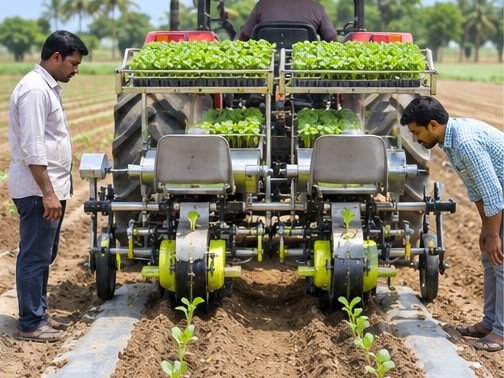
Modular 2-row plug transplanter for Indian trays and bed widths
Transplanting vegetable seedlings by hand is slow, back-breaking work, and the labour often isn't there on the day the seedlings are ready. Imported transplanters are built for European trays and wide beds, so they jam or plant badly on Indian farms.
A modular two-row transplanter that picks plugs from the trays Indian nurseries already use and plants them upright on local bed widths.
Seedlings planted faster and more evenly than by hand, at a price vegetable growers and hiring centres can manage.
Aim
product
Programme
Crop & value-chain solutions
Segment
Vegetables
Type
Product (hardware)
Grade
Product grade
Priority
Very high
Duration
18 months (12 months development plus one season of trials)
Where it fits
Peri-urban belts and vegetable clusters of UP, West Bengal, Odisha, Maharashtra and Karnataka
Method
Adapt existing Indian design; CIDSA Agni
Team role
Manufacturing & dealership
CIDSA lab
Lab 4 – Farm Equipment & Innovation Lab
Funding route
Grant first, then milestone-linked seed
Outcome
Technology transfer and adaptation
Software and tools
MSC Apex Modeller, MSC Nastran LS Productivity Bundle (Nastran LS + Patran), Marc Complete Package
Partners to involve
Agri university / ICAR institute, Indian OEM / MSME manufacturer, FPO / KVK / farmer network
Estimated budget
₹19.7 lakh, released in stages
Stages and funding
L0 · Learn and specify
₹2.8 lakh · 3 short course seats and 1 professional programme seat; 3 lab software tools for 4 months; mentoring and design reviews
L1 · Proof of concept
₹2.4 lakh · Design, analysis and virtual prototype on CIDSA lab software
L2 · Prototype
₹4.8 lakh · 2 prototypes built and bench-tested
L3 · Validation and certification
₹3 lakh · Field trials and statutory testing
L4 · Pilot batch
₹4.7 lakh · 5 pilot units placed with early buyers, half the cost recovered
L5 · Launch to revenue
₹2 lakh · Launch: dealer or channel onboarding, demos, documentation and first orders
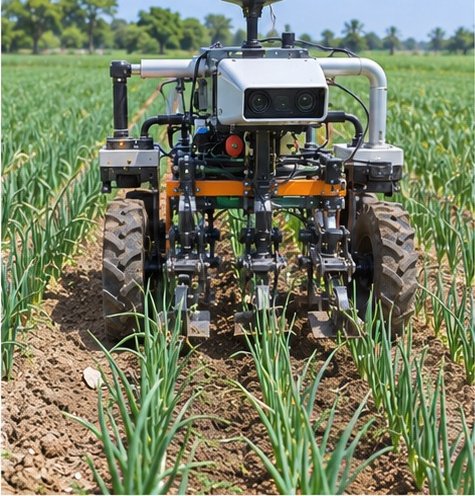
Onions are sown so densely that weeds between the plants can only be pulled by hand, bent over for days. Labour is costly and scarce at weeding time, and late weeding cuts bulb size.
A camera-guided weeder that recognises onion plants and removes weeds between them inside dense beds.
Clean onion beds with a fraction of the hand-weeding labour, and very little crop damage.
Aim
product, innovation
Programme
Crop & value-chain solutions
Segment
Vegetables
Type
Product (hardware)
Grade
Product grade
Priority
Very high
Duration
18 months (12 months development plus one season of trials)
Where it fits
Peri-urban belts and vegetable clusters of UP, West Bengal, Odisha, Maharashtra and Karnataka
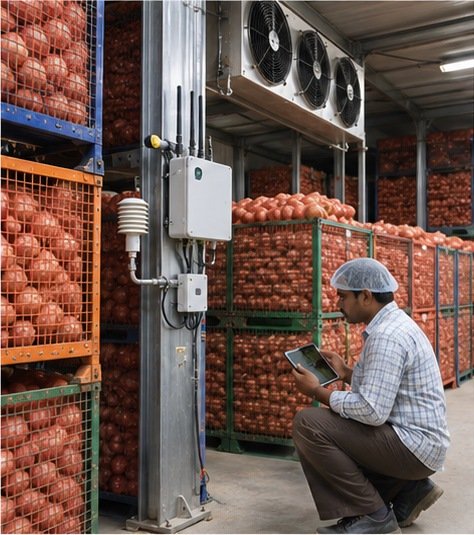
Temperature, humidity and gas sensors with rot early warning
Onions in farm stores rot quietly from the inside. By the time the smell is noticed, a large part of the stock may be gone, often just when prices are rising and the farmer was waiting to sell.
Temperature, humidity and gas sensors placed in the store, with phone alerts when conditions point to rot starting.
Rot caught early enough to ventilate, sort or sell, so far fewer onions are lost in storage.
Aim
product, innovation, smart
Programme
Crop & value-chain solutions
Segment
Vegetables
Type
Product (hardware)
Grade
Product grade
Priority
Very high
Duration
18 months (12 months development plus one season of trials)
Where it fits
Peri-urban belts and vegetable clusters of UP, West Bengal, Odisha, Maharashtra and Karnataka
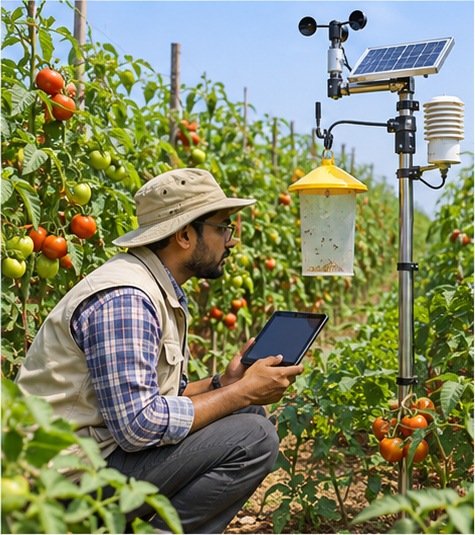
Trap counts and degree-day model for timely control
Tomato leaf-miner (Tuta) spreads fast through a crop, and by the time leaves look mined the damage is under way. Farmers respond by spraying again and again, which costs money and still often misses the right moment.
Trap counts combined with a temperature-based model that predicts when the next generation will hatch and when to act.
Timely, targeted control with fewer sprays and much less leaf-miner damage.
Aim
smart
Programme
Crop & value-chain solutions
Segment
Vegetables
Type
Software / platform module
Grade
Platform grade
Priority
Very high
Duration
18 months (12 months development plus one season of trials)
Where it fits
Peri-urban belts and vegetable clusters of UP, West Bengal, Odisha, Maharashtra and Karnataka
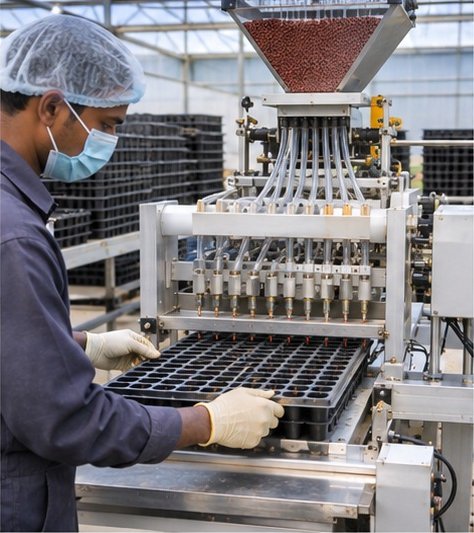
Semi-automatic vacuum seeder for 98 and 104-cell trays
Filling nursery trays by hand is slow, and it's hard to drop exactly one seed in every cell. Gaps waste tray space and doubles waste costly hybrid seed.
A semi-automatic vacuum seeder that sows a whole 98- or 104-cell tray in one action.
Trays seeded quickly with one seed per cell, cutting seed waste and nursery labour.
Aim
product
Programme
Crop & value-chain solutions
Segment
Vegetables
Type
Product (hardware)
Grade
Product grade
Priority
High
Duration
18 months (12 months development plus one season of trials)
Where it fits
Peri-urban belts and vegetable clusters of UP, West Bengal, Odisha, Maharashtra and Karnataka
Method
Adapt existing Indian design; CIDSA Agni
Team role
Manufacturing & dealership
CIDSA lab
Lab 4 – Farm Equipment & Innovation Lab
Funding route
Grant first, then milestone-linked seed
Outcome
Technology transfer and adaptation
Software and tools
MSC Apex Modeller, MSC Nastran LS Productivity Bundle (Nastran LS + Patran)
Partners to involve
Indian OEM / MSME manufacturer, Startup / incubator
Estimated budget
₹13.6 lakh, released in stages
Stages and funding
L0 · Learn and specify
₹2.4 lakh · 3 short course seats and 1 professional programme seat; 2 lab software tools for 4 months; mentoring and design reviews
L1 · Proof of concept
₹2.4 lakh · Design, analysis and virtual prototype on CIDSA lab software
L2 · Prototype
₹2.1 lakh · 2 prototypes built and bench-tested
L3 · Validation and certification
₹3 lakh · Field trials and statutory testing
L4 · Pilot batch
₹1.7 lakh · 5 pilot units placed with early buyers, half the cost recovered
L5 · Launch to revenue
₹2 lakh · Launch: dealer or channel onboarding, demos, documentation and first orders
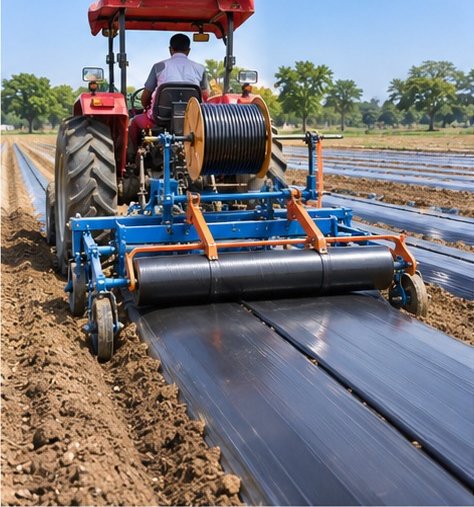
Mulch and drip make vegetables more profitable, but forming beds, laying film and placing drip lines are usually separate jobs. Each pass costs time, and laying film by hand is fiddly and wasteful.
A bed former that shapes the bed and lays both the mulch film and the drip lateral in a single pass.
Beds formed, mulched and fitted with drip in one trip down the field.
Aim
product
Programme
Crop & value-chain solutions
Segment
Vegetables
Type
Product (hardware)
Grade
Product grade
Priority
High
Duration
18 months (12 months development plus one season of trials)
Where it fits
Peri-urban belts and vegetable clusters of UP, West Bengal, Odisha, Maharashtra and Karnataka
Method
Adapt existing Indian design; CIDSA Agni
Team role
Manufacturing & dealership
CIDSA lab
Lab 2 – Smart Precision Agriculture Lab
Funding route
Grant first, then milestone-linked seed
Outcome
Technology transfer and adaptation
Software and tools
CIDSA Smart Irrigation Flow Engine, IoT based Smart Irrigation System (Hardware & Software Kits), CIDSA Jala Water Intelligence Suite
Partners to involve
Agri university / ICAR institute, Indian OEM / MSME manufacturer
Estimated budget
₹12.2 lakh, released in stages
Stages and funding
L0 · Learn and specify
₹2.8 lakh · 3 short course seats and 1 professional programme seat; 3 lab software tools for 4 months; mentoring and design reviews
L1 · Proof of concept
₹2.4 lakh · Design, analysis and virtual prototype on CIDSA lab software
L2 · Prototype
₹1.5 lakh · 2 prototypes built and bench-tested
L3 · Validation and certification
₹2.4 lakh · Field trials and statutory testing
L4 · Pilot batch
₹1.1 lakh · 5 pilot units placed with early buyers, half the cost recovered
L5 · Launch to revenue
₹2 lakh · Launch: dealer or channel onboarding, demos, documentation and first orders