Home › Projects › Weeding and intercultural Weeding and intercultural: joint development projects 8 projects open for teams, with CIDSA lab support, software access and staged funding. Notes on each project follow the list.
All projects
M-300 Product grade
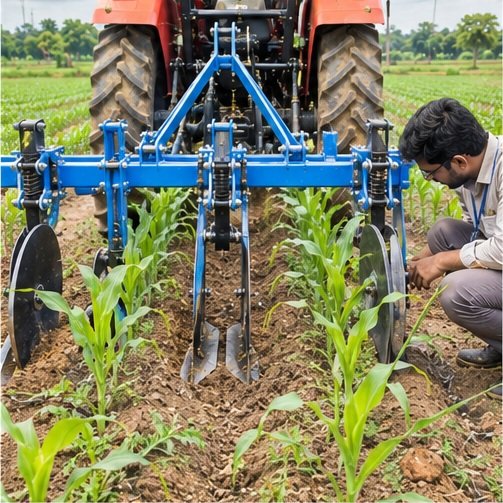
Inter-row weeder blade and guard optimisation
Sweep geometry for weeding efficiency with low crop damage
Inter-row weeders either leave weeds near the crop or cut crop plants, so farmers stay wide and hand-weed the rest.
Optimised sweep shapes and crop guards.
More weeds removed with less crop damage.
Aim design, product Programme Equipment engineering Segment Weeding & Intercultural Type Tractor inter-row cultivator Grade Product grade Priority Very high Duration 18 months (12 months development plus one season of trials) Where it fits Rice, cotton, vegetables, pulses and sugarcane Method DEM particle / soil–tool simulation; Instrumented testing & design of experiments Team role Manufacturing & dealership CIDSA lab Lab 4 – Farm Equipment & Innovation Lab Funding route Grant first, then milestone-linked seed Outcome Co-development with shared IP Software and tools Marc Complete Package Partners to involve Agri university / ICAR institute, Engineering institution, Indian OEM / MSME manufacturer Estimated budget ₹8.1 lakh, released in stages
Stages and funding L0 · Learn and specify ₹2 lakh · 3 short course seats and 1 professional programme seat; 1 lab software tool for 4 months; mentoring and design reviews L1 · Proof of concept ₹1.5 lakh · Design, analysis and virtual prototype on CIDSA lab software L2 · Prototype ₹0.8 lakh · 1 prototype built and bench-tested L3 · Validation and certification ₹3 lakh · Field trials and statutory testing L5 · Launch to revenue ₹0.8 lakh · Launch: dealer or channel onboarding, demos, documentation and first orders
Open M-300 in the portal and form a team
M-301 Product grade
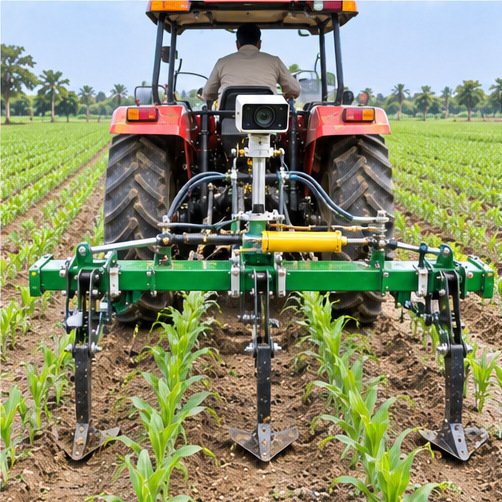
Camera-guided side-shift hitch
Low-cost steering frame keeping blades close to the crop row
Even an experienced driver can't keep weeding blades within a few centimetres of the crop row for hours. So blades are set wide, and the weeds closest to the plants survive.
A low-cost camera system that watches the row and shifts the implement sideways to follow it.
Weeding blades held close to the row all day without cutting crop plants.
Aim product, innovation Programme Equipment engineering Segment Weeding & Intercultural Type Tractor inter-row cultivator Grade Product grade Priority Very high Duration 24 months Where it fits Rice, cotton, vegetables, pulses and sugarcane Method Embedded control & model-based design; Machine vision / AI Team role Manufacturing & dealership CIDSA lab Lab 8 – Farm Intelligence & Robotics Lab Funding route Grant first, then milestone-linked seed Outcome Co-development with shared IP Software and tools Adams Controls Bundle (Controls, Mechatronics & Vibration), Easy5 Basic Package, CIDSA Autonomous Farm Navigation System Partners to involve Engineering institution, Startup / incubator, Indian OEM / MSME manufacturer Estimated budget ₹12.8 lakh, released in stages
Stages and funding L0 · Learn and specify ₹2.8 lakh · 3 short course seats and 1 professional programme seat; 3 lab software tools for 4 months; mentoring and design reviews L1 · Proof of concept ₹2.4 lakh · Design, analysis and virtual prototype on CIDSA lab software L2 · Prototype ₹1.5 lakh · 2 prototypes built and bench-tested L3 · Validation and certification ₹3 lakh · Field trials and statutory testing L4 · Pilot batch ₹1.1 lakh · 5 pilot units placed with early buyers, half the cost recovered L5 · Launch to revenue ₹2 lakh · Launch: dealer or channel onboarding, demos, documentation and first orders
Open M-301 in the portal and form a team
M-302 Product grade
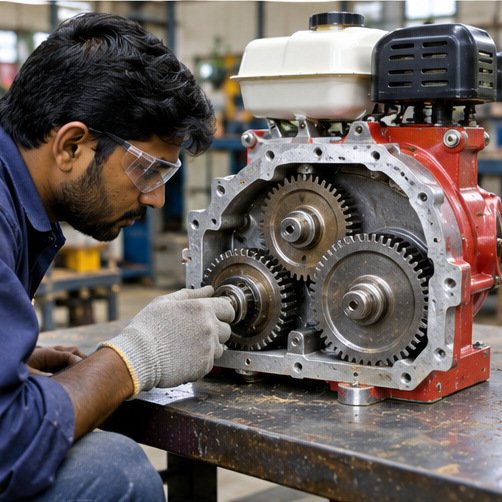
Power weeder transmission cost-down
Gear train simplification and housing redesign
Power weeders are priced beyond many small farmers, and much of the cost sits in a transmission more complex than the job needs.
A simpler gear train and housing with fewer parts.
A cheaper power weeder that lasts just as long.
Aim design, product Programme Equipment engineering Segment Weeding & Intercultural Type Power weeder Grade Product grade Priority Very high Duration 18 months (12 months development plus one season of trials) Where it fits Rice, cotton, vegetables, pulses and sugarcane Method Value engineering & should-costing; FEA structural analysis; CAD & DFM (TCCAD) Team role Manufacturing & dealership CIDSA lab Lab 4 – Farm Equipment & Innovation Lab Funding route Grant first, then milestone-linked seed Outcome Co-development with shared IP Software and tools MSC Nastran LS Productivity Bundle (Nastran LS + Patran), MSC Apex Modeller Partners to involve Indian OEM / MSME manufacturer, Engineering institution Estimated budget ₹7.9 lakh, released in stages
Stages and funding L0 · Learn and specify ₹2.4 lakh · 3 short course seats and 1 professional programme seat; 2 lab software tools for 4 months; mentoring and design reviews L1 · Proof of concept ₹1.5 lakh · Design, analysis and virtual prototype on CIDSA lab software L2 · Prototype ₹0.8 lakh · 1 prototype built and bench-tested L3 · Validation and certification ₹2.4 lakh · Field trials and statutory testing L5 · Launch to revenue ₹0.8 lakh · Launch: dealer or channel onboarding, demos, documentation and first orders
Open M-302 in the portal and form a team
M-303 Product grade
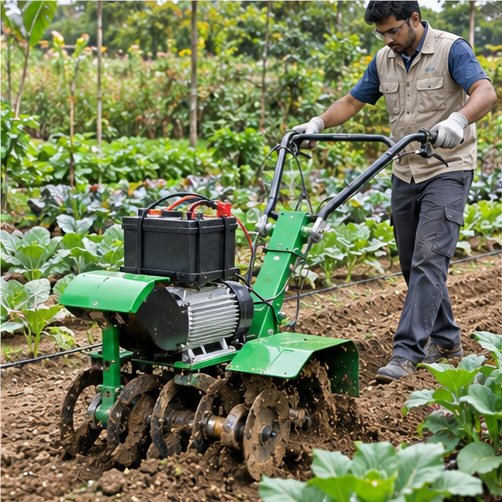
Electric power-weeder powertrain sizing
Motor, gearbox and pack sized from measured duty cycles
Electric power weeders are often fitted with motors and batteries that are too big, adding cost, or too small, so the battery dies mid-job. Nobody has measured what the real work demands.
Motor, gearbox and battery sized from duty cycles measured in the field.
An electric weeder that lasts a full working session without being overbuilt or overpriced.
Aim product, innovation Programme Equipment engineering Segment Weeding & Intercultural Type Power weeder Grade Product grade Priority Very high Duration 18 months (12 months development plus one season of trials) Where it fits Rice, cotton, vegetables, pulses and sugarcane Method Battery & powertrain modelling; Multibody dynamics; Instrumented testing & design of experiments Team role Manufacturing & dealership CIDSA lab Lab 5 – Drone Technology & Aerial Imaging Lab Funding route Grant first, then milestone-linked seed Outcome Co-development with shared IP Software and tools Easy5 Electrical Systems Library Partners to involve Engineering institution, Startup / incubator, Indian OEM / MSME manufacturer Estimated budget ₹7.5 lakh, released in stages
Stages and funding L0 · Learn and specify ₹2 lakh · 3 short course seats and 1 professional programme seat; 1 lab software tool for 4 months; mentoring and design reviews L1 · Proof of concept ₹1.5 lakh · Design, analysis and virtual prototype on CIDSA lab software L2 · Prototype ₹0.8 lakh · 1 prototype built and bench-tested L3 · Validation and certification ₹2.4 lakh · Field trials and statutory testing L5 · Launch to revenue ₹0.8 lakh · Launch: dealer or channel onboarding, demos, documentation and first orders
Open M-303 in the portal and form a team
M-304 Product grade
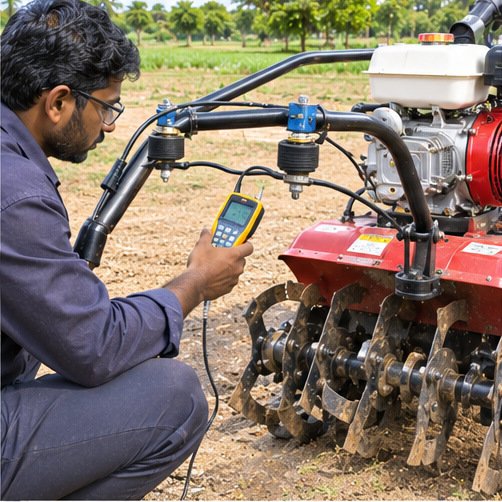
Power tiller handle vibration reduction
Isolators and tine balancing to cut hand-arm vibration
Power tiller handles shake hard, and hours of that vibration cause hand and arm problems that many operators simply live with.
Vibration isolators in the handle mounts and better-balanced tines.
Noticeably less vibration at the handles over a working day.
Aim design, product Programme Equipment engineering Segment Weeding & Intercultural Type Power tiller Grade Product grade Priority Very high Duration 18 months (12 months development plus one season of trials) Where it fits Rice, cotton, vegetables, pulses and sugarcane Method Multibody dynamics; Ergonomic assessment; Instrumented testing & design of experiments Team role Manufacturing & dealership CIDSA lab Lab 1 – Agricultural Automation & IoT Lab Funding route Grant first, then milestone-linked seed Outcome Co-development with shared IP Software and tools Adams Studio Package (Adams View & Adams Solver) Partners to involve Agri university / ICAR institute, Engineering institution, Indian OEM / MSME manufacturer Estimated budget ₹15.8 lakh, released in stages
Stages and funding L0 · Learn and specify ₹2 lakh · 3 short course seats and 1 professional programme seat; 1 lab software tool for 4 months; mentoring and design reviews L1 · Proof of concept ₹2.4 lakh · Design, analysis and virtual prototype on CIDSA lab software L2 · Prototype ₹3.6 lakh · 2 prototypes built and bench-tested L3 · Validation and certification ₹2.4 lakh · Field trials and statutory testing L4 · Pilot batch ₹3.4 lakh · 5 pilot units placed with early buyers, half the cost recovered L5 · Launch to revenue ₹2 lakh · Launch: dealer or channel onboarding, demos, documentation and first orders
Open M-304 in the portal and form a team
M-305 Product grade
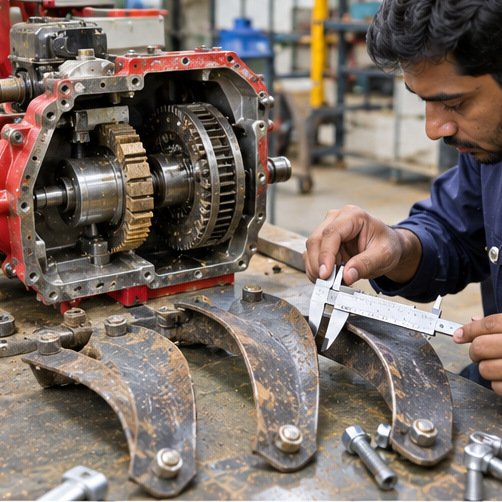
Power tiller rotary tine and clutch durability
Tine holder and clutch life in wet and dry tillage
Power tiller tine holders and clutches wear out quickly in both wet and dry tillage, and repairs stop work at the busiest time.
A durability study and redesign of the tine holders and clutch.
Longer tine-holder and clutch life in both wet and dry work.
Aim product Programme Equipment engineering Segment Weeding & Intercultural Type Power tiller Grade Product grade Priority High Duration 18 months (12 months development plus one season of trials) Where it fits Rice, cotton, vegetables, pulses and sugarcane Method Fatigue & durability analysis; Materials & wear testing Team role Manufacturing & dealership CIDSA lab Lab 4 – Farm Equipment & Innovation Lab Funding route Grant first, then milestone-linked seed Outcome Co-development with shared IP Software and tools CAEFatigue Premium, Simufact Welding Direct Energy Deposition Partners to involve Engineering institution, Indian OEM / MSME manufacturer Estimated budget ₹16.2 lakh, released in stages
Stages and funding L0 · Learn and specify ₹2.4 lakh · 3 short course seats and 1 professional programme seat; 2 lab software tools for 4 months; mentoring and design reviews L1 · Proof of concept ₹2.4 lakh · Design, analysis and virtual prototype on CIDSA lab software L2 · Prototype ₹3.6 lakh · 2 prototypes built and bench-tested L3 · Validation and certification ₹2.4 lakh · Field trials and statutory testing L4 · Pilot batch ₹3.4 lakh · 5 pilot units placed with early buyers, half the cost recovered L5 · Launch to revenue ₹2 lakh · Launch: dealer or channel onboarding, demos, documentation and first orders
Open M-305 in the portal and form a team
M-306 Product grade
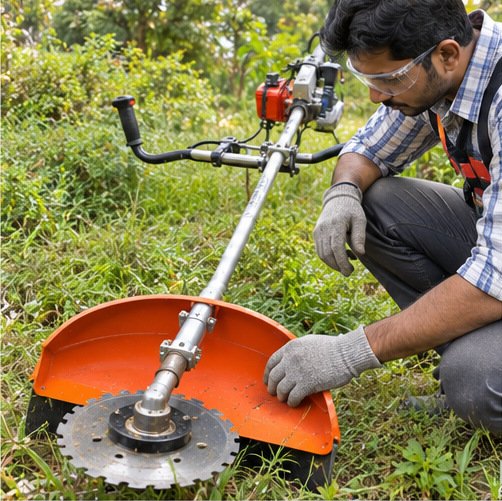
Brush cutter shaft vibration and guard redesign
Lower hand-arm vibration and a safer debris guard
Brush cutters shake the operator's hands and arms, and stones and debris thrown by the head cause injuries.
A lower-vibration drive shaft and a safer debris guard.
Less vibration and far fewer debris injuries.
Aim design, product Programme Equipment engineering Segment Weeding & Intercultural Type Brush cutter & orchard mower Grade Product grade Priority High Duration 18 months (12 months development plus one season of trials) Where it fits Rice, cotton, vegetables, pulses and sugarcane Method Multibody dynamics; Ergonomic assessment Team role Manufacturing & dealership CIDSA lab Lab 1 – Agricultural Automation & IoT Lab Funding route Grant first, then milestone-linked seed Outcome Co-development with shared IP Software and tools Adams Machinery Module Bundle, Adams Studio Package (Adams View & Adams Solver) Partners to involve Engineering institution, Indian OEM / MSME manufacturer Estimated budget ₹10.6 lakh, released in stages
Stages and funding L0 · Learn and specify ₹2.4 lakh · 3 short course seats and 1 professional programme seat; 2 lab software tools for 4 months; mentoring and design reviews L1 · Proof of concept ₹2.4 lakh · Design, analysis and virtual prototype on CIDSA lab software L2 · Prototype ₹0.9 lakh · 2 prototypes built and bench-tested L3 · Validation and certification ₹2.4 lakh · Field trials and statutory testing L4 · Pilot batch ₹0.5 lakh · 5 pilot units placed with early buyers, half the cost recovered L5 · Launch to revenue ₹2 lakh · Launch: dealer or channel onboarding, demos, documentation and first orders
Open M-306 in the portal and form a team
M-307 Product grade
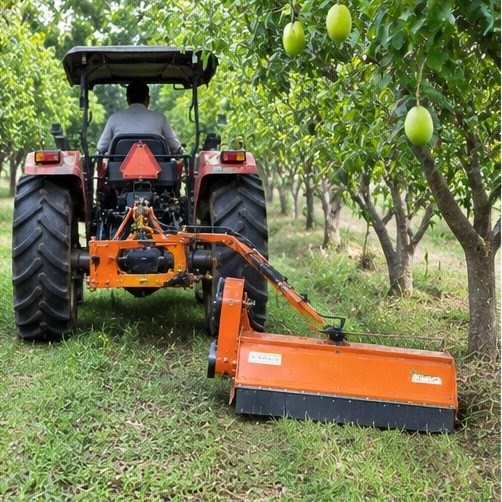
Orchard flail mower offset and height control
Under-canopy mowing with fewer passes
Mowing under orchard canopies takes several passes and still misses spots near the trunks, while getting too close damages bark.
Offset and height control for orchard flail mowers.
Clean under-canopy mowing in fewer passes, without touching the trees.
Aim design, product Programme Equipment engineering Segment Weeding & Intercultural Type Brush cutter & orchard mower Grade Product grade Priority Medium Duration 24 months Where it fits Rice, cotton, vegetables, pulses and sugarcane Method Multibody dynamics; CAD & DFM (TCCAD) Team role Manufacturing & dealership CIDSA lab Lab 1 – Agricultural Automation & IoT Lab Funding route Grant first, then milestone-linked seed Outcome Co-development with shared IP Software and tools Adams Studio Package (Adams View & Adams Solver) Partners to involve Agri university / ICAR institute, Indian OEM / MSME manufacturer Estimated budget ₹14.3 lakh, released in stages
Stages and funding L0 · Learn and specify ₹2 lakh · 3 short course seats and 1 professional programme seat; 1 lab software tool for 4 months; mentoring and design reviews L1 · Proof of concept ₹2.4 lakh · Design, analysis and virtual prototype on CIDSA lab software L2 · Prototype ₹2.9 lakh · 2 prototypes built and bench-tested L3 · Validation and certification ₹2.4 lakh · Field trials and statutory testing L4 · Pilot batch ₹2.6 lakh · 5 pilot units placed with early buyers, half the cost recovered L5 · Launch to revenue ₹2 lakh · Launch: dealer or channel onboarding, demos, documentation and first orders
Open M-307 in the portal and form a team